
4-(Dimethylamino)cinnamaldehyde
Synonym(s):4-(Dimethylamino)-cinnamaldehyde;4-(Dimethylamino)-cinnamaldehyde solution;DMAC;DMACA
- CAS NO.:6203-18-5
- Empirical Formula: C11H13NO
- Molecular Weight: 175.23
- MDL number: MFCD00007002
- EINECS: 228-267-0
- SAFETY DATA SHEET (SDS)
- Update Date: 2026-05-27 23:07:18
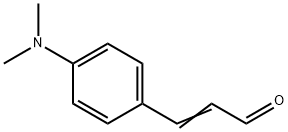
What is 4-(Dimethylamino)cinnamaldehyde?
Chemical properties
white to light yellow crystal powde
The Uses of 4-(Dimethylamino)cinnamaldehyde
4-(Dimethylamino)cinnamaldehyde is a reagent for assay of indole product of apotryptophanase and tryptophanase. It has been used in a chromogenic method for quantifying proanthocyandines in cranberry powder.
The Uses of 4-(Dimethylamino)cinnamaldehyde
4-(Dimethylamino)cinnamaldehyde is a reagent used in the assay of apotryptophanase and tryptophanase. It has been used in a chromogenic method for quantifying proanthocyandines in cranberry powder.
The Uses of 4-(Dimethylamino)cinnamaldehyde
Used to determine the ability of an organism to split indole from the tryptophan molecule.
What are the applications of Application
4-(Dimethylamino)cinnamaldehyde is a reagent used in the assay of apotryptophanase & tryptophanase
Definition
ChEBI: 4-dimethylaminocinnamaldehyde is a member of cinnamaldehydes.
General Description
DMACA is basically a selective staining reagent. It helps identify the flavanols by staining them blue in color.
Biochem/physiol Actions
Reagent for assay of indole product of apotryptophanase and tryptophanase. DMAC produces colored adducts with flavanols for subsequent HPLC. It has been used in a chromogenic method for quantifying proanthocyandines in cranberry powder.
Purification Methods
The aldehyde crystallises from EtOH or ligroin and is dried in vacuo. The oxime has m 157o (from ligroin). The phenylhydrazone has m 169o (form MeOH). It is used as a reagent for amines (with NH3, UV has max at 630nm). [K.nig et al. Chem Ber 61 2075 2075, Quareshi & Kahn Anal Chim Acta 86 309 1976, Beilstein 14 III 184, 14 IV 197.]
Properties of 4-(Dimethylamino)cinnamaldehyde
| Melting point: | 138-140 °C(lit.) |
| Boiling point: | 306.53°C (rough estimate) |
| Density | 1.0582 (rough estimate) |
| refractive index | 1.5260 (estimate) |
| storage temp. | -20°C |
| solubility | dioxane: 50 mg/mL, clear |
| form | Powder |
| pka | 4.59±0.24(Predicted) |
| color | Yellow to orange |
| Sensitive | Air & Light Sensitive |
| BRN | 972369 |
| Stability: | Stable. Incompatible with strong oxidizing agents, strong bases. |
| CAS DataBase Reference | 6203-18-5(CAS DataBase Reference) |
| NIST Chemistry Reference | 2-Propenal, 3-[4-(dimethylamino)phenyl]-(6203-18-5) |
| EPA Substance Registry System | 2-Propenal, 3-[4-(dimethylamino)phenyl]- (6203-18-5) |
Safety information for 4-(Dimethylamino)cinnamaldehyde
| Signal word | Warning |
| Pictogram(s) |
 Exclamation Mark Irritant GHS07  Environment GHS09 |
| GHS Hazard Statements |
H315:Skin corrosion/irritation H319:Serious eye damage/eye irritation H335:Specific target organ toxicity, single exposure;Respiratory tract irritation H411:Hazardous to the aquatic environment, long-term hazard |
| Precautionary Statement Codes |
P261:Avoid breathing dust/fume/gas/mist/vapours/spray. P264:Wash hands thoroughly after handling. P264:Wash skin thouroughly after handling. P271:Use only outdoors or in a well-ventilated area. P273:Avoid release to the environment. P302+P352:IF ON SKIN: wash with plenty of soap and water. P305+P351+P338:IF IN EYES: Rinse cautiously with water for several minutes. Remove contact lenses, if present and easy to do. Continuerinsing. |
Computed Descriptors for 4-(Dimethylamino)cinnamaldehyde
| InChIKey | RUKJCCIJLIMGEP-ONEGZZNKSA-N |
New Products
9-Mesityl-10-methylacridinium perchlorate Sulfapyridine Fmoc-OSu (R)-(-)-2-Amino-1-propanol Cyclobutanone 5-bromo-4-fluoro-2-nitrobenzaldehyde 4 pentyn 1 ol N-Vinylformamide Phenethyl cinnamate Pyrrolo[1,2-a]pyrimidine-6-carboxylic acid, 4,6,7,8-tetrahydro-4-oxo-, sodium salt (1:1), (6S) Ethyl 3-phenylpropanoate β-Bromostyrene Methacrylate-PEG-Methacrylate, Mn:35000 2,4-Dihydroxyacetophenone 2-Chloro 5-Fluoro Pyridine Vasicinone 2-Chloroisonicotinic Acid Tween 80 or Polysorbate 80 5-Bromo-1-Pentyne 1-(2-Methyl-5-nitrophenyl)guanidine Nitrate Methyl trans-4-Aminocyclohexanecarboxylate Hydrochloride 2-Pentyn-1-oL 4-Nitrobenzotrifluoride N-(4-Cyano-3-(trifluoromethyl)phenyl)-2-methyloxirane-2-carboxamideRelated products of tetrahydrofuran

You may like
-
 p-Dimethylaminocinnamaldehyde, GR 99%+ CAS 6203-18-5View Details
6203-18-5 -
p-Dimethylamino-Cinnamaldehyde extrapure CAS 6203-18-5View Details
6203-18-5 -
4-Dimethylaminocinnamaldehyde CAS 6203-18-5View Details
6203-18-5 -
p-DIMETHYL AMINO CINNAMALDEHYDE AR CAS 6203-18-5View Details
6203-18-5 -
4-(Dimethylamino)-cinnamaldehyde CAS 6203-18-5View Details
6203-18-5 -
4-(Dimethylamino)cinnamaldehyde CAS 6203-18-5View Details
6203-18-5 -
DMACA Reagent CAS 6203-18-5View Details
6203-18-5 -
Fmoc-OSu 98+View Details
82911-69-1