
4-Bromobenzoyl chloride
- CAS NO.:586-75-4
- Empirical Formula: C7H4BrClO
- Molecular Weight: 219.46
- MDL number: MFCD00000683
- EINECS: 209-580-1
- SAFETY DATA SHEET (SDS)
- Update Date: 2026-06-04 16:00:12
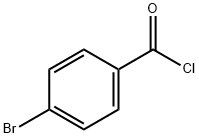
What is 4-Bromobenzoyl chloride?
Chemical properties
White to light brown low melting solid
The Uses of 4-Bromobenzoyl chloride
4-Bromobenzoyl chloride is used in the synthesis of HIV-1 protease inhibitors. It is also used in the synthesis of oxazoles, cyclohexanone derivatives as analgesic and antimicrobial agents.
Purification Methods
Check IR of a film to see if OH bands are present. If absent then recrystallise from pet ether and dry it in vacuo. If OH bands are weak, then distil it in vacuo and recrystallise if necessary. If OH bands are very strong, then treat with an equal volume of redistilled SOCl2 reflux for 2hours, then evaporate excess of SOCl2 and distil the residual oil or low melting solid. Store it in the dark away from moisture. LACHRYMATORY. [Martin & Partington J Chem Soc 1175 1936, Beilstein 9 IV 1023.]
Properties of 4-Bromobenzoyl chloride
| Melting point: | 36-39 °C(lit.) |
| Boiling point: | 246 °C |
| Density | 1.6111 (rough estimate) |
| refractive index | 1.5963 (estimate) |
| Flash point: | >230 °F |
| storage temp. | 2-8°C |
| solubility | Chloroform, Methanol (Slightly) |
| form | Low Melting Solid |
| color | White to light brown |
| Water Solubility | Soluble in methanol. Reacts with water forming Hcl. |
| Sensitive | Moisture Sensitive |
| BRN | 636641 |
| Stability: | Moisture Sensitive |
| CAS DataBase Reference | 586-75-4(CAS DataBase Reference) |
| NIST Chemistry Reference | Benzoyl chloride, 4-bromo-(586-75-4) |
| EPA Substance Registry System | Benzoyl chloride, 4-bromo- (586-75-4) |
Safety information for 4-Bromobenzoyl chloride
| Signal word | Danger |
| Pictogram(s) |
 Corrosion Corrosives GHS05 |
| GHS Hazard Statements |
H314:Skin corrosion/irritation |
| Precautionary Statement Codes |
P260:Do not breathe dust/fume/gas/mist/vapours/spray. P280:Wear protective gloves/protective clothing/eye protection/face protection. P301+P330+P331:IF SWALLOWED: Rinse mouth. Do NOT induce vomiting. P303+P361+P353:IF ON SKIN (or hair): Remove/Take off Immediately all contaminated clothing. Rinse SKIN with water/shower. P305+P351+P338:IF IN EYES: Rinse cautiously with water for several minutes. Remove contact lenses, if present and easy to do. Continuerinsing. |
Computed Descriptors for 4-Bromobenzoyl chloride
New Products
2-Bromo-4-hydroxypyridine 2-Benzyl-1,1,3,3-tetramethylisoindoline AMINO-O-TOLYL-ACETIC ACID AMINO(2-BROMOPHENYL)ACETIC ACID 6-BROMOTETRAZOLO[1,5-A]PYRIDINE 3-Oxocyclobutanecarboxylic acid 1,3-Diazaspiro[4.5]decane-2,4-dione, 8,8-difluoro- AMINO-(3-FLUORO-PHENYL)-ACETIC ACID Pyrrolo[1,2-a]pyrimidine-6-carboxylic acid, 4,6,7,8-tetrahydro-4-oxo-, sodium salt (1:1), (6S) Obidoxime hydrochloride API Piperazine, 1-(3-methoxyphenyl)-, hydrochloride (1:1) Decanoic acid, 2-[4-(phenylmethoxy)phenyl]ethyl ester 2,4-Dihydroxybenzaldehyde 3-Cyano-4-(2-methylpropoxy)benzenecarbothioamide 1-(2, 4-dichlorophenyl)-N-(2, 4-difluorophenyl)-N isopropyl-5-oxo-1H-1, 2, 4-trizole-4(5H)-carboxamide 2,4-Dihydroxyacetophenone 2-Chloro 5-Fluoro Pyridine Vasicinone 2-Chloroisonicotinic Acid Tween 80 or Polysorbate 80 2-Butyn-1-oL N-(4-fluoro-2-methoxy-5-nitrophenyl)-4-(1-methyl-1H-indol-3-yl)pyrimidin-2-amine Pirtobrutinib intd. N-(4-Cyano-3-(trifluoromethyl)phenyl)-2-methyloxirane-2-carboxamideRelated products of tetrahydrofuran
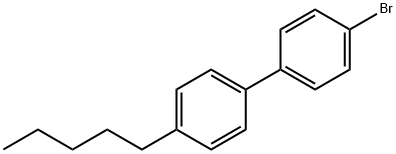
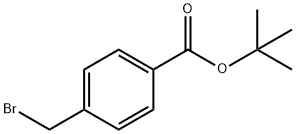
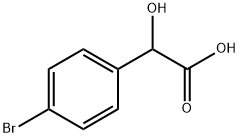
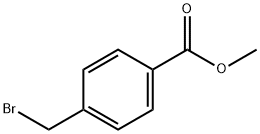
You may like
-
 4-Bromobenzoyl chloride CAS 586-75-4View Details
586-75-4 -
4-Bromobenzoyl Chloride CAS 586-75-4View Details
586-75-4 -
4-Bromobenzoyl chloride CAS 586-75-4View Details
586-75-4 -
586-75-4 4-Bromobenzoyl chloride 99.11%View Details
586-75-4 -
Methyl-2-chloro pyridine-5-carboxylate 98%View Details
58481-11-1 -
695-34-1 2-Amino 4-Methyl Pyridine 98%View Details
695-34-1 -
9005-64-6 Tween 80 or Polysorbate 80 98%View Details
9005-64-6 -
Tetrahydropiperin 23434-88-0 >98%View Details
23434-88-0
Statement: All products displayed on this website are only used for non medical purposes such as industrial applications or scientific research, and cannot be used for clinical diagnosis or treatment of humans or animals. They are not medicinal or edible.