
4-BENZYLOXYBENZYL BROMIDE
- CAS NO.:5544-60-5
- Empirical Formula: C14H13BrO
- Molecular Weight: 277.16
- MDL number: MFCD07368336
- SAFETY DATA SHEET (SDS)
- Update Date: 2026-05-28 01:02:30
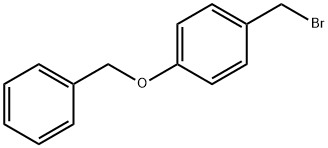
What is 4-BENZYLOXYBENZYL BROMIDE?
Chemical properties
4-BENZYLOXYBENZYL BROMIDE is Dark Grey Solid
The Uses of 4-BENZYLOXYBENZYL BROMIDE
4-BENZYLOXYBENZYL BROMIDE is a useful reactant in the synthesis of many antibacterial drugs. Ethyl 4-benzyloxybenzoate analogue with hypolipidemic activity.
Properties of 4-BENZYLOXYBENZYL BROMIDE
| Melting point: | 83-85 °C |
| Boiling point: | 366.0±22.0 °C(Predicted) |
| Density | 1.361±0.06 g/cm3(Predicted) |
| storage temp. | Inert atmosphere,Store in freezer, under -20°C |
| solubility | Dichloromethane |
| form | Solid |
| color | Dark Grey |
Safety information for 4-BENZYLOXYBENZYL BROMIDE
Computed Descriptors for 4-BENZYLOXYBENZYL BROMIDE
New Products
Cis-Tosylate Dibenzo[b,f][1,4]thiazepin-11(10H)-one 1,2,3,9-Tetrahydro-9-Methyl-4H-Carbazole-4-One Dibenzoyl-L-tartaric acid Anhydrous (Resolution Reagent) N-BOC-piperidine-4-carboxylic acid 1-Benzhydrylazetane-3-carbonitrile AMINO-(3-CHLORO-PHENYL)-ACETIC ACID 2-(2-Chlorophenyl)glycine (±)-amino(2-fluorophenyl)acetic acid 8-oxa-1,3-diazaspiro[4.5]decane-2,4-dione BENZOIC ACID-D5 TRIFLOURO ACETICACID-D METHANE SULFONIC ACID-D4 PHOSPORIC ACID-D3 85 W% IN D2O TOLUENE-D3 BENZENE-D6 1-Acetyl-4-(4-hydroxyphenyl)piperazine 1-(3-Chlorophenyl)piperazine hydrochlorideRelated products of tetrahydrofuran
You may like
-
 5544-60-5 4-BENZYLOXY BENZYLBROMIDE 98%View Details
5544-60-5 -
 5544-60-5 98%View Details
5544-60-5 -
 7292-71-9 AMINO-(3-CHLORO-PHENYL)-ACETIC ACID 98+View Details
7292-71-9 -
2-(2-Chlorophenyl)glycine 98+View Details
88744-36-9 -
7292-71-9 AMINO-(3-CHLORO-PHENYL)-ACETIC ACID 98+View Details
7292-71-9 -
84145-28-8 98+View Details
84145-28-8 -
2-(2-Chlorophenyl)glycine 98+View Details
88744-36-9 -
8-oxa-1,3-diazaspiro[4.5]decane-2,4-dione 39124-19-1 98+View Details
39124-19-1
Statement: All products displayed on this website are only used for non medical purposes such as industrial applications or scientific research, and cannot be used for clinical diagnosis or treatment of humans or animals. They are not medicinal or edible.