
3,4-Dimethoxystyrene
Synonym(s):1,2-Dimethoxy-4-vinylbenzene;3,4-Dimethoxystyrol;4-Ethenyl-1,2-dimethoxybenzene;4-Vinylveratrole
- CAS NO.:6380-23-0
- Empirical Formula: C10H12O2
- Molecular Weight: 164.2
- MDL number: MFCD00008615
- EINECS: 228-962-9
- SAFETY DATA SHEET (SDS)
- Update Date: 2026-09-12 18:54:48
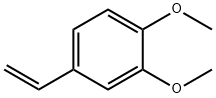
What is 3,4-Dimethoxystyrene?
Chemical properties
Yellow Oil
Occurrence
Reported found in coffee, rum and buckwheat.
The Uses of 3,4-Dimethoxystyrene
3,4-Dimethoxy Styrene (~1% Hydroquinone as stabilizer) (cas# 6380-23-0) is a compound useful in organic synthesis.
Definition
ChEBI: 1,2-Dimethoxy-4-vinylbenzene is a dimethoxybenzene.
Synthesis Reference(s)
Tetrahedron Letters, 21, p. 3451, 1980 DOI: 10.1016/S0040-4039(00)78712-0
Properties of 3,4-Dimethoxystyrene
| Boiling point: | 120-125 °C/10 mmHg (lit.) |
| Density | 1.109 g/mL at 25 °C (lit.) |
| refractive index | n |
| FEMA | 3138 | 3,4-DIMETHOXY-1-VINYLBENZENE |
| Flash point: | >230 °F |
| storage temp. | 2-8°C |
| solubility | Chloroform, Ethyl Acetate, Methanol |
| form | Oil |
| color | Clear Colourless to Pale Yellow |
| Odor | at 100.00 %. green floral weedy cortex fruity |
| JECFA Number | 1251 |
| Stability: | Light Sensitive |
| EPA Substance Registry System | Benzene, 4-ethenyl-1,2-dimethoxy- (6380-23-0) |
Safety information for 3,4-Dimethoxystyrene
| Signal word | Warning |
| Pictogram(s) |
 Exclamation Mark Irritant GHS07  Health Hazard GHS08 |
| GHS Hazard Statements |
H319:Serious eye damage/eye irritation H341:Germ cell mutagenicity H351:Carcinogenicity H412:Hazardous to the aquatic environment, long-term hazard |
| Precautionary Statement Codes |
P202:Do not handle until all safety precautions have been read and understood. P264:Wash hands thoroughly after handling. P264:Wash skin thouroughly after handling. P273:Avoid release to the environment. P280:Wear protective gloves/protective clothing/eye protection/face protection. P305+P351+P338:IF IN EYES: Rinse cautiously with water for several minutes. Remove contact lenses, if present and easy to do. Continuerinsing. P308+P313:IF exposed or concerned: Get medical advice/attention. |
Computed Descriptors for 3,4-Dimethoxystyrene
New Products
5-bromo-4-fluoro-2-nitrobenzaldehyde (R)-(-)-2-Amino-1-propanol Cyclobutanone Fmoc-OSu 1-(2-Chloroethyl)pyrrolidine Hydrochloride 2-Amino-2-(4-methylphenyl)acetic acid Obidoxime hydrochloride API Decanoic acid, 2-[4-(phenylmethoxy)phenyl]ethyl ester Piperazine, 1-(3-methoxyphenyl)-, hydrochloride (1:1) 4-Bromo-2,6-difluoroaniline 4 pentyn 1 ol N-Vinylformamide Methacrylate-PEG-Methacrylate, Mn:35000 2,4-Dihydroxyacetophenone 2-Chloro 5-Fluoro Pyridine Vasicinone 2-Chloroisonicotinic Acid Tween 80 or Polysorbate 80 2-Pentyn-1-oL 4-Nitrobenzotrifluoride N-(4-Cyano-3-(trifluoromethyl)phenyl)-2-methyloxirane-2-carboxamide N-(4-fluoro-2-methoxy-5-nitrophenyl)-4-(1-methyl-1H-indol-3-yl)pyrimidin-2-amine Pirtobrutinib intd. 2-Butyn-1-oLRelated products of tetrahydrofuran
You may like
-
 3,4-Dimethoxystyrene CAS 6380-23-0View Details
6380-23-0 -
Fmoc-OSu 98+View Details
82911-69-1 -
7250-67-1 1-(2-Chloroethyl)pyrrolidine Hydrochloride 98+View Details
7250-67-1 -
13227-01-5 98+View Details
13227-01-5 -
7250-67-1 1-(2-Chloroethyl)pyrrolidine Hydrochloride 98+View Details
7250-67-1 -
13227-01-5 98+View Details
13227-01-5 -
7250-67-1 1-(2-Chloroethyl)pyrrolidine Hydrochloride 98+View Details
7250-67-1 -
13227-01-5 98+View Details
13227-01-5
Statement: All products displayed on this website are only used for non medical purposes such as industrial applications or scientific research, and cannot be used for clinical diagnosis or treatment of humans or animals. They are not medicinal or edible.