
3,4-dihydroxyphenylacetone
- CAS NO.:2503-44-8
- Empirical Formula: C9H10O3
- Molecular Weight: 166.17
- MDL number: MFCD03093024
- SAFETY DATA SHEET (SDS)
- Update Date: 2026-05-27 22:38:46
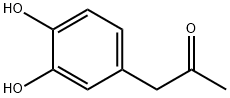
What is 3,4-dihydroxyphenylacetone?
Description
3'',4''-Dihydroxyphenylacetone (Item No. 19522) is an analytical reference standard. It is a minor metabolite of 3,4-MDEA (Item Nos. 14085 | 15689), MDMA, and α-methyldopa produced by oxidative deamination. This product is intended for forensic and research applications.
Description
3',4'-Dihydroxypropiophenone, also known as DOPA, is a metabolite of dopamine, which is produced in the brain and kidneys. DOPA is a precursor to the synthesis of melanin, which is found in skin cells. Glutamate dehydrogenase converts DOPA to 3-methoxytyramine, which can be detected chromatographically in urine samples. Examining a urine sample for DOPA testing can be used to diagnose Parkinson's disease. DOPA may also be detected in plasma in patients with bacterial and urinary tract infections
Chemical properties
Thick Yellow Oil
The Uses of 3,4-dihydroxyphenylacetone
A metabolite of racemic 3,4-methylenedioxyethylamphetamine.
The Uses of 3,4-dihydroxyphenylacetone
3',4'-Dihydroxyphenylacetone , MDMA, and α-methyldopa produced by oxidative deamination. This product is intended for forensic and research applications.
What are the applications of Application
3′,4′-Dihydroxyphenylacetone is a metabolite of racemic 3,4-methylenedioxyethylamphetamine
Definition
ChEBI: 3,4-Dihydroxyphenylacetone is an alkylbenzene.
Production Methods
3,4-dihydroxylphenylacetaldehyde (DHPAA) synthase catalyzes a complicated decarboxylation-deamination process of α-methyl dopa (AMD), leading to the production of 3,4-dihydroxyphenylacetone.
Properties of 3,4-dihydroxyphenylacetone
| Melting point: | -30 °C (decomp) |
| Boiling point: | 170-173 °C(Press: 0.3 Torr) |
| Density | 1.251±0.06 g/cm3(Predicted) |
| storage temp. | Sealed in dry,Store in freezer, under -20°C |
| solubility | Chloroform (Slightly), DMSO (Slightly), Methanol (Slightly) |
| form | powder |
| pka | 9.59±0.10(Predicted) |
| color | White to Very Dark Brown |
| Stability: | Light Sensitive |
| InChI | InChI=1S/C9H10O3/c1-6(10)4-7-2-3-8(11)9(12)5-7/h2-3,5,11-12H,4H2,1H3 |
| CAS DataBase Reference | 2503-44-8 |
Safety information for 3,4-dihydroxyphenylacetone
| Signal word | Warning |
| Pictogram(s) |
 Exclamation Mark Irritant GHS07 |
| GHS Hazard Statements |
H315:Skin corrosion/irritation H319:Serious eye damage/eye irritation H335:Specific target organ toxicity, single exposure;Respiratory tract irritation |
| Precautionary Statement Codes |
P261:Avoid breathing dust/fume/gas/mist/vapours/spray. P264:Wash hands thoroughly after handling. P264:Wash skin thouroughly after handling. P271:Use only outdoors or in a well-ventilated area. P280:Wear protective gloves/protective clothing/eye protection/face protection. P302+P352:IF ON SKIN: wash with plenty of soap and water. P305+P351+P338:IF IN EYES: Rinse cautiously with water for several minutes. Remove contact lenses, if present and easy to do. Continuerinsing. |
Computed Descriptors for 3,4-dihydroxyphenylacetone
| InChIKey | JQXBETDGCMQLMK-UHFFFAOYSA-N |
| SMILES | C(C1=CC=C(O)C(O)=C1)C(=O)C |
3,4-dihydroxyphenylacetone manufacturer
GLP Pharma Standards
New Products
5-bromo-4-fluoro-2-nitrobenzaldehyde (R)-(-)-2-Amino-1-propanol Cyclobutanone Fmoc-OSu 1-(2-Chloroethyl)pyrrolidine Hydrochloride 2-Amino-2-(4-methylphenyl)acetic acid Obidoxime hydrochloride API Decanoic acid, 2-[4-(phenylmethoxy)phenyl]ethyl ester Piperazine, 1-(3-methoxyphenyl)-, hydrochloride (1:1) 4-Bromo-2,6-difluoroaniline 4 pentyn 1 ol N-Vinylformamide Methacrylate-PEG-Methacrylate, Mn:35000 2,4-Dihydroxyacetophenone 2-Chloro 5-Fluoro Pyridine Vasicinone 2-Chloroisonicotinic Acid Tween 80 or Polysorbate 80 2-Pentyn-1-oL 4-Nitrobenzotrifluoride N-(4-Cyano-3-(trifluoromethyl)phenyl)-2-methyloxirane-2-carboxamide N-(4-fluoro-2-methoxy-5-nitrophenyl)-4-(1-methyl-1H-indol-3-yl)pyrimidin-2-amine Pirtobrutinib intd. 2-Butyn-1-oLRelated products of tetrahydrofuran

You may like
-
 3,4-dihydroxyphenylacetone CAS 2503-44-8View Details
2503-44-8 -
2503-44-8 Dihydroxyphenylacetone NLT 95%View Details
2503-44-8 -
7250-67-1 1-(2-Chloroethyl)pyrrolidine Hydrochloride 98+View Details
7250-67-1 -
13227-01-5 98+View Details
13227-01-5 -
7250-67-1 1-(2-Chloroethyl)pyrrolidine Hydrochloride 98+View Details
7250-67-1 -
13227-01-5 98+View Details
13227-01-5 -
7250-67-1 1-(2-Chloroethyl)pyrrolidine Hydrochloride 98+View Details
7250-67-1 -
13227-01-5 98+View Details
13227-01-5