
3,4-Dichloro-1,2,5-thiadiazole
- CAS NO.:5728-20-1
- Empirical Formula: C2Cl2N2S
- Molecular Weight: 155.01
- MDL number: MFCD00010072
- EINECS: 227-232-7
- SAFETY DATA SHEET (SDS)
- Update Date: 2026-05-27 23:34:01
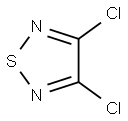
What is 3,4-Dichloro-1,2,5-thiadiazole?
Chemical properties
Colorless liquid
The Uses of 3,4-Dichloro-1,2,5-thiadiazole
3,4-Dichloro-1,2,5-thiadiazole is a chlorinated thiadiazole that is a potent inhibitors of nitrification in soil. 3,4-Dichloro-1,2,5-thiadiazole is used as a building block in the preparaton of the β-adrenergic blocking agent, Timolol (T443700).
The Uses of 3,4-Dichloro-1,2,5-thiadiazole
3,4-Dichloro-1,2,5-thiadiazole is a chlorinated thiadiazole that is a potent inhibitors of nitrification in soil. 3,4-Dichloro-1,2,5-thiadiazole is used as a building block in the preparaton of the β-adrenergic blocking agent, Timolol.
The Uses of 3,4-Dichloro-1,2,5-thiadiazole
3,4-Dichloro-1,2,5-thiadiazole has been employed:
- as guest molecule to investigate solid-state 13C NMR spectra of inclusion compounds of 2,6-dimethyl-bicyclo[3.3.1]nonane-exo-2-exo-6-diol with small organic molecules
- in preparation of [1,2,5]thiadiazol-3-yl-piperazine compounds
Synthesis Reference(s)
Tetrahedron Letters, 15, p. 1687, 1974 DOI: 10.1016/S0040-4039(01)82554-5
Properties of 3,4-Dichloro-1,2,5-thiadiazole
| Melting point: | 82-83 °C |
| Boiling point: | 158 °C (lit.) |
| Density | 1.648 g/mL at 25 °C (lit.) |
| refractive index | 1.561 |
| Flash point: | >100°C |
| storage temp. | Keep in dark place,Sealed in dry,Room Temperature |
| solubility | Soluble in chloroform and methanol. |
| form | Oil |
| pka | -3.82±0.10(Predicted) |
| color | Colorless |
| Sensitive | Hygroscopic |
| BRN | 606585 |
| CAS DataBase Reference | 5728-20-1(CAS DataBase Reference) |
Safety information for 3,4-Dichloro-1,2,5-thiadiazole
| Signal word | Warning |
| Pictogram(s) |
 Exclamation Mark Irritant GHS07 |
| GHS Hazard Statements |
H315:Skin corrosion/irritation H319:Serious eye damage/eye irritation H335:Specific target organ toxicity, single exposure;Respiratory tract irritation |
| Precautionary Statement Codes |
P261:Avoid breathing dust/fume/gas/mist/vapours/spray. P264:Wash hands thoroughly after handling. P264:Wash skin thouroughly after handling. P271:Use only outdoors or in a well-ventilated area. P280:Wear protective gloves/protective clothing/eye protection/face protection. P302+P352:IF ON SKIN: wash with plenty of soap and water. P305+P351+P338:IF IN EYES: Rinse cautiously with water for several minutes. Remove contact lenses, if present and easy to do. Continuerinsing. |
Computed Descriptors for 3,4-Dichloro-1,2,5-thiadiazole
3,4-Dichloro-1,2,5-thiadiazole manufacturer
Navone Specialties (OPC) Pvt Ltd
3Y
Phone:+91-9323789882
Whatsapp: +91- 9323789882
product: 3,4-Dichloro-1,2,5-thiadiazole (Timolol Maleate) Int. 5728-20-1 99%
New Products
Dibenzoyl-L-tartaric acid Anhydrous (Resolution Reagent) Cis-Tosylate Dibenzo[b,f][1,4]thiazepin-11(10H)-one 1,2,3,9-Tetrahydro-9-Methyl-4H-Carbazole-4-One 1-(4-methoxyphenyl)-4-(4-Nitrophenyl)Piperazine (IT-1) BOC Piperazine 1-Benzhydrylazetane-3-carbonitrile 8-oxa-1,3-diazaspiro[4.5]decane-2,4-dione (±)-amino(2-fluorophenyl)acetic acid 2-(2-Chlorophenyl)glycine AMINO-(3-CHLORO-PHENYL)-ACETIC ACID 2'-Fluoroacetophenone METHANOL-D1(OD) TERTIARY BUTANOL-D9 N-ETHYL-D5-AMINE HYDROCHLORIDE BENZOIC ACID-D CHLOROFORM-D TOLUENE-D3 Trans,trans muconic acid HC Blue-16 4-Amino-2-chloro-6,7-dimethoxyquinazoline Ethyl 4,5-bis(2-methoxyethoxy)-2-nitrobenzoate 2,3-Dimethoxypyridine 1-(3-Chlorophenyl)piperazine hydrochlorideRelated products of tetrahydrofuran



You may like
-
 3,4-Dichloro-1,2,5-thiadiazole CAS 5728-20-1View Details
5728-20-1 -
3,4-Dichloro-1,2,5-thiadiazole CAS 5728-20-1View Details
5728-20-1 -
3,4-Dichloro-1,2,5-thiadiazole 98%View Details
5728-20-1 -
3,4-Dichloro-1,2,5-thiadiazole (Timolol Maleate) Int. 5728-20-1 99%View Details
5728-20-1 -
 Product InrtroductionView Details
 -
 DGO24View Details
 -
 DGO29View Details
 -
 DGO32View Details
Statement: All products displayed on this website are only used for non medical purposes such as industrial applications or scientific research, and cannot be used for clinical diagnosis or treatment of humans or animals. They are not medicinal or edible.