
3-VINYLPHENYLBORONIC ACID
Synonym(s):(3-Ethenylphenyl)boronic acid;m-Vinylbenzeneboronic acid
- CAS NO.:15016-43-0
- Empirical Formula: C8H9BO2
- Molecular Weight: 147.97
- MDL number: MFCD01074679
- EINECS: 604-722-2
- SAFETY DATA SHEET (SDS)
- Update Date: 2026-05-27 23:56:35
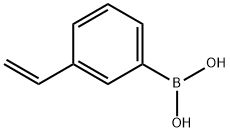
What is 3-VINYLPHENYLBORONIC ACID?
The Uses of 3-VINYLPHENYLBORONIC ACID
suzuki reaction
The Uses of 3-VINYLPHENYLBORONIC ACID
Reactant involved in:
- Suzuki-Miyaura reactions
- Molecular imprinting of fructose and pinacol
- Synthesis of arylmercapturic acids via Chen-Lam-Evans arylation
- Three-component cross-coupling yeilding diarylketones
- Generation of acyl anion equivalents
General Description
May contain varying amounts of anhydride.
Purification Methods
This binder for paper or glass crystallises in white plates from H2O (m 144-145o), and its IR has max 919 and 995 (CH2CH=CH2), 1350 (B-O) and 3220 (OH) cm-1 . The dibromo derivative crystallises in white needles from H2O with m 196-197.5o. [Wesley & Rush J Org Chem 27 2598 1962, Beilstein 16 III 1279, 16 IV 1677.]
Properties of 3-VINYLPHENYLBORONIC ACID
| Melting point: | 141-147 °C |
| Boiling point: | 320.2±35.0 °C(Predicted) |
| Density | 1.09±0.1 g/cm3(Predicted) |
| storage temp. | 2-8°C |
| form | powder or crystals |
| pka | 8.34±0.10(Predicted) |
| BRN | 3030426 |
| CAS DataBase Reference | 15016-43-0(CAS DataBase Reference) |
Safety information for 3-VINYLPHENYLBORONIC ACID
| Signal word | Danger |
| Pictogram(s) |
 Skull and Crossbones Acute Toxicity GHS06  Exclamation Mark Irritant GHS07 |
| GHS Hazard Statements |
H301:Acute toxicity,oral H315:Skin corrosion/irritation H319:Serious eye damage/eye irritation H335:Specific target organ toxicity, single exposure;Respiratory tract irritation |
| Precautionary Statement Codes |
P261:Avoid breathing dust/fume/gas/mist/vapours/spray. P264:Wash hands thoroughly after handling. P264:Wash skin thouroughly after handling. P280:Wear protective gloves/protective clothing/eye protection/face protection. P301+P310:IF SWALLOWED: Immediately call a POISON CENTER or doctor/physician. P304+P340:IF INHALED: Remove victim to fresh air and Keep at rest in a position comfortable for breathing. P305+P351+P338:IF IN EYES: Rinse cautiously with water for several minutes. Remove contact lenses, if present and easy to do. Continuerinsing. P405:Store locked up. |
Computed Descriptors for 3-VINYLPHENYLBORONIC ACID
New Products
2-Bromo-4-hydroxypyridine Dibenzoyl-L-tartaric acid Anhydrous (Resolution Reagent) Dibenzo[b,f][1,4]thiazepin-11(10H)-one 1,2,3,9-Tetrahydro-9-Methyl-4H-Carbazole-4-One Cis-Tosylate 1-(4-methoxyphenyl)-4-(4-Nitrophenyl)Piperazine (IT-1) 2'-Fluoroacetophenone 1-aminocyclobutanecarbonitrile hydrochloride AMINO-O-TOLYL-ACETIC ACID N-Methyl-2-amino-2-methylpropionamide 4-(FMOC-AMINO)-TETRAHYDROPYRAN-4-CARBOXYLIC ACID 1-Aminocyclobutanecarboxylic Acid Hydrochloride METHANOL-D1(OD) TERTIARY BUTANOL-D9 N-ETHYL-D5-AMINE HYDROCHLORIDE BENZOIC ACID-D CHLOROFORM-D TOLUENE-D3 2-(2-Bromophenyl)ethanol Boc-D-Glu(OMe)-OMe 2,5 Dibromopyridine Ethyl 4-hydroxy-3-oxobutanoate Dimethyl (2S)-2-((tert-butoxycarbonyl)amino)-4-(cyanomethyl)pentanedioate 1-(3-Chlorophenyl)piperazine hydrochlorideRelated products of tetrahydrofuran
![[3-(E-3-METHOXY-3-OXO-1-PROPEN-1-YL)PHENYL]BORONIC ACID](https://img.chemicalbook.in/CAS/GIF/380430-59-1.gif)
![3-[(E)-2-NITROVINYL]PHENYLBORONIC ACID](https://img.chemicalbook.in/CAS/GIF/850567-99-6.gif)
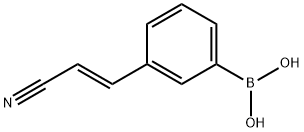
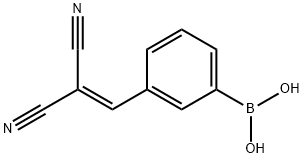
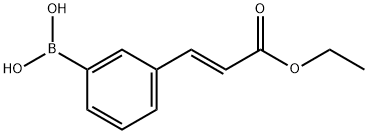
You may like
-
 3-Vinylphenylboronic Acid (contains varying amounts of Anhydride) CAS 15016-43-0View Details
15016-43-0 -
98071-16-0 1-Aminocyclobutanecarboxylic Acid Hydrochloride 98+View Details
98071-16-0 -
106914-07-2 N-Methyl-2-amino-2-methylpropionamide 98+View Details
106914-07-2 -
129592-98-9 98+View Details
129592-98-9 -
4-(FMOC-AMINO)-TETRAHYDROPYRAN-4-CARBOXYLIC ACID 98+View Details
285996-72-7 -
1-aminocyclobutanecarbonitrile hydrochloride 845821-84-3 98+View Details
845821-84-3 -
98071-16-0 1-Aminocyclobutanecarboxylic Acid Hydrochloride 98+View Details
98071-16-0 -
 ADC-151View Details
27176-87-0
Statement: All products displayed on this website are only used for non medical purposes such as industrial applications or scientific research, and cannot be used for clinical diagnosis or treatment of humans or animals. They are not medicinal or edible.