
3-Methyl-1-butanethiol
Synonym(s):Isoamyl mercaptan
- CAS NO.:541-31-1
- Empirical Formula: C5H12S
- Molecular Weight: 104.21
- MDL number: MFCD00004899
- EINECS: 208-774-3
- SAFETY DATA SHEET (SDS)
- Update Date: 2026-05-28 02:45:21
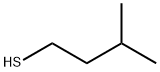
What is 3-Methyl-1-butanethiol?
Chemical properties
clear colorless to slightly yellow liquid
Occurrence
Reported present in beer
The Uses of 3-Methyl-1-butanethiol
3-Methyl-1-butanethiol, is a versatile organic building block in the synthesis of sulfur containnig pharmaceutical compounds. It is used in the synthesis of some poly(alkylene glycol dithiophosphates) with functional groups in the S-alkyl radical, possessing long-lasting anthelminthic and antibacterial properties. It is also shown to be one of the flavor components from beef, pork, and chicken
What are the applications of Application
3-Methyl-1-butanethiol is used in the synthesis of monolayer-capped gold nanoparticles
Definition
ChEBI: Isopentyl mercaptan is an alkanethiol.
Aroma threshold values
Detection: 0.002 ppb
Properties of 3-Methyl-1-butanethiol
| Melting point: | -133.51°C |
| Boiling point: | 120 °C |
| Density | 0.835 g/mL at 25 °C(lit.) |
| vapor pressure | 41.4 mm Hg ( 37.7 °C) |
| FEMA | 3858 | 3-METHYLBUTANETHIOL |
| refractive index | n |
| Flash point: | 65 °F |
| storage temp. | Flammables area |
| solubility | soluble in Chloroform |
| pka | 10.41±0.10(Predicted) |
| form | Liquid |
| color | Clear colorless to slightly yellow |
| Odor | at 0.10 % in propylene glycol. sulfurous onion green onion garlic |
| Odor Threshold | 0.00000077ppm |
| Sensitive | Air Sensitive |
| JECFA Number | 513 |
| BRN | 635659 |
| CAS DataBase Reference | 541-31-1(CAS DataBase Reference) |
| NIST Chemistry Reference | 1-Butanethiol, 3-methyl-(541-31-1) |
| EPA Substance Registry System | 1-Butanethiol, 3-methyl- (541-31-1) |
Safety information for 3-Methyl-1-butanethiol
| Signal word | Danger |
| Pictogram(s) |
 Flame Flammables GHS02  Exclamation Mark Irritant GHS07 |
| GHS Hazard Statements |
H225:Flammable liquids H315:Skin corrosion/irritation H319:Serious eye damage/eye irritation H335:Specific target organ toxicity, single exposure;Respiratory tract irritation |
| Precautionary Statement Codes |
P210:Keep away from heat/sparks/open flames/hot surfaces. — No smoking. P302+P352:IF ON SKIN: wash with plenty of soap and water. P305+P351+P338:IF IN EYES: Rinse cautiously with water for several minutes. Remove contact lenses, if present and easy to do. Continuerinsing. |
Computed Descriptors for 3-Methyl-1-butanethiol
New Products
2-Bromo-4-hydroxypyridine Dibenzoyl-L-tartaric acid Anhydrous (Resolution Reagent) Dibenzo[b,f][1,4]thiazepin-11(10H)-one 1,2,3,9-Tetrahydro-9-Methyl-4H-Carbazole-4-One Cis-Tosylate 1-(4-methoxyphenyl)-4-(4-Nitrophenyl)Piperazine (IT-1) 1-aminocyclobutanecarbonitrile hydrochloride AMINO-O-TOLYL-ACETIC ACID 1-Aminocyclobutanecarboxylic Acid Hydrochloride AMINO(2-BROMOPHENYL)ACETIC ACID 6-BROMOTETRAZOLO[1,5-A]PYRIDINE 3-Oxocyclobutanecarboxylic acid METHANOL-D1(OD) TERTIARY BUTANOL-D9 N-ETHYL-D5-AMINE HYDROCHLORIDE BENZOIC ACID-D CHLOROFORM-D TOLUENE-D3 2-(2-Bromophenyl)ethanol Boc-D-Glu(OMe)-OMe 2,5 Dibromopyridine Ethyl 4-hydroxy-3-oxobutanoate Dimethyl (2S)-2-((tert-butoxycarbonyl)amino)-4-(cyanomethyl)pentanedioate 1-(3-Chlorophenyl)piperazine hydrochlorideRelated products of tetrahydrofuran

You may like
-
 Isoamyl Mercaptan CAS 541-31-1View Details
541-31-1 -
254762-66-8 AMINO(2-BROMOPHENYL)ACETIC ACID 98+View Details
254762-66-8 -
254762-66-8 AMINO(2-BROMOPHENYL)ACETIC ACID 98+View Details
254762-66-8 -
23716-23-1 98+View Details
23716-23-1 -
6-BROMOTETRAZOLO[1,5-A]PYRIDINE 98+View Details
5799-75-7 -
254762-66-8 AMINO(2-BROMOPHENYL)ACETIC ACID 98+View Details
254762-66-8 -
23716-23-1 98+View Details
23716-23-1 -
6-BROMOTETRAZOLO[1,5-A]PYRIDINE 98+View Details
5799-75-7
Statement: All products displayed on this website are only used for non medical purposes such as industrial applications or scientific research, and cannot be used for clinical diagnosis or treatment of humans or animals. They are not medicinal or edible.