
3-Chloropivaloyl chloride
- CAS NO.:4300-97-4
- Empirical Formula: C5H8Cl2O
- Molecular Weight: 155.02
- MDL number: MFCD00000710
- EINECS: 224-311-8
- SAFETY DATA SHEET (SDS)
- Update Date: 2026-07-16 16:37:17
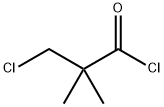
What is 3-Chloropivaloyl chloride?
Chemical properties
clear colorless to light yellow-brown liquid
The Uses of 3-Chloropivaloyl chloride
3-Chloropivaloyl Chloride is useful in the synthesis of compounds with antimicrobial and antioxidant activities.
General Description
A colorless liquid. Very toxic by ingestion, inhalation and skin absorption. Flash point near 70°F. Corrosive. Contact may severely irritate skin, eyes, and mucous membranes. Used to make other chemicals.
Air & Water Reactions
Highly flammable. Slightly soluble in water and less dense than water. Hence floats on water. Reacts with water to form hydrochloric acid (hydrogen chloride).
Reactivity Profile
3-Chloropivaloyl chloride is incompatible with strong oxidizing agents, alcohols, bases, including amines. May react vigorously or explosively if mixed with diisopropyl ether or other ethers in the presence of trace amounts of metal salts [J. Haz. Mat., 1981, 4, 291].
Health Hazard
TOXIC; inhalation, ingestion or contact (skin, eyes) with vapors, dusts or substance may cause severe injury, burns or death. Contact with molten substance may cause severe burns to skin and eyes. Reaction with water or moist air will release toxic, corrosive or flammable gases. Reaction with water may generate much heat that will increase the concentration of fumes in the air. Fire will produce irritating, corrosive and/or toxic gases. Runoff from fire control or dilution water may be corrosive and/or toxic and cause pollution.
Fire Hazard
Combustible material: may burn but does not ignite readily. Substance will react with water (some violently) releasing flammable, toxic or corrosive gases and runoff. When heated, vapors may form explosive mixtures with air: indoors, outdoors and sewers explosion hazards. Most vapors are heavier than air. They will spread along ground and collect in low or confined areas (sewers, basements, tanks). Vapors may travel to source of ignition and flash back. Contact with metals may evolve flammable hydrogen gas. Containers may explode when heated or if contaminated with water.
Properties of 3-Chloropivaloyl chloride
| Boiling point: | 85-86 °C60 mm Hg(lit.) |
| Density | 1.199 g/mL at 25 °C(lit.) |
| refractive index | n |
| Flash point: | 145 °F |
| Specific Gravity | 1.199 |
| color | Clear, colourless |
| Water Solubility | reacts |
| CAS DataBase Reference | 4300-97-4(CAS DataBase Reference) |
| EPA Substance Registry System | 3-Chloropivaloyl chloride (4300-97-4) |
Safety information for 3-Chloropivaloyl chloride
| Signal word | Danger |
| Pictogram(s) |
 Corrosion Corrosives GHS05 |
| GHS Hazard Statements |
H314:Skin corrosion/irritation H330:Acute toxicity,inhalation H335:Specific target organ toxicity, single exposure;Respiratory tract irritation |
| Precautionary Statement Codes |
P280:Wear protective gloves/protective clothing/eye protection/face protection. P309+P311:IF exposed or if you feel unwell: call a POISON CENTER or doctor/physician. |
Computed Descriptors for 3-Chloropivaloyl chloride
New Products
9-Mesityl-10-methylacridinium perchlorate Sulfapyridine Fmoc-OSu (R)-(-)-2-Amino-1-propanol Cyclobutanone 5-bromo-4-fluoro-2-nitrobenzaldehyde 4 pentyn 1 ol N-Vinylformamide Phenethyl cinnamate Pyrrolo[1,2-a]pyrimidine-6-carboxylic acid, 4,6,7,8-tetrahydro-4-oxo-, sodium salt (1:1), (6S) Ethyl 3-phenylpropanoate β-Bromostyrene Methacrylate-PEG-Methacrylate, Mn:35000 2,4-Dihydroxyacetophenone 2-Chloro 5-Fluoro Pyridine Vasicinone 2-Chloroisonicotinic Acid Tween 80 or Polysorbate 80 5-Bromo-1-Pentyne 1-(2-Methyl-5-nitrophenyl)guanidine Nitrate Methyl trans-4-Aminocyclohexanecarboxylate Hydrochloride N-(4-Cyano-3-(trifluoromethyl)phenyl)-2-methyloxirane-2-carboxamide 4-Nitrobenzotrifluoride 2-Pentyn-1-oLRelated products of tetrahydrofuran


You may like
-
 1191-95-3 Cyclobutanone 98+View Details
1191-95-3 -
213382-45-7 98+View Details
213382-45-7 -
Fmoc-OSu 98+View Details
82911-69-1 -
(R)-(-)-2-Amino-1-propanol 35320-23-1 98+View Details
35320-23-1 -
1191-95-3 Cyclobutanone 98+View Details
1191-95-3 -
213382-45-7 98+View Details
213382-45-7 -
Fmoc-OSu 98+View Details
82911-69-1 -
(R)-(-)-2-Amino-1-propanol 35320-23-1 98+View Details
35320-23-1