
(2S,3S,4R)-2-Carboxy-4-isopropyl-3-pyrrolidineacetic acid
Synonym(s):2-Carboxy-4-isopropyl-3-pyrrolidineacetic acid
- CAS NO.:52497-36-6
- Empirical Formula: C10H17NO4
- Molecular Weight: 215.25
- MDL number: MFCD03412037
- SAFETY DATA SHEET (SDS)
- Update Date: 2026-09-12 18:54:40
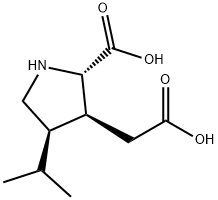
What is (2S,3S,4R)-2-Carboxy-4-isopropyl-3-pyrrolidineacetic acid?
Description
Dihydrokainic acid (DHK) is an inhibitor of excitatory amino acid transporter 2 (EAAT2; Ki = 23 μM for glutamate uptake by COS cells expressing EAAT2). It is selective for EEAT2 over EAAT1 and EAAT3 (Ki = >3 mM for both). DHK microinfusion (5 nmol) into the rat infralimbic cortex reduces the time spent immobile in the forced swim test, indicating antidepressant-like behavior, an effect that is blocked by the AMPA receptor antagonist NBQX and the serotonin (5-HT) receptor subtype 5-HT1A antagonist WAY-100635 . It also increases glutamate and serotonin levels and the expression of c-Fos in the dorsal raphe nucleus. In contrast, DHK microinjection (6.25 nmol) into the rat prefrontal cortex (PFC) increases the latency to drink sucrose in a sucrose intake test, indicating anhedonia-like behavior. It also impairs memory acquisition, consolidation, and retrieval in mice in the novel object recognition test.
The Uses of (2S,3S,4R)-2-Carboxy-4-isopropyl-3-pyrrolidineacetic acid
Dihydrokainic acid has been used as a glutamate transporter (GLT-1) inhibitor in the glutamate uptake assay of astrocytes and glial cells. It may be used as a GLT-1 inhibitor in Lateral habenula (LHb).
What are the applications of Application
Dihydrokainic acid is an EAAT2(GLT1)-selective non-transportable inhibitor of L-glutamate and L-aspartate uptake
Definition
ChEBI: Dihydrokainic acid is a dicarboxylic acid. It is functionally related to a kainic acid.
Biological Activity
EAAT2(GLT1)-selective non-transportable inhibitor of L-glutamate and L-aspartate uptake (K i = 23 μ M). 130-fold selective over EAAT1 and EAAT3 (K i > 3 mM). Also available as part of the Excitatory Amino Acid Transporter Inhibitor Tocriset™ .
Biochem/physiol Actions
Dihydrokainic favors neuronal cell death. It modulates anxiety and depression behaviors.
Storage
Room temperature
Properties of (2S,3S,4R)-2-Carboxy-4-isopropyl-3-pyrrolidineacetic acid
| Melting point: | 285 °C (decomp) |
| Boiling point: | 416.6±30.0 °C(Predicted) |
| Density | 1.187±0.06 g/cm3(Predicted) |
| storage temp. | 2-8°C |
| solubility | H2O: >10 mg/mL |
| form | solid |
| pka | 2.11±0.60(Predicted) |
| color | White |
| Water Solubility | Soluble to 25 mM in water |
Safety information for (2S,3S,4R)-2-Carboxy-4-isopropyl-3-pyrrolidineacetic acid
Computed Descriptors for (2S,3S,4R)-2-Carboxy-4-isopropyl-3-pyrrolidineacetic acid
New Products
5-bromo-4-fluoro-2-nitrobenzaldehyde (R)-(-)-2-Amino-1-propanol Cyclobutanone Fmoc-OSu 1-(2-Chloroethyl)pyrrolidine Hydrochloride 2-Amino-2-(4-methylphenyl)acetic acid β-Bromostyrene Ethyl 3-phenylpropanoate Phenethyl cinnamate Dipropyl disulfide 4 pentyn 1 ol N-Vinylformamide Methacrylate-PEG-Methacrylate, Mn:35000 2,4-Dihydroxyacetophenone 2-Chloro 5-Fluoro Pyridine Vasicinone 2-Chloroisonicotinic Acid Tween 80 or Polysorbate 80 2-Butyn-1-oL 2-Pentyn-1-oL 4-Nitrobenzotrifluoride N-(4-fluoro-2-methoxy-5-nitrophenyl)-4-(1-methyl-1H-indol-3-yl)pyrimidin-2-amine Pirtobrutinib intd. N-(4-Cyano-3-(trifluoromethyl)phenyl)-2-methyloxirane-2-carboxamideRelated products of tetrahydrofuran
You may like
-
 Dihydrokainic acid CAS 52497-36-6View Details
52497-36-6 -
Fmoc-OSu 98+View Details
82911-69-1 -
7250-67-1 1-(2-Chloroethyl)pyrrolidine Hydrochloride 98+View Details
7250-67-1 -
13227-01-5 98+View Details
13227-01-5 -
7250-67-1 1-(2-Chloroethyl)pyrrolidine Hydrochloride 98+View Details
7250-67-1 -
13227-01-5 98+View Details
13227-01-5 -
7250-67-1 1-(2-Chloroethyl)pyrrolidine Hydrochloride 98+View Details
7250-67-1 -
13227-01-5 98+View Details
13227-01-5