
(2S)-5,7-Dihydroxy-2-(3-hydroxy-4-methoxyphenyl)-4-chromanone, 3',5,7-Trihydroxy-4-methoxyflavanone
Synonym(s):3′,5,7-Trihydroxy-4′-methoxyflavanone;5,7-Dihydroxy-2-(3-hydroxy-4-methoxyphenyl)-4-chromanone;Hesperetin
- CAS NO.:69097-99-0
- Empirical Formula: C16H14O6
- Molecular Weight: 302.28
- MDL number: MFCD00016956
- SAFETY DATA SHEET (SDS)
- Update Date: 2026-05-28 05:59:41
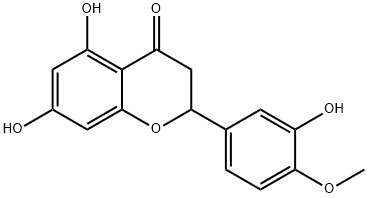
What is (2S)-5,7-Dihydroxy-2-(3-hydroxy-4-methoxyphenyl)-4-chromanone, 3',5,7-Trihydroxy-4-methoxyflavanone?
The Uses of (2S)-5,7-Dihydroxy-2-(3-hydroxy-4-methoxyphenyl)-4-chromanone, 3',5,7-Trihydroxy-4-methoxyflavanone
Hesperetin has been used as a standard in studies involving the cytotoxic effect of hesperetin on doxorubicin-resistant MCF-7 cells using enzyme-linked immunosorbent assay (ELISA) technique.
What are the applications of Application
Hesperetin is a dietary flavanone with chemopreventive effect
Definition
ChEBI: 5,7-dihydroxy-2-(3-hydroxy-4-methoxyphenyl)-3,4-dihydro-2H-1-benzopyran-4-one is an ether and a member of flavonoids.
General Description
Hesperetin is an aglycon form of flavonoid, which can be found in peels of citrus fruits.
Biochem/physiol Actions
Dietary flavanone with chemopreventive effect.
Properties of (2S)-5,7-Dihydroxy-2-(3-hydroxy-4-methoxyphenyl)-4-chromanone, 3',5,7-Trihydroxy-4-methoxyflavanone
| Melting point: | 227-232°C |
| Boiling point: | 586.2±50.0 °C(Predicted) |
| Density | 1.458±0.06 g/cm3(Predicted) |
| FEMA | 4313 | 5,7-DIHYDROXY-2-(3-HYDROXY-4-METHOXYPHENYL)CHROMAN-4-ONE |
| storage temp. | 2-8°C |
| solubility | ethanol: soluble50mg/mL, clear to almost clear, colorless to slightly yellow |
| form | powder (with a light tan cast) |
| pka | 7.49±0.40(Predicted) |
| color | Pale Yellow to Light Brown |
| JECFA Number | 2024 |
Safety information for (2S)-5,7-Dihydroxy-2-(3-hydroxy-4-methoxyphenyl)-4-chromanone, 3',5,7-Trihydroxy-4-methoxyflavanone
| Signal word | Warning |
| Pictogram(s) |
 Exclamation Mark Irritant GHS07 |
| GHS Hazard Statements |
H315:Skin corrosion/irritation H319:Serious eye damage/eye irritation |
| Precautionary Statement Codes |
P264:Wash hands thoroughly after handling. P264:Wash skin thouroughly after handling. P280:Wear protective gloves/protective clothing/eye protection/face protection. P302+P352:IF ON SKIN: wash with plenty of soap and water. P305+P351+P338:IF IN EYES: Rinse cautiously with water for several minutes. Remove contact lenses, if present and easy to do. Continuerinsing. P332+P313:IF SKIN irritation occurs: Get medical advice/attention. P337+P313:IF eye irritation persists: Get medical advice/attention. |
Computed Descriptors for (2S)-5,7-Dihydroxy-2-(3-hydroxy-4-methoxyphenyl)-4-chromanone, 3',5,7-Trihydroxy-4-methoxyflavanone
New Products
1-(4-methoxyphenyl)-4-(4-Nitrophenyl)Piperazine (IT-1) 1,2,3,9-Tetrahydro-9-Methyl-4H-Carbazole-4-One Dibenzo[b,f][1,4]thiazepin-11(10H)-one Cis-Tosylate Dibenzoyl-L-tartaric acid Anhydrous (Resolution Reagent) 1-Benzhydrylazetane-3-carbonitrile 8-oxa-1,3-diazaspiro[4.5]decane-2,4-dione (±)-amino(2-fluorophenyl)acetic acid 2-(2-Chlorophenyl)glycine AMINO-(3-CHLORO-PHENYL)-ACETIC ACID 2'-Fluoroacetophenone METHANOL-D1(OD) N-ETHYL-D5-AMINE HYDROCHLORIDE BENZOIC ACID-D CHLOROFORM-D BENZENE-D6 TOLUENE-D3 2-Hydroxybutanenitrile 1-Benzylindolin-2-one Ethyl 2-bromo-3-oxobutanoate 4-(3-chloropropyl)morpholine 1-Benzylindoline-2,3-dione 3-Oxocyclobutanecarboxylic acid 1-(3-Chlorophenyl)piperazine hydrochlorideRelated products of tetrahydrofuran
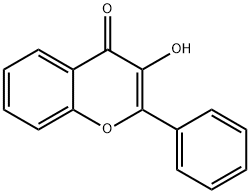
You may like
-
 (R,S)-hesperetin 98%View Details
 -
 Hesperetin, 97%+ CAS 69097-99-0View Details
69097-99-0 -
Hesperetin CAS 69097-99-0View Details
69097-99-0 -
5-Bromo-2-chloro- benzoic acid 21739-92-4 98%View Details
21739-92-4 -
52092-43-0 2-Bromo-4-nitropyridine-N-oxide 98%View Details
52092-43-0 -
2,4,6-Trichloro-5-nitropyrimidine 98%View Details
4359-87-9 -
1-Methylpiperidine-4-thiol 1072-99-7 98%View Details
1072-99-7 -
68886-07-7 98%View Details
68886-07-7
Statement: All products displayed on this website are only used for non medical purposes such as industrial applications or scientific research, and cannot be used for clinical diagnosis or treatment of humans or animals. They are not medicinal or edible.