
2,6-Dinitrophenol
- CAS NO.:573-56-8
- Empirical Formula: C6H4N2O5
- Molecular Weight: 184.11
- MDL number: MFCD00024235
- EINECS: 209-357-9
- SAFETY DATA SHEET (SDS)
- Update Date: 2026-09-12 18:55:56
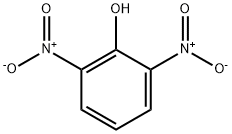
What is 2,6-Dinitrophenol?
Chemical properties
Light yellow crystalline
The Uses of 2,6-Dinitrophenol
2,6-Dinitrophenol is an aromatic nitrophenol.
Definition
ChEBI: 2,6-dinitrophenol is a dinitrophenol.
General Description
Yellow crystalline solid with a sweet musty odor. Sinks and mixes slowly with water.
Air & Water Reactions
Mixes slowly with water.
Reactivity Profile
2,6-DINITROPHENOL can detonate or explode when heated under confinement [USCG, 1999]. Phenols do not behave as organic alcohols, as one might guess from the presence of a hydroxyl (-OH) group in their structure. Instead, they react as weak organic acids. Phenols and cresols are much weaker as acids than common carboxylic acids (phenol has Ka = 1.3 x 10^[-10]). These materials are incompatible with strong reducing substances such as hydrides, nitrides, alkali metals, and sulfides. Flammable gas (H2) is often generated, and the heat of the reaction may ignite the gas. Heat is also generated by the acid-base reaction between phenols and bases.
Health Hazard
INHALATION, INGESTION AND SKIN ABSORPTION: Headache, anorexia, nausea, vomiting, abdominal pain, diarrhea, fever, pain in chest, difficult breathing, profuse sweating and thirst, dizziness and fatigue. SKIN: Discoloration and irritation. Corrosive to skin.
Purification Methods
Crystallise it from H2O, aqueous EtOH, *C6H6/cyclohexane, or *C6H6/pet ether (b 60-80o, 1:1). [Beilstein 6 III 867, 6 IV 1383.]
Properties of 2,6-Dinitrophenol
| Melting point: | 61-63 °C(lit.) |
| Boiling point: | 318.03°C (rough estimate) |
| Density | 1.7195 (rough estimate) |
| vapor density | 6.35 (vs air) |
| refractive index | 1.4738 (estimate) |
| solubility | Solubility Sparingly soluble in water; soluble in ethanol, chloroform, ether |
| form | crystals |
| pka | 3.69, 3.7, 3.5(at 25℃) |
| color | Yellowish |
| PH Range | Colorless (1.7) to yellow (4.4) |
| Water Solubility | 314.9mg/L(15 ºC) |
| Merck | 14,3282 |
| BRN | 1913410 |
| Stability: | Light Sensitive, Possibly Shock Sensitive |
| Major Application | Energetic materials, battery, lubricants, curing agents for epoxy resins, fungicidal, herbicidal, food storage, drugs |
| CAS DataBase Reference | 573-56-8(CAS DataBase Reference) |
| EPA Substance Registry System | 2,6-Dinitrophenol (573-56-8) |
Safety information for 2,6-Dinitrophenol
Computed Descriptors for 2,6-Dinitrophenol
New Products
9-Mesityl-10-methylacridinium perchlorate Sulfapyridine Fmoc-OSu (R)-(-)-2-Amino-1-propanol Cyclobutanone 5-bromo-4-fluoro-2-nitrobenzaldehyde 4 pentyn 1 ol N-Vinylformamide Phenethyl cinnamate Pyrrolo[1,2-a]pyrimidine-6-carboxylic acid, 4,6,7,8-tetrahydro-4-oxo-, sodium salt (1:1), (6S) Ethyl 3-phenylpropanoate β-Bromostyrene Methacrylate-PEG-Methacrylate, Mn:35000 2,4-Dihydroxyacetophenone 2-Chloro 5-Fluoro Pyridine Vasicinone 2-Chloroisonicotinic Acid Tween 80 or Polysorbate 80 5-Bromo-1-Pentyne 1-(2-Methyl-5-nitrophenyl)guanidine Nitrate Methyl trans-4-Aminocyclohexanecarboxylate Hydrochloride 2-Pentyn-1-oL 4-Nitrobenzotrifluoride N-(4-Cyano-3-(trifluoromethyl)phenyl)-2-methyloxirane-2-carboxamideRelated products of tetrahydrofuran

You may like
-
 1191-95-3 Cyclobutanone 98+View Details
1191-95-3 -
213382-45-7 98+View Details
213382-45-7 -
Fmoc-OSu 98+View Details
82911-69-1 -
(R)-(-)-2-Amino-1-propanol 35320-23-1 98+View Details
35320-23-1 -
1191-95-3 Cyclobutanone 98+View Details
1191-95-3 -
213382-45-7 98+View Details
213382-45-7 -
Fmoc-OSu 98+View Details
82911-69-1 -
(R)-(-)-2-Amino-1-propanol 35320-23-1 98+View Details
35320-23-1