
2,6-Diethylaniline
Synonym(s):2-Amino-1,3-diethylbenzene
- CAS NO.:579-66-8
- Empirical Formula: C10H15N
- Molecular Weight: 149.23
- MDL number: MFCD00007753
- EINECS: 209-445-7
- SAFETY DATA SHEET (SDS)
- Update Date: 2026-05-28 04:18:30
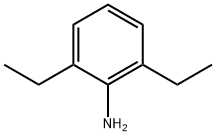
What is 2,6-Diethylaniline?
Chemical properties
Clear liquid
The Uses of 2,6-Diethylaniline
2,6-Diethylaniline is an intermediate for the production of alachlor, butachlor, metolachlor-herbicides, tiafentiurone-insecticide, carbodiimide and RIM-PUR. Product Data Sheet
The Uses of 2,6-Diethylaniline
2,6-Diethylaniline is used as a reagent in the synthesis of herbicides, for instance Butachlor (B689925); a pre-emergent chloroacetanalide herbicide commonly used for weed control in rice as well as cotton, maize, wheat and other crops.
Production Methods
2,6-Diethylaniline is obtained in high yield when aniline is heated with ethylene at 200-300°C under high pressure in the presence of aluminum anilide (Northcott 1978).
General Description
The 2,6-diethylaniline complexes with iodine, as a sigma-acceptor, were studied spectrophotometrically in chloroform, dichloromethane and carbontetrachloride solutions. It is an intermediate for the production of alachlor, butachlor, metolachlor-herbicides, tiafentiurone-insecticide, carbodiimide and RIM-PUR.
Industrial uses
2,6-Diethylaniline is used in the synthesis of herbicides such as Nevirex G and butachlor (Vertesi and Miklos 1982; Lee et al 1982).
Metabolic pathway
Incubation of 2,6-diethylaniline (DEA) with NADPH- fortified rat liver microsomal enzymes produces 4- amino-3,5-diethylphenol (ADEP) as the major oxidation product. ADEP is shown to undergo further oxidation to 3,5-diethylbenzoquinone-4-imine (DEBQI), which is isolated as a minor metabolite during DEA oxidation.
Metabolism
Incubation of 2,6-diethylaniline with NADPH-fortified microsomes produced 4-amino-3,5-diethylphenol (ADEP) as the major oxidation product (Feng and Wratten 1987). ADEP underwent further oxidation to 3,5-diethyl-benzoquinone-4-imine which is isolated as a minor metabolite during 2,6-diethylaniline metabolism. 2,6-Diethylaniline is produced under aerobic soil conditions as a minor metabolite of the herbicide butachlor (Lee et al 1982). 2,6-Diethylaniline is degraded by the soil microorganism Chaetomium globosum to 2,6-diethylacetanilide and 2,6-diethyl-p-benzoquinone (Lee and Ryu 1982). 2,6-Diethylaniline was also very persistent towards biodegradation in pond water with and without sewage sludge inoculation (Lyons et al 1985).
Properties of 2,6-Diethylaniline
| Melting point: | 3-4 °C |
| Boiling point: | 243 °C (lit.) |
| Density | 0.906 g/mL at 25 °C (lit.) |
| vapor pressure | 0.02 mm Hg ( 20 °C) |
| refractive index | n |
| Flash point: | 254 °F |
| storage temp. | Keep in dark place,Inert atmosphere,Room temperature |
| solubility | Chloroform (Slightly), Methanol (Slightly) |
| form | Liquid |
| pka | 4.13±0.10(Predicted) |
| color | Clear yellow to reddish-brown |
| Water Solubility | 0.67g/L(26.7 ºC) |
| Sensitive | Air Sensitive |
| BRN | 1423626 |
| Stability: | Air Sensitive |
| CAS DataBase Reference | 579-66-8(CAS DataBase Reference) |
| NIST Chemistry Reference | Benzenamine, 2,6-diethyl-(579-66-8) |
| EPA Substance Registry System | 2,6-Diethylaniline (579-66-8) |
Safety information for 2,6-Diethylaniline
| Signal word | Warning |
| Pictogram(s) |
 Exclamation Mark Irritant GHS07  Health Hazard GHS08 |
| GHS Hazard Statements |
H302:Acute toxicity,oral H315:Skin corrosion/irritation H319:Serious eye damage/eye irritation H341:Germ cell mutagenicity |
| Precautionary Statement Codes |
P201:Obtain special instructions before use. P202:Do not handle until all safety precautions have been read and understood. P264:Wash hands thoroughly after handling. P264:Wash skin thouroughly after handling. P270:Do not eat, drink or smoke when using this product. P280:Wear protective gloves/protective clothing/eye protection/face protection. P308+P313:IF exposed or concerned: Get medical advice/attention. P405:Store locked up. P501:Dispose of contents/container to..… |
Computed Descriptors for 2,6-Diethylaniline
2,6-Diethylaniline manufacturer
New Products
5-bromo-4-fluoro-2-nitrobenzaldehyde (R)-(-)-2-Amino-1-propanol Cyclobutanone Fmoc-OSu 1-(2-Chloroethyl)pyrrolidine Hydrochloride 2-Amino-2-(4-methylphenyl)acetic acid β-Bromostyrene Ethyl 3-phenylpropanoate Phenethyl cinnamate Dipropyl disulfide 4 pentyn 1 ol N-Vinylformamide Methacrylate-PEG-Methacrylate, Mn:35000 2,4-Dihydroxyacetophenone 2-Chloro 5-Fluoro Pyridine Vasicinone 2-Chloroisonicotinic Acid Tween 80 or Polysorbate 80 2-Butyn-1-oL 2-Pentyn-1-oL 4-Nitrobenzotrifluoride N-(4-fluoro-2-methoxy-5-nitrophenyl)-4-(1-methyl-1H-indol-3-yl)pyrimidin-2-amine Pirtobrutinib intd. N-(4-Cyano-3-(trifluoromethyl)phenyl)-2-methyloxirane-2-carboxamideRelated products of tetrahydrofuran
You may like
-
 2,6 Diethyl aniline 98%View Details
 -
 579-66-8 98%View Details
579-66-8 -
 2,6-Diethylaniline CAS 579-66-8View Details
579-66-8 -
2,6-Diethylaniline CAS 579-66-8View Details
579-66-8 -
2,6-Diethylaniline CAS 579-66-8View Details
579-66-8 -
7250-67-1 1-(2-Chloroethyl)pyrrolidine Hydrochloride 98+View Details
7250-67-1 -
7250-67-1 1-(2-Chloroethyl)pyrrolidine Hydrochloride 98+View Details
7250-67-1 -
13227-01-5 98+View Details
13227-01-5