
2,5-DIAMINOTOLUENE DIHYDROCHLORIDE
- CAS NO.:615-45-2
- Empirical Formula: C7H11ClN2
- Molecular Weight: 158.63
- MDL number: MFCD00035512
- SAFETY DATA SHEET (SDS)
- Update Date: 2026-05-28 01:01:24
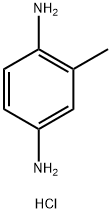
What is 2,5-DIAMINOTOLUENE DIHYDROCHLORIDE?
The Uses of 2,5-DIAMINOTOLUENE DIHYDROCHLORIDE
2,5-Diaminotoluene Dihydrochloride is an aromatic compound that is commonly used in permanent hair-dye formulations. 2,5-Diaminotoluene is weakly mutagenic and is also partially responsible for causing allergic contact dermatitis in humans.
Safety Profile
Poison by ingestion. Experimental teratogenic effects. Mutation data reported. When heated to decomposition it emits very toxic fumes of NOx and HCl. See also CHLORIDES.
Properties of 2,5-DIAMINOTOLUENE DIHYDROCHLORIDE
| Water Solubility | Soluble in water |
| form | powder to crystal |
| color | White to Gray to Red |
| CAS DataBase Reference | 615-45-2(CAS DataBase Reference) |
| EPA Substance Registry System | 1,4-Benzenediamine, 2-methyl-, hydrochloride (1:2) (615-45-2) |
Safety information for 2,5-DIAMINOTOLUENE DIHYDROCHLORIDE
| Signal word | Danger |
| Pictogram(s) |
 Skull and Crossbones Acute Toxicity GHS06  Exclamation Mark Irritant GHS07 |
| GHS Hazard Statements |
H315:Skin corrosion/irritation H317:Sensitisation, Skin H319:Serious eye damage/eye irritation |
| Precautionary Statement Codes |
P261:Avoid breathing dust/fume/gas/mist/vapours/spray. P264:Wash hands thoroughly after handling. P264:Wash skin thouroughly after handling. P270:Do not eat, drink or smoke when using this product. P271:Use only outdoors or in a well-ventilated area. P272:Contaminated work clothing should not be allowed out of the workplace. P280:Wear protective gloves/protective clothing/eye protection/face protection. P405:Store locked up. P403+P233:Store in a well-ventilated place. Keep container tightly closed. P501:Dispose of contents/container to..… |
Computed Descriptors for 2,5-DIAMINOTOLUENE DIHYDROCHLORIDE
New Products
N-Carbethoxy-4-piperidone 1-Aminocyclopentane carbonitrile Tetrabutylammonium perchlorate N,O-Dimethylhydroxylamine hydrochloride (RS)-beta-Amino-beta-(4-bromophenyl)propionic acid 2-Amino-5-bromo-4-(trifluoromethyl)pyridine N-Vinylformamide 4 pentyn 1 ol Phenethyl cinnamate Dipropyl disulfide Ethyl 3-phenylpropanoate β-Bromostyrene Methacrylate-PEG-Methacrylate, Mn:35000 2,4-Dihydroxyacetophenone 2-Chloro 5-Fluoro Pyridine Vasicinone 2-Chloroisonicotinic Acid Tween 80 or Polysorbate 80 5-Bromo-1-Pentyne 1-(2-Methyl-5-nitrophenyl)guanidine Nitrate Methyl trans-4-Aminocyclohexanecarboxylate Hydrochloride N-(4-Cyano-3-(trifluoromethyl)phenyl)-2-methyloxirane-2-carboxamide 2-Pentyn-1-oL 4-NitrobenzotrifluorideRelated products of tetrahydrofuran
![1-(2,4-DICHLOROBENZYL)-5-NITRO-3-[(PENTANOYLOXY)IMINO]-1,3-DIHYDRO-2H-INDOL-2-ONE](https://img.chemicalbook.in/StructureFile/ChemBookStructure2/GIF/CB1682564.gif)

![3-([(2-CHLOROACETYL)OXY]IMINO)-1-(4-CHLOROBENZYL)-5-NITRO-1,3-DIHYDRO-2H-INDOL-2-ONE](https://img.chemicalbook.in/StructureFile/ChemBookStructure2/GIF/CB0738194.gif)
![1-(4-CHLOROBENZYL)-3-([(2,2-DICHLOROACETYL)OXY]IMINO)-5-NITRO-1,3-DIHYDRO-2H-INDOL-2-ONE](https://img.chemicalbook.in/StructureFile/ChemBookStructure2/GIF/CB0669702.gif)

![3-[(ACETYLOXY)IMINO]-1-(2,4-DICHLOROBENZYL)-5-NITRO-1,3-DIHYDRO-2H-INDOL-2-ONE](https://img.chemicalbook.in/StructureFile/ChemBookStructure2/GIF/CB0274517.gif)
You may like
-
 2,5-Diaminotoluene Dihydrochloride CAS 615-45-2View Details
615-45-2 -
144-83-2 Sulfapyridine 98+View Details
144-83-2 -
29976-53-2 98+View Details
29976-53-2 -
(RS)-beta-Amino-beta-(4-bromophenyl)propionic acid 39773-47-2 98+View Details
39773-47-2 -
6638-79-5 N,O-Dimethylhydroxylamine hydrochloride 98+View Details
6638-79-5 -
674783-97-2 98+View Details
674783-97-2 -
1-Aminocyclopentane carbonitrile 98+View Details
49830-37-7 -
Tetrabutylammonium perchlorate 1923-70-2 98+View Details
1923-70-2
Statement: All products displayed on this website are only used for non medical purposes such as industrial applications or scientific research, and cannot be used for clinical diagnosis or treatment of humans or animals. They are not medicinal or edible.