
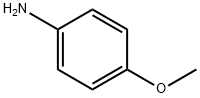
2,4-Diaminoanisole sulfate
- CAS NO.:39156-41-7
- Empirical Formula: C7H10N2O.H2O4S
- Molecular Weight: 236.25
- MDL number: MFCD00012978
- EINECS: 254-323-9
- SAFETY DATA SHEET (SDS)
- Update Date: 2026-05-28 04:10:42
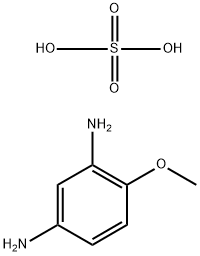
What is 2,4-Diaminoanisole sulfate ?
Chemical properties
2,4-Diaminoanisole is a needle-like solid.
The Uses of 2,4-Diaminoanisole sulfate
2,4-Diaminoanisole sulfate has been used primarily as a component of oxidizing “permanent” hair- and fur-dye formulations. In 1978, about 75% of hair-dye formulations contained 2,4-diaminoanisole orits sulfate. However, a U.S. regulation requiring a warning label on allhair dyes containing 2,4-diaminoanisole or its sulfate was to become effective in April 1980, and the chemicals were voluntarily removed from products before that time (IARC 1982). 2,4-Diaminoanisole also has been used as an intermediate in the production of C.I. basic brown 2, which has been used to dye furs, acrylic fibers, cotton, wool, nylon, polyester, leather, and suede and has been an ingredient of shoe polishes (IARC 1978, 1982).
General Description
Off-white to violet or dark brown powder. Emits toxic fumes of nitrogen oxides and sulfur oxides when heated to decomposition.
Air & Water Reactions
Water soluble. Darkens on exposure to light.
Reactivity Profile
2,4-Diaminoanisole sulfate is weakly acidic. Can react as either an oxidizing agent or reducing agent.
Fire Hazard
Flash point data for 2,4-Diaminoanisole sulfate are not available; however, 2,4-Diaminoanisole sulfate is probably combustible.
Safety Profile
Confirmed carcinogen with experimental carcinogenic, neoplastigenic, and tumorigenic data. Poison by intraperitoneal route. Mutation data reported. When heated to decomposition it emits very toxic fumes of NOx and SOx. See also other diaminoanisole entries.
Potential Exposure
The principal use of 2,4-diamino-ani- sole (and its salts such as the sulfate) as a component of oxidation (permanent) hair and fur dye formulations. Human exposure to 2,4-diaminoanisole sulfate may possibly occur through skin absorption at chemical and dye production facilities, as well as through dermal contact in persons using hair dyes containing the chemical.
Carcinogenicity
2,4-Diaminoanisole sulfate is reasonably anticipated to be a human carcinogen based on sufficient evidence of carcinogenicity from studies in experimental animals.
Shipping
UN2811 Toxic solids, organic, n.o.s., Hazard Class: 6.1; Labels: 6.1-Poisonous materials, Technical Name Required. UN3143 Dyes, solid, toxic, n.o.s. or Dye intermediates, solid, toxic, n.o.s., Hazard Class: 6.1; Labels: 6.1-Poisonous materials, Technical Name Required.
Incompatibilities
Incompatible with strong oxidizers (chlorates, nitrates, peroxides, permanganates, perchlorates, chlorine, bromine, fluorine, etc.); contact may cause fires or explosions. Keep away from alkaline materials, strong bases, strong acids, oxoacids, and epoxides. The sulfate may react violently with aluminum and magnesium.
Waste Disposal
Dissolve or mix the material with a combustible solvent and burn in a chemical incinera- tor equipped with an afterburner and scrubber. All federal, state, and local environmental regulations must be observed .
Properties of 2,4-Diaminoanisole sulfate
| Melting point: | 189-192°C |
| storage temp. | Keep in dark place,Inert atmosphere,Room temperature |
| Water Solubility | Soluble. 1-5 g/100 mL at 18.5 ºC |
| CAS DataBase Reference | 39156-41-7(CAS DataBase Reference) |
| EPA Substance Registry System | 2,4-Diaminoanisole sulfate (39156-41-7) |
Safety information for 2,4-Diaminoanisole sulfate
| Signal word | Warning |
| Pictogram(s) |
 Exclamation Mark Irritant GHS07  Health Hazard GHS08 |
| GHS Hazard Statements |
H302:Acute toxicity,oral H315:Skin corrosion/irritation H319:Serious eye damage/eye irritation H332:Acute toxicity,inhalation H335:Specific target organ toxicity, single exposure;Respiratory tract irritation H351:Carcinogenicity H361:Reproductive toxicity |
| Precautionary Statement Codes |
P280:Wear protective gloves/protective clothing/eye protection/face protection. P310:Immediately call a POISON CENTER or doctor/physician. P305+P351+P338:IF IN EYES: Rinse cautiously with water for several minutes. Remove contact lenses, if present and easy to do. Continuerinsing. |
Computed Descriptors for 2,4-Diaminoanisole sulfate
New Products
Dibenzoyl-L-tartaric acid Anhydrous (Resolution Reagent) Cis-Tosylate Dibenzo[b,f][1,4]thiazepin-11(10H)-one 1,2,3,9-Tetrahydro-9-Methyl-4H-Carbazole-4-One 1-(4-methoxyphenyl)-4-(4-Nitrophenyl)Piperazine (IT-1) BOC Piperazine 1-Benzhydrylazetane-3-carbonitrile 8-oxa-1,3-diazaspiro[4.5]decane-2,4-dione (±)-amino(2-fluorophenyl)acetic acid 2-(2-Chlorophenyl)glycine AMINO-(3-CHLORO-PHENYL)-ACETIC ACID 2'-Fluoroacetophenone METHANOL-D1(OD) TERTIARY BUTANOL-D9 N-ETHYL-D5-AMINE HYDROCHLORIDE BENZOIC ACID-D CHLOROFORM-D TOLUENE-D3 Trans,trans muconic acid HC Blue-16 4-Amino-2-chloro-6,7-dimethoxyquinazoline Ethyl 4,5-bis(2-methoxyethoxy)-2-nitrobenzoate 2,3-Dimethoxypyridine 1-(3-Chlorophenyl)piperazine hydrochlorideRelated products of tetrahydrofuran


You may like
-
 2,4-Diaminoanisole sulfate CASView Details
 -
 Product IntroductionView Details
 -
 Product InrtroductionView Details
 -
 DGO24View Details
 -
 DGO25View Details
 -
 DGO29View Details
 -
 DGO32View Details
 -
 DGO36View Details