
2,3,4,5-Tetrachlorophenol
- CAS NO.:4901-51-3
- Empirical Formula: C6H2Cl4O
- Molecular Weight: 231.89
- MDL number: MFCD00053449
- EINECS: 225-531-7
- SAFETY DATA SHEET (SDS)
- Update Date: 2026-09-12 18:55:36
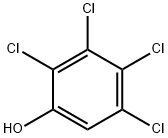
What is 2,3,4,5-Tetrachlorophenol?
The Uses of 2,3,4,5-Tetrachlorophenol
2,3,4,5-Tetrachlorophenol is a halogenated phenol found in textiles and leather products.
Definition
ChEBI: A tetrachlorophenol in which the chlorines are located at positions 2, 3, 4, and 5.
General Description
Needles (from petroleum ether, ligroin) or beige solid.
Air & Water Reactions
Insoluble in water.
Reactivity Profile
2,3,4,5-TETRACHLOROPHENOL is incompatible with acid chlorides, acid anhydrides and oxidizing agents .
Fire Hazard
Flash point data for 2,3,4,5-TETRACHLOROPHENOL are not available. 2,3,4,5-TETRACHLOROPHENOL is probably combustible.
Purification Methods
Crystallise the phenol from pet ether. The benzoate has m 110o (from EtOH). [Beilstein 6 II 182, 6 III 729, 6 IV 1020.]
Properties of 2,3,4,5-Tetrachlorophenol
| Melting point: | 117℃ |
| Boiling point: | 331.59°C (rough estimate) |
| Density | 1.7544 (rough estimate) |
| refractive index | 1.5133 (estimate) |
| Flash point: | 4 °C |
| storage temp. | APPROX 4°C
|
| solubility | DMF: 30 mg/ml,DMSO: 15 mg/ml,Ethanol: 30 mg/ml,Ethanol:PBS (pH 7.2) (1:3): 0.25 mg/ml |
| pka | 6.15±0.28(Predicted) |
| form | neat |
| Water Solubility | 166mg/L(25 ºC) |
| BRN | 2049590 |
| EPA Substance Registry System | 2,3,4,5-Tetrachlorophenol (4901-51-3) |
Safety information for 2,3,4,5-Tetrachlorophenol
| Signal word | Danger |
| Pictogram(s) |
 Corrosion Corrosives GHS05  Skull and Crossbones Acute Toxicity GHS06  Environment GHS09 |
| GHS Hazard Statements |
H301:Acute toxicity,oral H315:Skin corrosion/irritation H318:Serious eye damage/eye irritation H335:Specific target organ toxicity, single exposure;Respiratory tract irritation H410:Hazardous to the aquatic environment, long-term hazard |
| Precautionary Statement Codes |
P261:Avoid breathing dust/fume/gas/mist/vapours/spray. P273:Avoid release to the environment. P280:Wear protective gloves/protective clothing/eye protection/face protection. P301+P310:IF SWALLOWED: Immediately call a POISON CENTER or doctor/physician. P302+P352:IF ON SKIN: wash with plenty of soap and water. P305+P351+P338:IF IN EYES: Rinse cautiously with water for several minutes. Remove contact lenses, if present and easy to do. Continuerinsing. |
Computed Descriptors for 2,3,4,5-Tetrachlorophenol
New Products
2-(2-Chlorophenyl)glycine Propiolic Acid 1-(3-Hydroxy-4-methoxyphenyl)-2-nitroethene (±)-amino(2-fluorophenyl)acetic acid trans-3-Benzyloxy-4-methoxy-beta-nitrostyrene 1-Pentadecanol 2,4-Dihydroxybenzaldehyde Dipropyl disulfide Pyrrolo[1,2-a]pyrimidine-6-carboxylic acid, 4,6,7,8-tetrahydro-4-oxo-, sodium salt (1:1), (6S) Obidoxime hydrochloride API 4 pentyn 1 ol N-Vinylformamide Methacrylate-PEG-Methacrylate, Mn:35000 2,4-Dihydroxyacetophenone 2-Chloro 5-Fluoro Pyridine Vasicinone 2-Chloroisonicotinic Acid Tween 80 or Polysorbate 80 2-Butyn-1-oL N-(4-Cyano-3-(trifluoromethyl)phenyl)-2-methyloxirane-2-carboxamide N-(4-fluoro-2-methoxy-5-nitrophenyl)-4-(1-methyl-1H-indol-3-yl)pyrimidin-2-amine Pirtobrutinib intd. 2-Pentyn-1-oL 4-NitrobenzotrifluorideRelated products of tetrahydrofuran

You may like
-
 2,3,4,5-Tetrachlorophenol CAS 4901-51-3View Details
4901-51-3 -
471-25-0 Propiolic Acid 98+View Details
471-25-0 -
84145-28-8 98+View Details
84145-28-8 -
trans-3-Benzyloxy-4-methoxy-beta-nitrostyrene 98+View Details
63909-29-5 -
2-(2-Chlorophenyl)glycine 88744-36-9 98+View Details
88744-36-9 -
40216-83-9 trans-4-Hydroxy-L-proline methyl ester hydrochloride 98+View Details
40216-83-9 -
629-76-5 98+View Details
629-76-5 -
1-(3-Hydroxy-4-methoxyphenyl)-2-nitroethene 98+View Details
39816-35-8
Statement: All products displayed on this website are only used for non medical purposes such as industrial applications or scientific research, and cannot be used for clinical diagnosis or treatment of humans or animals. They are not medicinal or edible.