
2-(R)-(1-Ethyl-2-hydroxyethylamino)-6-(4-(2-pyridyl)benzyl)-9-isopropylpurinetrihydrochloride
Synonym(s):(2R)-2-[[9-(1-Methylethyl)-6-[[[4-(2-pyridinyl)phenyl]methyl]amino]-9H-purin-2-yl]amino]-butanol-1;(R)-2-(1-Hydroxybut-2-ylamino)-6-[4-(2-pyridyl)phenylmethylamino]-9-iso-propylpurine;C&R8
- CAS NO.:294646-77-8
- Empirical Formula: C24H29N7O
- Molecular Weight: 431.53
- MDL number: MFCD18785641
- SAFETY DATA SHEET (SDS)
- Update Date: 2026-01-13 11:17:50
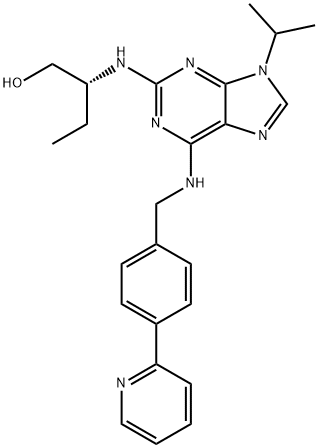
What is 2-(R)-(1-Ethyl-2-hydroxyethylamino)-6-(4-(2-pyridyl)benzyl)-9-isopropylpurinetrihydrochloride?
Description
CR8 (294646-77-8) is a second generation analog of roscovitine which inhibits cyclin-dependent kinases with increased potency, Cdk1/cyclin B, Cdk2/cyclin A, Cdk2/cyclin E, Cdk5, p25, and Cdk9/cyclin T, IC50s=0.09, 0.072, 0.041, 0.11 and 0.18 μM respectively.1,2 Acts as a molecular glue degrader that depletes cyclin K.3 CR8 displays neuroprotective effects in various models including traumatic brain injury.4
The Uses of 2-(R)-(1-Ethyl-2-hydroxyethylamino)-6-(4-(2-pyridyl)benzyl)-9-isopropylpurinetrihydrochloride
CR8, (R)-Isomer is a cell-permeable, ATP-binding pocket-targeting CDK/CK1 dual-specific inhibitor.
What are the applications of Application
(R)-CR8 is inhibits cyclin-dependent kinase (cdk) and casein kinase 1
What are the applications of Application
CR8, (R)-Isomer is a cell-permeable, ATP-binding pocket-targeting CDK/CK1 dual-specific inhibitor
Biochem/physiol Actions
CR8 is a potent and selective inhibitor of cyclin dependent kinase (CDK1, 2, 5, 7, and 9). CR8 is a more potent pyridyl analogue of roscovitine (Cat. No. R7772). In comparison to roscovirtine, the compound gains in potency toward CK1, which is involved in amyloid-β formation. The R-CR8 enantiomer is slightly more potent than S. CR8 is around 30 times more potent at cellular assay then roscovitine. Acts as a molecular glue to induce cyclin K degradation.
References
Bettayeb et al. (2008), C8, a potent and selective, roscovitine-derived inhibitor of cyclin-dependent kinases; Oncogene, 27 5797 Bettayeb et al. (2010), CDK Inhibitors Roscovitine and CR8 Trigger Mcl-1 Down-Regulation and Apoptotic Cell Death in Neuroblastoma Cells; Genes Cancer, 1 369 Slabiki et al. (2020), The CDK inhibitor CR8 acts as a molecular glue degrader that depletes cyclin K; Nature, 585 293 Aubrecht et al. (2018), Comparing effects of CDK inhibitor and E2F1/2 ablation on neuronal cell death pathways in vitro and after traumatic brain injury; Cell Death Dis., 9 112
Properties of 2-(R)-(1-Ethyl-2-hydroxyethylamino)-6-(4-(2-pyridyl)benzyl)-9-isopropylpurinetrihydrochloride
| Melting point: | 98-100℃ |
| Boiling point: | 671.4±65.0 °C(Predicted) |
| Density | 1.27±0.1 g/cm3(Predicted) |
| storage temp. | 2-8°C |
| solubility | DMSO: ≥10mg/mL |
| form | powder |
| pka | 14.56±0.10(Predicted) |
| color | off-white |
| Stability: | Stable for 2 years as supplied. Solutions in DMSO may be stored at -20°C for up to 1 month. |
Safety information for 2-(R)-(1-Ethyl-2-hydroxyethylamino)-6-(4-(2-pyridyl)benzyl)-9-isopropylpurinetrihydrochloride
| Signal word | Warning |
| Pictogram(s) |
 Exclamation Mark Irritant GHS07 |
| GHS Hazard Statements |
H302:Acute toxicity,oral H315:Skin corrosion/irritation H319:Serious eye damage/eye irritation H335:Specific target organ toxicity, single exposure;Respiratory tract irritation |
| Precautionary Statement Codes |
P261:Avoid breathing dust/fume/gas/mist/vapours/spray. P305+P351+P338:IF IN EYES: Rinse cautiously with water for several minutes. Remove contact lenses, if present and easy to do. Continuerinsing. |
Computed Descriptors for 2-(R)-(1-Ethyl-2-hydroxyethylamino)-6-(4-(2-pyridyl)benzyl)-9-isopropylpurinetrihydrochloride
New Products
DL-beta-(3-Bromophenyl)alanine Tetrabutylammonium perchlorate N,O-Dimethylhydroxylamine hydrochloride (RS)-beta-Amino-beta-(4-bromophenyl)propionic acid 2-Amino-5-bromo-4-(trifluoromethyl)pyridine(RM for Indian lab) N,N CARBONYL DIIMIDAZOLE Levothyroxine Impurity-F Montelukast EP Impurity-D/Montelukast USP Related Compound C Atorvastatin FXA Impurity/Atorvastatin Cyclic 6-Hydroxy Impurity Sodium Salt Isosulfan blue Keto N-Oxide Impurity Ivermectin Impurity F N-Nitroso des Methyl Tramadol/N-Nitroso-N-Desmethyl-Tramadol (R)-BoroLeu-(+)-Pinanediol-CF3COOH 1,4-bis(methylsulfonyl)butane 4-(5-amino-1-methyl-1h-benzoimidazol-2-yl)-butyric acid isopropyl ester. 5-Methyl-1,3-benzenediacetonitrile 4-Fluorothiophenol 1-methyl amino-2,4-dinitro benzene CSA (DL-10-Camphorsulfonic Acid) 2-Hydroxy-4-methylnicotinic acid 3-iodo-1H-pyrazolo[3,4-d]pyrimidin-4-amine (2S)-1-((2S,3S)-3-(2-methylbutyl)-4-oxooxetan-2-yl)pentadecan-2-yl formylleucinate 1-(3,5-dichlorophenyl)-2,2,2-trifluoroethane-1-sulfonyl chloride S-(1-(3,5-dichlorophenyl)-2,2,2-trifluoroethyl) ethanethioateRelated products of tetrahydrofuran


![3-[(Aminocarbonyl)amino]-5-(3-fluorophenyl)-N-(3S)-3-piperidinyl-2-Thiophenecarboxamide](https://img.chemicalbook.in/CAS/GIF/860352-01-8.gif)
You may like
-
 CR8 CAS 294646-77-8View Details
294646-77-8 -
674783-97-2 98+View Details
674783-97-2 -
H-D-TRP(FOR)-OH HCL 98+View Details
367453-01-8 -
DL-beta-(3-Bromophenyl)alanine 117391-50-1 98+View Details
117391-50-1 -
49830-37-7 98+View Details
49830-37-7 -
3-Amino-3-(4-fluorophenyl)propanoic acid 98+View Details
325-89-3 -
1428243-26-8 98+View Details
1428243-26-8 -
1-aminocyclopentane carbonitrile, HCl 98+View Details
16195-83-8