
2-(Phenyl)-4-(3-hydroxy-4-chlorophenyl)-5-(4-pyridyl)-1H-imidazole
Synonym(s):2-(Phenyl)-4-(3-hydroxy-4-chlorophenyl)-5-(4-pyridyl)-1H-imidazole, L 779450;2-Chloro-5-[2-phenyl-4-(4-pyridinyl)-1H-imidazol-5-yl]-phenol;L 779450;Raf Kinase Inhibitor IV - CAS 303727-31-3 - Calbiochem
- CAS NO.:303727-31-3
- Empirical Formula: C20H14ClN3O
- Molecular Weight: 347.8
- MDL number: MFCD12828750
- SAFETY DATA SHEET (SDS)
- Update Date: 2026-07-17 09:03:53
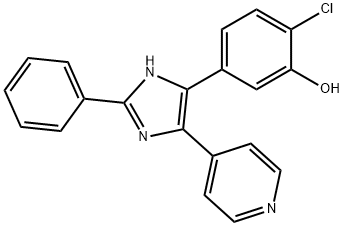
What is 2-(Phenyl)-4-(3-hydroxy-4-chlorophenyl)-5-(4-pyridyl)-1H-imidazole?
The Uses of 2-(Phenyl)-4-(3-hydroxy-4-chlorophenyl)-5-(4-pyridyl)-1H-imidazole
Raf kinase inhibitor, a potential treatment for neurotraumatic diseases. Its effects also suppress DNA synthesis and induce apoptosis in targeted cells, presenting new applications in treating certain types of cancers.
What are the applications of Application
L-779,450 is a potent, ATP-competitive Raf kinase inhibitor
Definition
ChEBI: 2-chloro-5-(2-phenyl-5-pyridin-4-yl-1H-imidazol-4-yl)phenol is a member of imidazoles.
Biological Activity
Potent, ATP-competitive Raf kinase inhibitor (IC 50 = 10 nM) that displays > 7, > 30 and > 70-fold selectivity over p38 α , GSK3 β and Lck respectively. Suppresses DNA synthesis and induces apoptosis in cells that proliferate in response to Raf-1 and A-Raf but not B-Raf.
Properties of 2-(Phenyl)-4-(3-hydroxy-4-chlorophenyl)-5-(4-pyridyl)-1H-imidazole
| Boiling point: | 579.8±50.0 °C(Predicted) |
| Density | 1.335±0.06 g/cm3(Predicted) |
| storage temp. | Sealed in dry,2-8°C |
| solubility | DMSO:44.67(Max Conc. mg/mL);128.44(Max Conc. mM) DMF:30.0(Max Conc. mg/mL);86.26(Max Conc. mM) DMF:PBS (pH 7.2) (1:7):0.12(Max Conc. mg/mL);0.35(Max Conc. mM) Ethanol:2.0(Max Conc. mg/mL);5.75(Max Conc. mM) |
| form | Powder |
| pka | 8.09±0.10(Predicted) |
| color | Light yellow to yellow |
Safety information for 2-(Phenyl)-4-(3-hydroxy-4-chlorophenyl)-5-(4-pyridyl)-1H-imidazole
| Signal word | Danger |
| Pictogram(s) |
 Skull and Crossbones Acute Toxicity GHS06 |
| GHS Hazard Statements |
H301:Acute toxicity,oral H315:Skin corrosion/irritation H319:Serious eye damage/eye irritation H335:Specific target organ toxicity, single exposure;Respiratory tract irritation |
| Precautionary Statement Codes |
P280:Wear protective gloves/protective clothing/eye protection/face protection. P305+P351+P338:IF IN EYES: Rinse cautiously with water for several minutes. Remove contact lenses, if present and easy to do. Continuerinsing. P337+P313:IF eye irritation persists: Get medical advice/attention. |
Computed Descriptors for 2-(Phenyl)-4-(3-hydroxy-4-chlorophenyl)-5-(4-pyridyl)-1H-imidazole
New Products
2-Bromo-4-hydroxypyridine Dibenzoyl-L-tartaric acid Anhydrous (Resolution Reagent) Dibenzo[b,f][1,4]thiazepin-11(10H)-one 1,2,3,9-Tetrahydro-9-Methyl-4H-Carbazole-4-One Cis-Tosylate 1-(4-methoxyphenyl)-4-(4-Nitrophenyl)Piperazine (IT-1) 1-aminocyclobutanecarbonitrile hydrochloride AMINO-O-TOLYL-ACETIC ACID 1-Aminocyclobutanecarboxylic Acid Hydrochloride AMINO(2-BROMOPHENYL)ACETIC ACID 6-BROMOTETRAZOLO[1,5-A]PYRIDINE 3-Oxocyclobutanecarboxylic acid METHANOL-D1(OD) TERTIARY BUTANOL-D9 N-ETHYL-D5-AMINE HYDROCHLORIDE BENZOIC ACID-D CHLOROFORM-D TOLUENE-D3 2-(2-Bromophenyl)ethanol Boc-D-Glu(OMe)-OMe 2,5 Dibromopyridine Ethyl 4-hydroxy-3-oxobutanoate Dimethyl (2S)-2-((tert-butoxycarbonyl)amino)-4-(cyanomethyl)pentanedioate 1-(3-Chlorophenyl)piperazine hydrochlorideRelated products of tetrahydrofuran

You may like
-
 Raf Kinase Inhibitor IV CAS 303727-31-3View Details
303727-31-3 -
254762-66-8 AMINO(2-BROMOPHENYL)ACETIC ACID 98+View Details
254762-66-8 -
254762-66-8 AMINO(2-BROMOPHENYL)ACETIC ACID 98+View Details
254762-66-8 -
23716-23-1 98+View Details
23716-23-1 -
6-BROMOTETRAZOLO[1,5-A]PYRIDINE 98+View Details
5799-75-7 -
254762-66-8 AMINO(2-BROMOPHENYL)ACETIC ACID 98+View Details
254762-66-8 -
23716-23-1 98+View Details
23716-23-1 -
6-BROMOTETRAZOLO[1,5-A]PYRIDINE 98+View Details
5799-75-7
Statement: All products displayed on this website are only used for non medical purposes such as industrial applications or scientific research, and cannot be used for clinical diagnosis or treatment of humans or animals. They are not medicinal or edible.