
2-Methylglutaronitrile
- CAS NO.:4553-62-2
- Empirical Formula: C6H8N2
- Molecular Weight: 108.14
- MDL number: MFCD00001875
- EINECS: 224-923-5
- SAFETY DATA SHEET (SDS)
- Update Date: 2026-09-12 18:53:30
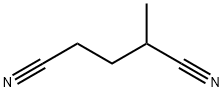
What is 2-Methylglutaronitrile?
The Uses of 2-Methylglutaronitrile
2-Methylglutaronitrile (MGN) may be used in the synthesis of 1,5-dimethyl-2-piperidone (1,5-DMPD) by chemoenzymatic process.
What are the applications of Application
2-Methylglutaronitrile is An intermediate chemical
General Description
Amber liquid.
Air & Water Reactions
Water soluble.
Reactivity Profile
Nitriles, such as 2-METHYLGLUTARONITRILE, may polymerize in the presence of metals and some metal compounds. They are incompatible with acids; mixing nitriles with strong oxidizing acids can lead to extremely violent reactions. Nitriles are generally incompatible with other oxidizing agents such as peroxides and epoxides. The combination of bases and nitriles can produce hydrogen cyanide. Nitriles are hydrolyzed in both aqueous acid and base to give carboxylic acids (or salts of carboxylic acids). These reactions generate heat. Peroxides convert nitriles to amides. Nitriles can react vigorously with reducing agents. Acetonitrile and propionitrile are soluble in water, but nitriles higher than propionitrile have low aqueous solubility. They are also insoluble in aqueous acids.
Health Hazard
ACUTE/CHRONIC HAZARDS: 2-METHYLGLUTARONITRILE is readily absorbed through the skin.
Fire Hazard
2-METHYLGLUTARONITRILE is combustible.
Properties of 2-Methylglutaronitrile
| Melting point: | −45 °C(lit.) |
| Boiling point: | 269-271 °C(lit.) |
| Density | 0.95 g/mL at 25 °C(lit.) |
| vapor pressure | 1.9Pa at 20℃ |
| refractive index | n |
| Flash point: | >230 °F |
| storage temp. | Store at +2°C to +8°C. |
| solubility | water: soluble |
| form | clear liquid |
| color | Colorless to Light yellow to Light orange |
| explosive limit | 0.3-3.25%(V) |
| Water Solubility | 52.3g/L at 20℃ |
| BRN | 1741955 |
| CAS DataBase Reference | 4553-62-2(CAS DataBase Reference) |
| EPA Substance Registry System | 2-Methylglutaronitrile (4553-62-2) |
Safety information for 2-Methylglutaronitrile
| Signal word | Danger |
| Pictogram(s) |
 Skull and Crossbones Acute Toxicity GHS06 |
| GHS Hazard Statements |
H330:Acute toxicity,inhalation |
| Precautionary Statement Codes |
P280:Wear protective gloves/protective clothing/eye protection/face protection. |
Computed Descriptors for 2-Methylglutaronitrile
| InChIKey | FPPLREPCQJZDAQ-UHFFFAOYSA-N |
New Products
5-bromo-4-fluoro-2-nitrobenzaldehyde (R)-(-)-2-Amino-1-propanol Cyclobutanone Fmoc-OSu 1-(2-Chloroethyl)pyrrolidine Hydrochloride 2-Amino-2-(4-methylphenyl)acetic acid β-Bromostyrene Ethyl 3-phenylpropanoate Phenethyl cinnamate Dipropyl disulfide 4 pentyn 1 ol N-Vinylformamide Methacrylate-PEG-Methacrylate, Mn:35000 2,4-Dihydroxyacetophenone 2-Chloro 5-Fluoro Pyridine Vasicinone 2-Chloroisonicotinic Acid Tween 80 or Polysorbate 80 2-Butyn-1-oL 2-Pentyn-1-oL 4-Nitrobenzotrifluoride N-(4-fluoro-2-methoxy-5-nitrophenyl)-4-(1-methyl-1H-indol-3-yl)pyrimidin-2-amine Pirtobrutinib intd. N-(4-Cyano-3-(trifluoromethyl)phenyl)-2-methyloxirane-2-carboxamideRelated products of tetrahydrofuran




You may like
-
 2-Methylglutaronitrile CAS 4553-62-2View Details
4553-62-2 -
2-Methylglutaronitrile CAS 4553-62-2View Details
4553-62-2 -
7250-67-1 1-(2-Chloroethyl)pyrrolidine Hydrochloride 98+View Details
7250-67-1 -
13227-01-5 98+View Details
13227-01-5 -
7250-67-1 1-(2-Chloroethyl)pyrrolidine Hydrochloride 98+View Details
7250-67-1 -
13227-01-5 98+View Details
13227-01-5 -
7250-67-1 1-(2-Chloroethyl)pyrrolidine Hydrochloride 98+View Details
7250-67-1 -
13227-01-5 98+View Details
13227-01-5