
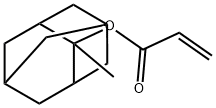
2-Methacryloyloxy-2-methyladamantane
- CAS NO.:177080-67-0
- Empirical Formula: C15H22O2
- Molecular Weight: 234.33
- MDL number: MFCD04114354
- SAFETY DATA SHEET (SDS)
- Update Date: 2026-05-28 01:01:43
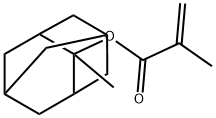
What is 2-Methacryloyloxy-2-methyladamantane?
Description
2-Methyl-2-adamantylmethacrylate is an aliphatic hydrocarbon with a trifluoromethyl group. It is a monomer that can be used to make polymers. 2-Methyl-2-adamantylmethacrylate has been shown to polymerize rapidly and form high molecular weight polymers. It reacts with hydroxyl groups to form ester linkages. This molecule also has the ability to self assemble, making it a supramolecular material. Impurities may affect the polymerization kinetics of this molecule and must be removed before use. As this compound is hydrophobic, it can only be patterned using a sublimable process.
Chemical properties
Off-white powder.
The Uses of 2-Methacryloyloxy-2-methyladamantane
2-Methyl-2-adamantylmethacrylate can be used to prepare Analog Semiconductors, Light-Emitting Diodes LED, Solar Photovoltaics PV.
General Description
Three different methacrylic monomers (g-butyrolactone methacrylate (GBLMA), 3-hydroxyl-1-adamantyl methacrylate (HAMA), and 2-methyl-2- adamantyl methacrylate (MAMA)) are the most often terpolymerized for 193 nm photoresists. The lactone group of GBLMA plays a vital role in the etching rate, facilitating binding to the substrate. The hydroxyl group of HAMA aids in the solubility and stability of the polymer. MAMA is particularly sensitive to 193 nm light and improves the etching resolution (chemical amplification)[1].
Synthesis
The synthesis of 2-Methyl-2-adamantylmethacrylate is as follows:Add 3546ml of n-heptane in the 5L four-necked flask equipped with stirring paddle, condenser tube and thermometer, turn on stirring, add 126.3g of 2-methyladamantanol to the system, and slowly add 0.022g polymerization inhibitor tetrachlorobenzoquinone to the reaction, add 110.8g basic ion exchange resin, adjust pH=7-8, cool down to -13°C, slowly add 110.8g vinyl methacrylate dropwise to the reaction system, keep the reaction for 7h, monitor the reaction progress, and take samples for detection After the reaction was completed, 1000 ml of water was added to the reaction system, and the mixture was stirred and extracted for phase separation. The organic phase was dried, concentrated under reduced pressure and evaporated to dryness to obtain 167 g of 2-methyl-2-adamantyl methacrylate product with a yield of 93.78%.

References
[1] M. Maríc. “Nitroxide‐mediated polymerization of adamantyl‐functional methacrylates for 193 nm photoresists.” Canadian Journal of Chemical Engineering 95 1 (2017): 708–716.
Properties of 2-Methacryloyloxy-2-methyladamantane
| Boiling point: | 301.3±11.0 °C(Predicted) |
| Density | 1.06±0.1 g/cm3(Predicted) |
| refractive index | 1.5050 to 1.5090 |
| Flash point: | 120°C(lit.) |
| storage temp. | 2-8°C |
| form | clear liquid |
| color | Colorless to Almost colorless |
| InChI | InChI=1S/C15H22O2/c1-9(2)14(16)17-15(3)12-5-10-4-11(7-12)8-13(15)6-10/h10-13H,1,4-8H2,2-3H3 |
Safety information for 2-Methacryloyloxy-2-methyladamantane
| Signal word | Warning |
| Pictogram(s) |
 Exclamation Mark Irritant GHS07 |
| GHS Hazard Statements |
H315:Skin corrosion/irritation H319:Serious eye damage/eye irritation |
| Precautionary Statement Codes |
P305+P351+P338:IF IN EYES: Rinse cautiously with water for several minutes. Remove contact lenses, if present and easy to do. Continuerinsing. |
Computed Descriptors for 2-Methacryloyloxy-2-methyladamantane
| InChIKey | FDYDISGSYGFRJM-UHFFFAOYSA-N |
| SMILES | C(OC1(C)C2CC3CC1CC(C3)C2)(=O)C(C)=C |
New Products
N-Carbethoxy-4-piperidone 1-Aminocyclopentane carbonitrile Tetrabutylammonium perchlorate N,O-Dimethylhydroxylamine hydrochloride (RS)-beta-Amino-beta-(4-bromophenyl)propionic acid 2-Amino-5-bromo-4-(trifluoromethyl)pyridine N-Vinylformamide 4 pentyn 1 ol Phenethyl cinnamate Pyrrolo[1,2-a]pyrimidine-6-carboxylic acid, 4,6,7,8-tetrahydro-4-oxo-, sodium salt (1:1), (6S) Ethyl 3-phenylpropanoate β-Bromostyrene Methacrylate-PEG-Methacrylate, Mn:35000 2,4-Dihydroxyacetophenone 2-Chloro 5-Fluoro Pyridine Vasicinone 2-Chloroisonicotinic Acid Tween 80 or Polysorbate 80 5-Bromo-1-Pentyne 1-(2-Methyl-5-nitrophenyl)guanidine Nitrate Methyl trans-4-Aminocyclohexanecarboxylate Hydrochloride 2-Pentyn-1-oL 4-Nitrobenzotrifluoride N-(4-Cyano-3-(trifluoromethyl)phenyl)-2-methyloxirane-2-carboxamideRelated products of tetrahydrofuran

You may like
-
 2-Methacryloyloxy-2-methyladamantane (stabilized with MEHQ) CAS 177080-67-0View Details
177080-67-0 -
144-83-2 Sulfapyridine 98+View Details
144-83-2 -
29976-53-2 98+View Details
29976-53-2 -
(RS)-beta-Amino-beta-(4-bromophenyl)propionic acid 39773-47-2 98+View Details
39773-47-2 -
6638-79-5 N,O-Dimethylhydroxylamine hydrochloride 98+View Details
6638-79-5 -
674783-97-2 98+View Details
674783-97-2 -
1-Aminocyclopentane carbonitrile 98+View Details
49830-37-7 -
Tetrabutylammonium perchlorate 1923-70-2 98+View Details
1923-70-2