
2-Methyl-1-pentene
- CAS NO.:763-29-1
- Empirical Formula: C6H12
- Molecular Weight: 84.16
- MDL number: MFCD00009405
- EINECS: 212-108-7
- SAFETY DATA SHEET (SDS)
- Update Date: 2026-05-28 05:21:48
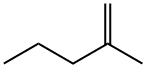
What is 2-Methyl-1-pentene?
Chemical properties
CLEAR COLOURLESS LIQUID
Physical properties
Clear, colorless flammable liquid with an unpleasant hydrocarbon odor.
The Uses of 2-Methyl-1-pentene
2-Methyl-1-pentene is prepared from 2-Methyl-1-pentene. 2-methyl-1-pentene is used in copolymerization of ethylene catalyzed by nonbridged half-titanocenes. The isomerization of 2-methyl-1-pentene leads to anionic activation of c-h bonds in olefins.
The Uses of 2-Methyl-1-pentene
Organic synthesis, flavors, perfumes,medicines, dyes, oils, resins.
Definition
ChEBI: 2-methyl-1-pentene is an alkene that is pent-1-ene carrying a methyl group at position 2. It has a role as a human metabolite. It is an alkene and a volatile organic compound. It derives from a hydride of a pentane.
General Description
Colorless liquid. Flash point -15°F. Floats on water. Irritating vapor.
Air & Water Reactions
Highly flammable. Insoluble in water.
Reactivity Profile
2-Methyl-1-pentene may react vigorously with strong oxidizing agents. May react exothermically with reducing agents to release hydrogen gas. In the presence of various catalysts (such as acids) or initiators, may undergo exothermic addition polymerization reactions.
Hazard
Flammable, dangerous fire risk.
Health Hazard
INHALATION: May produce anesthetic effects. EYES: Moderate eye irritation possible.
Fire Hazard
Behavior in Fire: Can react vigorously with oxidizing materials.
Source
California Phase II reformulated gasoline contained 2-methyl-1-pentene at a concentration of 1.25 g/kg. Gas-phase tailpipe emission rates from gasoline-powered automobiles with and without catalytic converters were 0.23 and 26.6 mg/km, respectively (Schauer et al., 2002).
Environmental Fate
Photolytic. The reported reaction rate constants for the reaction of 2-methyl-1-pentene with OH
radicals and ozone in the atmosphere are 1.05 x 10⁻¹⁷ and 6.26 x 10⁻¹¹ cm3/molecule?sec,
respectively (Atkinson and Carter, 1984; Atkinson, 1985).
Chemical/Physical. Complete combustion in air yields carbon dioxide and water.
Purification Methods
Water is removed, and formation of peroxides is prevented by several vacuum distillations of 2-methyl-1-pentene from sodium. It is stored with sodium-potassium alloy. [Beilstein 1 IV 841.]
Properties of 2-Methyl-1-pentene
| Melting point: | -136 °C |
| Boiling point: | 62 °C(lit.) |
| Density | 0.682 g/mL at 25 °C(lit.) |
| vapor pressure | 325 mm Hg ( 37.7 °C) |
| refractive index | n |
| Flash point: | −15 °F |
| storage temp. | 0-6°C |
| solubility | Soluble in alcohol, benzene, chloroform, petroleum (Weast, 1986); miscible in pentane,
cyclohexene, and other hydrocarbons. |
| form | Liquid |
| color | Clear colorless |
| Water Solubility | Insoluble in water. |
| BRN | 1340499 |
| Henry's Law Constant | 0.28 atm?m3/mol at 25 °C (Mackay and Shiu, 1981) |
| CAS DataBase Reference | 763-29-1(CAS DataBase Reference) |
| EPA Substance Registry System | 2-Methyl-1-pentene (763-29-1) |
Safety information for 2-Methyl-1-pentene
| Signal word | Danger |
| Pictogram(s) |
 Flame Flammables GHS02 |
| GHS Hazard Statements |
H225:Flammable liquids |
| Precautionary Statement Codes |
P210:Keep away from heat/sparks/open flames/hot surfaces. — No smoking. P233:Keep container tightly closed. P240:Ground/bond container and receiving equipment. P241:Use explosion-proof electrical/ventilating/lighting/…/equipment. P242:Use only non-sparking tools. P243:Take precautionary measures against static discharge. |
Computed Descriptors for 2-Methyl-1-pentene
New Products
1-(4-methoxyphenyl)-4-(4-Nitrophenyl)Piperazine (IT-1) 1,2,3,9-Tetrahydro-9-Methyl-4H-Carbazole-4-One Dibenzo[b,f][1,4]thiazepin-11(10H)-one Cis-Tosylate Dibenzoyl-L-tartaric acid Anhydrous (Resolution Reagent) 1-Benzhydrylazetane-3-carbonitrile 8-oxa-1,3-diazaspiro[4.5]decane-2,4-dione (±)-amino(2-fluorophenyl)acetic acid 2-(2-Chlorophenyl)glycine AMINO-(3-CHLORO-PHENYL)-ACETIC ACID 2'-Fluoroacetophenone METHANOL-D1(OD) N-ETHYL-D5-AMINE HYDROCHLORIDE BENZOIC ACID-D CHLOROFORM-D BENZENE-D6 TOLUENE-D3 2-Hydroxybutanenitrile 1-Benzylindolin-2-one Ethyl 2-bromo-3-oxobutanoate 4-(3-chloropropyl)morpholine 1-Benzylindoline-2,3-dione 3-Oxocyclobutanecarboxylic acid 1-(3-Chlorophenyl)piperazine hydrochlorideRelated products of tetrahydrofuran
You may like
-
 2-Methyl-1-pentene CAS 763-29-1View Details
763-29-1 -
2-Methyl-1-pentene CAS 763-29-1View Details
763-29-1 -
5-Bromo-2-chloro- benzoic acid 21739-92-4 98%View Details
21739-92-4 -
Guar Hydroxypropyltrimonium Chloride 98%View Details
65497-29-2 -
52092-43-0 2-Bromo-4-nitropyridine-N-oxide 98%View Details
52092-43-0 -
2,4,6-Trichloro-5-nitropyrimidine 98%View Details
4359-87-9 -
1-Methylpiperidine-4-thiol 1072-99-7 98%View Details
1072-99-7 -
68886-07-7 98%View Details
68886-07-7