
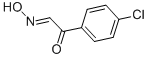
2-Isonitrosoacetophenone
Synonym(s):ω-(Hydroxyimino)acetophenone;ω-Isonitrosoacetophenone;Phenylglyoxaldoxime
- CAS NO.:532-54-7
- Empirical Formula: C8H7NO2
- Molecular Weight: 149.15
- MDL number: MFCD00002122
- EINECS: 208-539-5
- SAFETY DATA SHEET (SDS)
- Update Date: 2026-05-28 03:35:32
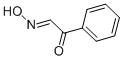
What is 2-Isonitrosoacetophenone?
Chemical properties
beige to yellowish crystalline powder
The Uses of 2-Isonitrosoacetophenone
2-Isonitrosoacetophenone is used to make a complex with copper and amino acids. These complexes has shown to have more antimicrobial activities against gram positive bacteria than gram negative bacteria and the complexes also have antioxidant activity.
The Uses of 2-Isonitrosoacetophenone
As a reagent for the detection of ferrous ions with which it gives a blue color soluble in chloroform.
Synthesis Reference(s)
The Journal of Organic Chemistry, 39, p. 2558, 1974 DOI: 10.1021/jo00931a022
Purification Methods
Crystallise it from water. [Beilstein 7 IV 2132.]
Properties of 2-Isonitrosoacetophenone
| Melting point: | 126-128 °C (lit.) |
| Boiling point: | 270.21°C (rough estimate) |
| Density | 1.2517 (rough estimate) |
| refractive index | 1.5320 (estimate) |
| storage temp. | 2-8°C |
| form | powder to crystal |
| pka | 8.49±0.10(Predicted) |
| color | White to Light yellow to Light orange |
| Water Solubility | SOLUBLE IN COLD WATER |
| Merck | 14,5191 |
| BRN | 2041691 |
| CAS DataBase Reference | 532-54-7(CAS DataBase Reference) |
| EPA Substance Registry System | Isonitrosoacetophenone (532-54-7) |
Safety information for 2-Isonitrosoacetophenone
| Signal word | Warning |
| Pictogram(s) |
 Exclamation Mark Irritant GHS07 |
| GHS Hazard Statements |
H302:Acute toxicity,oral |
| Precautionary Statement Codes |
P264:Wash hands thoroughly after handling. P264:Wash skin thouroughly after handling. P270:Do not eat, drink or smoke when using this product. P330:Rinse mouth. |
Computed Descriptors for 2-Isonitrosoacetophenone
New Products
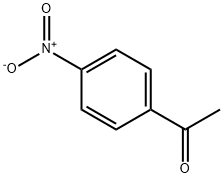
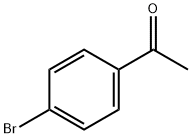
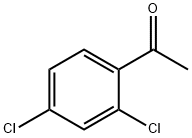
N-Carbethoxy-4-piperidone 1-Aminocyclopentane carbonitrile Tetrabutylammonium perchlorate N,O-Dimethylhydroxylamine hydrochloride (RS)-beta-Amino-beta-(4-bromophenyl)propionic acid 2-Amino-5-bromo-4-(trifluoromethyl)pyridine N-Vinylformamide 4 pentyn 1 ol Phenethyl cinnamate Dipropyl disulfide Ethyl 3-phenylpropanoate β-Bromostyrene Methacrylate-PEG-Methacrylate, Mn:35000 2,4-Dihydroxyacetophenone 2-Chloro 5-Fluoro Pyridine Vasicinone 2-Chloroisonicotinic Acid Tween 80 or Polysorbate 80 5-Bromo-1-Pentyne 1-(2-Methyl-5-nitrophenyl)guanidine Nitrate Methyl trans-4-Aminocyclohexanecarboxylate Hydrochloride N-(4-Cyano-3-(trifluoromethyl)phenyl)-2-methyloxirane-2-carboxamide 2-Pentyn-1-oL 4-NitrobenzotrifluorideRelated products of tetrahydrofuran


![2-[[(ETHOXYCARBONYL)OXY]IMINO]-1,2-DIPHENYLETHAN-1-ONE](https://img.chemicalbook.in/CAS/GIF/71066-97-2.gif)
You may like
-
 Isonitrosoacetophenone CAS 532-54-7View Details
532-54-7 -
Isonitrosoacetophenone 95% CAS 532-54-7View Details
532-54-7 -
144-83-2 Sulfapyridine 98+View Details
144-83-2 -
29976-53-2 98+View Details
29976-53-2 -
6638-79-5 N,O-Dimethylhydroxylamine hydrochloride 98+View Details
6638-79-5 -
674783-97-2 98+View Details
674783-97-2 -
1-Aminocyclopentane carbonitrile 98+View Details
49830-37-7 -
Tetrabutylammonium perchlorate 1923-70-2 98+View Details
1923-70-2
Statement: All products displayed on this website are only used for non medical purposes such as industrial applications or scientific research, and cannot be used for clinical diagnosis or treatment of humans or animals. They are not medicinal or edible.