
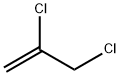
2-Chloropropene
Synonym(s):2-Chloro-1-propene;Isopropenyl chloride
- CAS NO.:557-98-2
- Empirical Formula: C3H5Cl
- Molecular Weight: 76.52
- MDL number: MFCD00000859
- EINECS: 209-187-5
- SAFETY DATA SHEET (SDS)
- Update Date: 2026-05-28 05:20:46
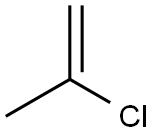
What is 2-Chloropropene?
Chemical properties
CLEAR COLOURLESS LIQUID
The Uses of 2-Chloropropene
2-Chloropropene is used in measurement of photoionization cross sections of allyl and 2-propenyl radicals to form C3H5+ by tunable vacuum ultraviolet synchrotron radiation coupled with photofragment translational spectroscopy.
Preparation
1,2-Propadiene adds hydrogen chloride to yield 2-chloropropene. One early synthesis involves dehydrohalogenation of 1,2-dichloropropane with potassium hydroxide.
General Description
2-chloropropene appears as a clear colorless volatile liquid. Less dense than water and insoluble in water. Vapors heavier than air.
Air & Water Reactions
Highly flammable. Insoluble in water.
Reactivity Profile
Halogenated aliphatic compounds, such as 2-Chloropropene, are moderately or very reactive. Reactivity generally decreases with increased degree of substitution of halogen for hydrogen atoms. Low molecular weight haloalkanes are highly flammable and can react with some metals to form dangerous products. Low molecular weight haloalkenes are highly flammable, peroxidizable and may polymerize violently. They may react violently with aluminum. Materials in this group are incompatible with strong oxidizing and reducing agents. Also, they are incompatible with many amines, nitrides, azo/diazo compounds, alkali metals, and epoxides.
Health Hazard
May cause toxic effects if inhaled or absorbed through skin. Inhalation or contact with material may irritate or burn skin and eyes. Fire will produce irritating, corrosive and/or toxic gases. Vapors may cause dizziness or suffocation. Runoff from fire control or dilution water may cause pollution.
Fire Hazard
HIGHLY FLAMMABLE: Will be easily ignited by heat, sparks or flames. Vapors may form explosive mixtures with air. Vapors may travel to source of ignition and flash back. Most vapors are heavier than air. They will spread along ground and collect in low or confined areas (sewers, basements, tanks). Vapor explosion hazard indoors, outdoors or in sewers. May polymerize explosively when heated or involved in a fire. Runoff to sewer may create fire or explosion hazard. Containers may explode when heated. Many liquids are lighter than water.
Safety Profile
Mildly toxic by inhalation. Mutation data reported. Very dangerous fire hazard when exposed to heat, flame, sparks, or powerful oxidizers. To fight fire, use water, spray, mist, fog, dry chemical, alcohol foam. When heated to decomposition it emits toxic fumes of Cl-. See also CHLORIDES.
Properties of 2-Chloropropene
| Melting point: | -138 °C |
| Boiling point: | 23 °C |
| Density | 0.91 |
| refractive index | n |
| Flash point: | -20°C |
| storage temp. | 2-8°C |
| form | clear liquid |
| color | Colorless to Almost colorless |
| Water Solubility | Not miscible or difficult to mix in water. |
| BRN | 1361376 |
| InChI | InChI=1S/C3H5Cl/c1-3(2)4/h1H2,2H3 |
| CAS DataBase Reference | 557-98-2(CAS DataBase Reference) |
| EPA Substance Registry System | 2-Chloropropene (557-98-2) |
Safety information for 2-Chloropropene
| Signal word | Danger |
| Pictogram(s) |
 Flame Flammables GHS02  Exclamation Mark Irritant GHS07 |
| GHS Hazard Statements |
H224:Flammable liquids H319:Serious eye damage/eye irritation H335:Specific target organ toxicity, single exposure;Respiratory tract irritation |
| Precautionary Statement Codes |
P210:Keep away from heat/sparks/open flames/hot surfaces. — No smoking. P305+P351+P338:IF IN EYES: Rinse cautiously with water for several minutes. Remove contact lenses, if present and easy to do. Continuerinsing. P403+P233:Store in a well-ventilated place. Keep container tightly closed. |
Computed Descriptors for 2-Chloropropene
| InChIKey | PNLQPWWBHXMFCA-UHFFFAOYSA-N |
| SMILES | C=C(Cl)C |
New Products
2-Amino-5-bromo-4-(trifluoromethyl)pyridine Sulfapyridine Fmoc-OSu (R)-(-)-2-Amino-1-propanol Cyclobutanone 5-bromo-4-fluoro-2-nitrobenzaldehyde β-Bromostyrene Ethyl 3-phenylpropanoate Phenethyl cinnamate Dipropyl disulfide N-Vinylformamide 4 pentyn 1 ol Methacrylate-PEG-Methacrylate, Mn:35000 2,4-Dihydroxyacetophenone 2-Chloro 5-Fluoro Pyridine Vasicinone 2-Chloroisonicotinic Acid Tween 80 or Polysorbate 80 2-Butyn-1-oL 2-Pentyn-1-oL 4-Nitrobenzotrifluoride N-(4-fluoro-2-methoxy-5-nitrophenyl)-4-(1-methyl-1H-indol-3-yl)pyrimidin-2-amine Pirtobrutinib intd. N-(4-Cyano-3-(trifluoromethyl)phenyl)-2-methyloxirane-2-carboxamideRelated products of tetrahydrofuran
You may like
-
 2-Chloropropene CAS 557-98-2View Details
557-98-2 -
2-Chloro-1-propene CAS 557-98-2View Details
557-98-2 -
Fmoc-OSu 98+View Details
82911-69-1 -
(R)-(-)-2-Amino-1-propanol 35320-23-1 98+View Details
35320-23-1 -
1191-95-3 Cyclobutanone 98+View Details
1191-95-3 -
213382-45-7 98+View Details
213382-45-7 -
Fmoc-OSu 98+View Details
82911-69-1 -
(R)-(-)-2-Amino-1-propanol 35320-23-1 98+View Details
35320-23-1