
2-Chlorobenzyl alcohol
- CAS NO.:17849-38-6
- Empirical Formula: C7H7ClO
- Molecular Weight: 142.58
- MDL number: MFCD00004604
- EINECS: 241-801-7
- SAFETY DATA SHEET (SDS)
- Update Date: 2026-05-27 22:42:59
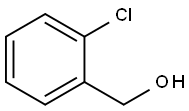
What is 2-Chlorobenzyl alcohol?
Chemical properties
white fine crystalline powder
The Uses of 2-Chlorobenzyl alcohol
(2-Chlorophenyl)methanol is used as a reactant in the preparation of aldehydes and ketones using transition metal free aerobic oxidation and catalyzed by TEMPO/Br2/NaNO2.
Synthesis Reference(s)
Journal of the American Chemical Society, 69, p. 2548, 1947 DOI: 10.1021/ja01202a082
Synthetic Communications, 25, p. 1689, 1995 DOI: 10.1080/00397919508015853
General Description
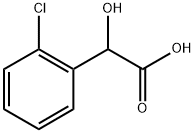
Major urinary metabolites of 2-chlorobenzyl alcohol in rats were 2-chlorohippuric acid, 2-chlorobenzyl cysteine, 2-chlorobenzoic acid and 2-chlorobenzyl glucuronic acid. It is a possible intermediate formed during the metabolism of 2-chloromandelic acid.
Properties of 2-Chlorobenzyl alcohol
| Melting point: | 69-71 °C (lit.) |
| Boiling point: | 227 °C (lit.) |
| Density | 1.1104 (rough estimate) |
| refractive index | 1.5390 (estimate) |
| Flash point: | 227°C |
| storage temp. | Sealed in dry,Room Temperature |
| solubility | chloroform: soluble25mg/mL, clear, colorless |
| form | Fine Crystalline Powder |
| pka | 13.99±0.10(Predicted) |
| color | White |
| BRN | 2042182 |
| CAS DataBase Reference | 17849-38-6(CAS DataBase Reference) |
| NIST Chemistry Reference | Benzenemethanol, 2-chloro-(17849-38-6) |
| EPA Substance Registry System | 2-Chlorobenzenemethanol (17849-38-6) |
Safety information for 2-Chlorobenzyl alcohol
| Signal word | Warning |
| Pictogram(s) |
 Exclamation Mark Irritant GHS07 |
| GHS Hazard Statements |
H315:Skin corrosion/irritation H319:Serious eye damage/eye irritation H335:Specific target organ toxicity, single exposure;Respiratory tract irritation |
| Precautionary Statement Codes |
P261:Avoid breathing dust/fume/gas/mist/vapours/spray. P305+P351+P338:IF IN EYES: Rinse cautiously with water for several minutes. Remove contact lenses, if present and easy to do. Continuerinsing. |
Computed Descriptors for 2-Chlorobenzyl alcohol
2-Chlorobenzyl alcohol manufacturer
ASM Organics
Andhra Pradesh
Phone:91-9866122393
Whatsapp: 91-9866122393
product: 2-Chlorobenzyl alcohol
New Products
2-(2-Chlorophenyl)glycine Propiolic Acid 1-(3-Hydroxy-4-methoxyphenyl)-2-nitroethene (±)-amino(2-fluorophenyl)acetic acid trans-3-Benzyloxy-4-methoxy-beta-nitrostyrene 1-Pentadecanol 4-(4-Αminophenyl)-3-Morpholinone 3-Morpholino-1-(4-(2-oxopiperidin-1-yl) phenyl)-5,6-dihyropyridin-2-(1H)-one 1-(4-Aminophenyl)-3-morpholino-5,6-dihydropyridin-2(1H)-one N-cyanoacetylurethane 1H-IndazoleRelated products of tetrahydrofuran
You may like
-
 17849-38-6 99%View Details
17849-38-6 -
2-Chlorobenzyl Alcohol CAS 17849-38-6View Details
17849-38-6 -
2-Chlorobenzyl alcohol, 99% CAS 17849-38-6View Details
17849-38-6 -
471-25-0 Propiolic Acid 98+View Details
471-25-0 -
84145-28-8 98+View Details
84145-28-8 -
2-(2-Chlorophenyl)glycine 88744-36-9 98+View Details
88744-36-9 -
40216-83-9 trans-4-Hydroxy-L-proline methyl ester hydrochloride 98+View Details
40216-83-9 -
1-(3-Hydroxy-4-methoxyphenyl)-2-nitroethene 98+View Details
39816-35-8
Statement: All products displayed on this website are only used for non medical purposes such as industrial applications or scientific research, and cannot be used for clinical diagnosis or treatment of humans or animals. They are not medicinal or edible.