
2-Chloroanthraquinone
- CAS NO.:131-09-9
- Empirical Formula: C14H7ClO2
- Molecular Weight: 242.66
- MDL number: MFCD00001227
- EINECS: 205-010-0
- SAFETY DATA SHEET (SDS)
- Update Date: 2026-05-28 06:32:21
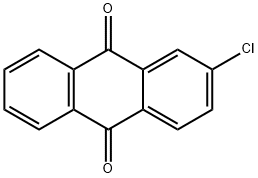
What is 2-Chloroanthraquinone?
Chemical properties
Pale yellow needle crystal. Insoluble in water, soluble in hot benzene, nitrobenzene, concentrated sulfuric acid.
The Uses of 2-Chloroanthraquinone
2-Chloroanthraquinone is an important dye intermediate that can be used to make alizarin and aminoanthraquinone. This product has been evaluated as a photo-reagent for the analysis of ginsenosides using photoreduction fluorescence (PRF) detection method.
Preparation
2-Chloroanthraquinone is prepared by condensing phthalic anhydride and chlorobenzene into p-chlorobenzoylbenzoic acid, and then cyclizing it with sulfuric acid.
Synthesis Reference(s)
Tetrahedron Letters, 24, p. 5499, 1983 DOI: 10.1016/S0040-4039(00)94122-4
Properties of 2-Chloroanthraquinone
| Melting point: | 209-211 °C (lit.) |
| Boiling point: | 345.65°C (rough estimate) |
| Density | 1.2377 (rough estimate) |
| refractive index | 1.5380 (estimate) |
| storage temp. | Sealed in dry,Room Temperature |
| form | powder to crystal |
| color | White to Light orange to Yellow |
| Water Solubility | insoluble |
| BRN | 2051842 |
| InChI | InChI=1S/C14H7ClO2/c15-8-5-6-11-12(7-8)14(17)10-4-2-1-3-9(10)13(11)16/h1-7H |
| CAS DataBase Reference | 131-09-9(CAS DataBase Reference) |
| NIST Chemistry Reference | 2-Chloroanthraquinone(131-09-9) |
| EPA Substance Registry System | 9,10-Anthracenedione, 2-chloro- (131-09-9) |
Safety information for 2-Chloroanthraquinone
| Signal word | Warning |
| Pictogram(s) |
 Exclamation Mark Irritant GHS07 |
| GHS Hazard Statements |
H317:Sensitisation, Skin |
| Precautionary Statement Codes |
P261:Avoid breathing dust/fume/gas/mist/vapours/spray. P272:Contaminated work clothing should not be allowed out of the workplace. P280:Wear protective gloves/protective clothing/eye protection/face protection. P302+P352:IF ON SKIN: wash with plenty of soap and water. P333+P313:IF SKIN irritation or rash occurs: Get medical advice/attention. |
Computed Descriptors for 2-Chloroanthraquinone
| InChIKey | FPKCTSIVDAWGFA-UHFFFAOYSA-N |
| SMILES | C1=C2C(C(=O)C3=C(C2=O)C=CC=C3)=CC=C1Cl |
2-Chloroanthraquinone manufacturer
New Products
2-Bromo-4-hydroxypyridine 2-Benzyl-1,1,3,3-tetramethylisoindoline AMINO-O-TOLYL-ACETIC ACID AMINO(2-BROMOPHENYL)ACETIC ACID 6-BROMOTETRAZOLO[1,5-A]PYRIDINE 3-Oxocyclobutanecarboxylic acid 1,3-Diazaspiro[4.5]decane-2,4-dione, 8,8-difluoro- AMINO-(3-FLUORO-PHENYL)-ACETIC ACID Pyrrolo[1,2-a]pyrimidine-6-carboxylic acid, 4,6,7,8-tetrahydro-4-oxo-, sodium salt (1:1), (6S) Obidoxime hydrochloride API Piperazine, 1-(3-methoxyphenyl)-, hydrochloride (1:1) Decanoic acid, 2-[4-(phenylmethoxy)phenyl]ethyl ester 2,4-Dihydroxybenzaldehyde 3-Cyano-4-(2-methylpropoxy)benzenecarbothioamide 1-(2, 4-dichlorophenyl)-N-(2, 4-difluorophenyl)-N isopropyl-5-oxo-1H-1, 2, 4-trizole-4(5H)-carboxamide 2,4-Dihydroxyacetophenone 2-Chloro 5-Fluoro Pyridine Vasicinone 2-Chloroisonicotinic Acid Tween 80 or Polysorbate 80 2-Butyn-1-oL N-(4-fluoro-2-methoxy-5-nitrophenyl)-4-(1-methyl-1H-indol-3-yl)pyrimidin-2-amine Pirtobrutinib intd. N-(4-Cyano-3-(trifluoromethyl)phenyl)-2-methyloxirane-2-carboxamideRelated products of tetrahydrofuran



You may like
-
 2-Chloroanthraquinone CAS 131-09-9View Details
131-09-9 -
2-Chloroanthraquinone CAS 131-09-9View Details
131-09-9 -
 2 Chloro AnthraquinoneView Details
131-09-9 -
Methyl-2-chloro pyridine-5-carboxylate 98%View Details
58481-11-1 -
695-34-1 2-Amino 4-Methyl Pyridine 98%View Details
695-34-1 -
2398-81-4 Nicotinic acid N-oxide 98%View Details
2398-81-4 -
9005-64-6 Tween 80 or Polysorbate 80 98%View Details
9005-64-6 -
Tetrahydropiperin 23434-88-0 >98%View Details
23434-88-0
Statement: All products displayed on this website are only used for non medical purposes such as industrial applications or scientific research, and cannot be used for clinical diagnosis or treatment of humans or animals. They are not medicinal or edible.