
2-BENZYL-1,3-DIOXOLANE
- CAS NO.:101-49-5
- Empirical Formula: C10H12O2
- Molecular Weight: 164.2
- MDL number: MFCD00003215
- EINECS: 202-946-1
- SAFETY DATA SHEET (SDS)
- Update Date: 2026-05-27 17:22:01
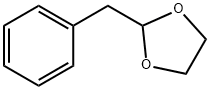
What is 2-BENZYL-1,3-DIOXOLANE?
Chemical properties
Clear colorless to pale yellow liquid
Occurrence
Has apparently not been reported to occur in nature.
Preparation
By condensation of phenylacetaldehyde and ethylene glycol (Arctander, 1969).
Safety Profile
Moderately toxic by ingestion andskin contact. When heated to decomposition it emits acridsmoke and irritating fumes.
Metabolism
Phenylacetaldehyde ethyleneglycol acetal is presumably capable of being hydrolysed to form phenylacetaldehyde and ethylene glycol (Fassett, 1963).
Purification Methods
Dissolve 2-benzyl-1,3-dioxolane in CH2Cl2, wash well with 1M NaOH, dry over K2CO3, filter, evaporate and distil it through a short path still (Kügelrohr). It has also been purified by preparative gas chromatography. [Raber & Guida Synthesis 808 1974, Lloyd & Luberoff J Org Chem 34 3949 1969, Beilstein 19 III/IV 220.]
Properties of 2-BENZYL-1,3-DIOXOLANE
| Boiling point: | 115 °C |
| Density | 1.085 |
| refractive index | n20/D 1.522(lit.) |
| Flash point: | 108 °C |
| solubility | Practically insoluble in water, soluble in alcohol and oils |
| form | Liquid |
| color | Clear colorless to pale yellow |
| Odor | Clean and mild, fresh-rosy, leafy odor |
| CAS DataBase Reference | 101-49-5 |
| EPA Substance Registry System | 1,3-Dioxolane, 2-(phenylmethyl)- (101-49-5) |
Safety information for 2-BENZYL-1,3-DIOXOLANE
| Signal word | Warning |
| Pictogram(s) |
 Exclamation Mark Irritant GHS07 |
| GHS Hazard Statements |
H315:Skin corrosion/irritation H319:Serious eye damage/eye irritation |
| Precautionary Statement Codes |
P264:Wash hands thoroughly after handling. P264:Wash skin thouroughly after handling. P280:Wear protective gloves/protective clothing/eye protection/face protection. |
Computed Descriptors for 2-BENZYL-1,3-DIOXOLANE
New Products
9-Mesityl-10-methylacridinium perchlorate Sulfapyridine Fmoc-OSu (R)-(-)-2-Amino-1-propanol Cyclobutanone 5-bromo-4-fluoro-2-nitrobenzaldehyde 4 pentyn 1 ol N-Vinylformamide Phenethyl cinnamate Pyrrolo[1,2-a]pyrimidine-6-carboxylic acid, 4,6,7,8-tetrahydro-4-oxo-, sodium salt (1:1), (6S) Ethyl 3-phenylpropanoate β-Bromostyrene Methacrylate-PEG-Methacrylate, Mn:35000 2,4-Dihydroxyacetophenone 2-Chloro 5-Fluoro Pyridine Vasicinone 2-Chloroisonicotinic Acid Tween 80 or Polysorbate 80 5-Bromo-1-Pentyne 1-(2-Methyl-5-nitrophenyl)guanidine Nitrate Methyl trans-4-Aminocyclohexanecarboxylate Hydrochloride N-(4-Cyano-3-(trifluoromethyl)phenyl)-2-methyloxirane-2-carboxamide 4-Nitrobenzotrifluoride 2-Pentyn-1-oLRelated products of tetrahydrofuran
You may like
-
 2-Benzyl-1,3-dioxolane CAS 101-49-5View Details
101-49-5 -
1191-95-3 Cyclobutanone 98+View Details
1191-95-3 -
Fmoc-OSu 98+View Details
82911-69-1 -
(R)-(-)-2-Amino-1-propanol 35320-23-1 98+View Details
35320-23-1 -
1191-95-3 Cyclobutanone 98+View Details
1191-95-3 -
213382-45-7 98+View Details
213382-45-7 -
Fmoc-OSu 98+View Details
82911-69-1 -
(R)-(-)-2-Amino-1-propanol 35320-23-1 98+View Details
35320-23-1
Statement: All products displayed on this website are only used for non medical purposes such as industrial applications or scientific research, and cannot be used for clinical diagnosis or treatment of humans or animals. They are not medicinal or edible.