
1,5-Dimethylhexylamine
Synonym(s):1,5-Dimethylhexylamine;6-Methyl-2-heptylamine
- CAS NO.:543-82-8
- Empirical Formula: C8H19N
- Molecular Weight: 129.24
- MDL number: MFCD00008092
- EINECS: 208-851-1
- SAFETY DATA SHEET (SDS)
- Update Date: 2026-05-28 04:10:12
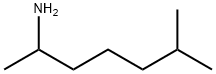
What is 1,5-Dimethylhexylamine?
Chemical properties
clear colorless to light yellow liquid with fishy smell.
The Uses of 1,5-Dimethylhexylamine
1,5-Dimethylhexylamine is an aliphatic secondary amine which shows leucine aminotransferase inhibition. 1,5-Dimethylhexylamine is used in the preparation of glycosyl β-amino acids with antitubercular activity.
The Uses of 1,5-Dimethylhexylamine
2-Amino-6-methylheptane can be used as:
- A building block for the synthesis of n-type photoconductor, N,N′-bis(1,5-dimethylhexyl)-3,4:9,10-perylenebis (dicarbox-imide) (PDHEP).
- A reagent in the synthesis of substituted pyrrolidones by reductive amination of levulinic acid using supported platinum catalyst.
- A nucleophilic amine in the synthesis of unsymmetrical sulfamide by reacting with sulfamic acid salts and triphenylphosphine ditriflate.
What are the applications of Application
2-Amino-6-methylheptane is a aliphatic secondary amine.
What are the applications of Application
1,5-Dimethylhexylamine can be used as a local anesthetic and vasoconstrictor, and it is mainly used as an intermediate in the production of gastrointestinal antispasmodic drug octamylamine.
Preparation
1,5-Dimethylhexylamine was synthesized from 6-methyl-2-heptanone ([928-68-7]) by amination and catalytic hydrogenation.
Definition
ChEBI: Octodrine is an alkylamine.
Properties of 1,5-Dimethylhexylamine
| Melting point: | 25°C |
| Boiling point: | 154-156 °C(lit.) |
| Density | 0.767 g/mL at 25 °C(lit.) |
| refractive index | n |
| Flash point: | 120 °F |
| storage temp. | Flammables area |
| solubility | DMSO (Slightly), Methanol (Slightly) |
| form | Liquid |
| pka | pKa 10.28 ± 0.1(H2O,t =25±0.2,I<0.001) (Uncertain) |
| color | White to Off-White |
| Merck | 14,6757 |
| BRN | 1209250 |
| Stability: | Hygroscopic |
| CAS DataBase Reference | 543-82-8(CAS DataBase Reference) |
| NIST Chemistry Reference | Octodrine(543-82-8) |
| EPA Substance Registry System | 2-Heptanamine, 6-methyl- (543-82-8) |
Safety information for 1,5-Dimethylhexylamine
| Signal word | Warning |
| Pictogram(s) |
 Flame Flammables GHS02  Exclamation Mark Irritant GHS07 |
| GHS Hazard Statements |
H226:Flammable liquids H302:Acute toxicity,oral H315:Skin corrosion/irritation H319:Serious eye damage/eye irritation |
| Precautionary Statement Codes |
P210:Keep away from heat/sparks/open flames/hot surfaces. — No smoking. P302+P352:IF ON SKIN: wash with plenty of soap and water. P305+P351+P338:IF IN EYES: Rinse cautiously with water for several minutes. Remove contact lenses, if present and easy to do. Continuerinsing. |
Computed Descriptors for 1,5-Dimethylhexylamine
New Products
1-(4-methoxyphenyl)-4-(4-Nitrophenyl)Piperazine (IT-1) 1,2,3,9-Tetrahydro-9-Methyl-4H-Carbazole-4-One Dibenzo[b,f][1,4]thiazepin-11(10H)-one Cis-Tosylate Dibenzoyl-L-tartaric acid Anhydrous (Resolution Reagent) 1-Benzhydrylazetane-3-carbonitrile 8-oxa-1,3-diazaspiro[4.5]decane-2,4-dione (±)-amino(2-fluorophenyl)acetic acid 2-(2-Chlorophenyl)glycine AMINO-(3-CHLORO-PHENYL)-ACETIC ACID 2'-Fluoroacetophenone METHANOL-D1(OD) N-ETHYL-D5-AMINE HYDROCHLORIDE BENZOIC ACID-D CHLOROFORM-D BENZENE-D6 TOLUENE-D3 2-Hydroxybutanenitrile 1-Benzylindolin-2-one Ethyl 2-bromo-3-oxobutanoate 4-(3-chloropropyl)morpholine 1-Benzylindoline-2,3-dione 3-Oxocyclobutanecarboxylic acid 1-(3-Chlorophenyl)piperazine hydrochlorideRelated products of tetrahydrofuran

You may like
-
 2-Amino-6-methylheptane CAS 543-82-8View Details
543-82-8 -
5-Bromo-2-chloro- benzoic acid 21739-92-4 98%View Details
21739-92-4 -
Guar Hydroxypropyltrimonium Chloride 98%View Details
65497-29-2 -
52092-43-0 2-Bromo-4-nitropyridine-N-oxide 98%View Details
52092-43-0 -
2,4,6-Trichloro-5-nitropyrimidine 98%View Details
4359-87-9 -
ethyl 2-amino-4-methoxy-5-(3-morpholinopropoxy)benzoate 1040264-49-0 98%View Details
1040264-49-0 -
1-Methylpiperidine-4-thiol 1072-99-7 98%View Details
1072-99-7 -
68886-07-7 98%View Details
68886-07-7
Statement: All products displayed on this website are only used for non medical purposes such as industrial applications or scientific research, and cannot be used for clinical diagnosis or treatment of humans or animals. They are not medicinal or edible.