
1,4-dibromonaphthalene
- CAS NO.:83-53-4
- Empirical Formula: C10H6Br2
- Molecular Weight: 285.96
- MDL number: MFCD00041823
- EINECS: 201-484-8
- SAFETY DATA SHEET (SDS)
- Update Date: 2026-05-28 03:06:08
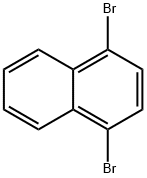
What is 1,4-dibromonaphthalene?
Chemical properties
light orange-beige fine crystalline powder
The Uses of 1,4-dibromonaphthalene
1,4-Dibromonaphthalene is used in the annelation of PAHs. Also used in the synthesis of novel, orally active dual NK1/NK2 antagonists.
What are the applications of Application
1,4-Dibromonaphthalene is an inhibitor of NK-1R and NK-2R
What are the applications of Application
1,4-Dibromonaphthalene is mainly used for pharmaceutical intermediates. synthesis of tribromo methoxynaphthalenes from 1,4-dibromonaphthalene. starting material 1,4-dibromonaphthalene was prepared starting from naphthalene or 1-bromonaphthalene.
5,8-Dibromo-1,4-naphthoquinone and 5,8-diiodo-1,4-naphthoquinone were prepared from 1,4-dibromonaphthalene and 1,4-diiodonaphthalene.
Preparation
An environment-friendly method was developed to synthesize 1,4-dibromonaphthalene (1,4-DBN) using 1,3-dialkylimidazolium and pyridinium ionic liquids as catalysts, over which the yields of 1,4-DBN were obtained as high as 100%.
An environment-friendly method for synthesis of 1,4-dibromo-naphthalene in aqueous solution of ionic liquids
Properties of 1,4-dibromonaphthalene
| Melting point: | 80-82 °C |
| Boiling point: | 288.1°C (rough estimate) |
| Density | 1.8199 (estimate) |
| vapor pressure | 0-93.326Pa at 25℃ |
| refractive index | 1.6000 (estimate) |
| storage temp. | Sealed in dry,Room Temperature |
| solubility | Chloroform, DMSO (Slightly), Methanol (Slightly) |
| form | Crystalline Powder or Crystals |
| color | White to light beige |
| Water Solubility | 347.9ug/L(25 ºC) |
| CAS DataBase Reference | 83-53-4(CAS DataBase Reference) |
| EPA Substance Registry System | Naphthalene, 1,4-dibromo- (83-53-4) |
Safety information for 1,4-dibromonaphthalene
| Signal word | Warning |
| Pictogram(s) |
 Exclamation Mark Irritant GHS07 |
| GHS Hazard Statements |
H315:Skin corrosion/irritation H319:Serious eye damage/eye irritation H335:Specific target organ toxicity, single exposure;Respiratory tract irritation |
| Precautionary Statement Codes |
P261:Avoid breathing dust/fume/gas/mist/vapours/spray. P264:Wash hands thoroughly after handling. P264:Wash skin thouroughly after handling. P280:Wear protective gloves/protective clothing/eye protection/face protection. P304+P340:IF INHALED: Remove victim to fresh air and Keep at rest in a position comfortable for breathing. P305+P351+P338:IF IN EYES: Rinse cautiously with water for several minutes. Remove contact lenses, if present and easy to do. Continuerinsing. P405:Store locked up. |
Computed Descriptors for 1,4-dibromonaphthalene
| InChIKey | IBGUDZMIAZLJNY-UHFFFAOYSA-N |
New Products
2-(2-Chlorophenyl)glycine Propiolic Acid 1-(3-Hydroxy-4-methoxyphenyl)-2-nitroethene (±)-amino(2-fluorophenyl)acetic acid trans-3-Benzyloxy-4-methoxy-beta-nitrostyrene 1-Pentadecanol 4-(4-Αminophenyl)-3-Morpholinone 3-Morpholino-1-(4-(2-oxopiperidin-1-yl) phenyl)-5,6-dihyropyridin-2-(1H)-one 1-(4-Aminophenyl)-3-morpholino-5,6-dihydropyridin-2(1H)-one N-cyanoacetylurethane 1H-IndazoleRelated products of tetrahydrofuran


You may like
-
 1,4-Dibromonaphthalene CAS 83-53-4View Details
83-53-4 -
471-25-0 Propiolic Acid 98+View Details
471-25-0 -
84145-28-8 98+View Details
84145-28-8 -
trans-3-Benzyloxy-4-methoxy-beta-nitrostyrene 98+View Details
63909-29-5 -
2-(2-Chlorophenyl)glycine 88744-36-9 98+View Details
88744-36-9 -
40216-83-9 trans-4-Hydroxy-L-proline methyl ester hydrochloride 98+View Details
40216-83-9 -
629-76-5 98+View Details
629-76-5 -
1-(3-Hydroxy-4-methoxyphenyl)-2-nitroethene 98+View Details
39816-35-8