
1,3-PHENYLENEDIACETIC ACID
- CAS NO.:19806-17-8
- Empirical Formula: C10H10O4
- Molecular Weight: 194.18
- MDL number: MFCD00004341
- EINECS: 243-332-3
- SAFETY DATA SHEET (SDS)
- Update Date: 2026-05-28 01:13:42
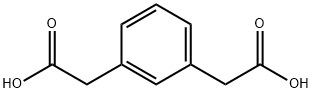
What is 1,3-PHENYLENEDIACETIC ACID?
Chemical properties
WHITE TO LIGHT YELLOW FINE CRYSTALLINE POWDER
The Uses of 1,3-PHENYLENEDIACETIC ACID
In order to establish defined biomacromolecular systems for mineralised tissue applications, type I collagen was functionalised with 1,3-phenylenediacetic acid (Ph) and investigated at the molecular, macroscopic and functional levels. The solvothermal reactions of 1,2-bis(imidazol-1?-yl)ethane (bime), 1,3-phenylenediacetic acid, 1,4-phenylenediacetic acid), 1,2-phenylenediacetic acid with different metal ions gave rise to four novel helical coordination polymers.
Properties of 1,3-PHENYLENEDIACETIC ACID
| Melting point: | 175-177 °C (lit.) |
| Boiling point: | 290.62°C (rough estimate) |
| Density | 1.2534 (rough estimate) |
| refractive index | 1.5430 (estimate) |
| storage temp. | Sealed in dry,Room Temperature |
| form | Fine Crystalline Powder |
| pka | 3.93±0.10(Predicted) |
| color | White to light yellow |
| Water Solubility | Slightly soluble in water. Solublitiy in methanol is almost transparency. |
| BRN | 2616749 |
| CAS DataBase Reference | 19806-17-8(CAS DataBase Reference) |
Safety information for 1,3-PHENYLENEDIACETIC ACID
| Signal word | Warning |
| Pictogram(s) |
 Exclamation Mark Irritant GHS07 |
| GHS Hazard Statements |
H315:Skin corrosion/irritation H319:Serious eye damage/eye irritation H335:Specific target organ toxicity, single exposure;Respiratory tract irritation |
| Precautionary Statement Codes |
P261:Avoid breathing dust/fume/gas/mist/vapours/spray. P264:Wash hands thoroughly after handling. P264:Wash skin thouroughly after handling. P271:Use only outdoors or in a well-ventilated area. P280:Wear protective gloves/protective clothing/eye protection/face protection. P302+P352:IF ON SKIN: wash with plenty of soap and water. P305+P351+P338:IF IN EYES: Rinse cautiously with water for several minutes. Remove contact lenses, if present and easy to do. Continuerinsing. |
Computed Descriptors for 1,3-PHENYLENEDIACETIC ACID
New Products
2-Amino-5-bromo- benzoic acid Dibenzoyl-L-tartaric acid Anhydrous (Resolution Reagent) 1,2,3,9-Tetrahydro-9-Methyl-4H-Carbazole-4-One Cis-Tosylate Dibenzo[b,f][1,4]thiazepin-11(10H)-one BOC Piperazine N-Methyl-2-amino-2-methylpropionamide 4-(FMOC-AMINO)-TETRAHYDROPYRAN-4-CARBOXYLIC ACID 1-Aminocyclobutanecarboxylic Acid Hydrochloride 3-Oxocyclobutanecarboxylic acid AMINO(2-BROMOPHENYL)ACETIC ACID 6-BROMOTETRAZOLO[1,5-A]PYRIDINE 4-Amino-2-chloro-6,7-dimethoxyquinazoline 2,3-Dimethoxypyridine 2,6-bis(bromomethyl)pyridine tert-Butyl 4-mercaptopiperidine-1-carboxylate 4'-(Methylmercapto)-acetophrnonone 1-Benzhydrylazetidin-3-ol-Hcl 1-(3-Chlorophenyl)piperazine hydrochloride Enzyme Breaker for Coal Bed Methane Slickwaterr Gas Well Guar Gum Enzyme Breaker Enzyme Breaker for Conventional Slickwater Fracturing Conventional Fracturing Guar Gum Enzyme Breaker Coalbed Methane Guar Gum Enzyme BreakerRelated products of tetrahydrofuran
![METHYL-3-[2-(4-AMINOBENZOYL)ACETAMINO]-4-[3,5-DICARBOXYMETHYL)-PHENOXY]-BENZOATE](https://img.chemicalbook.in/CAS/GIF/116919-25-6.gif)
![METHYL-3-[2-(4-NITROBENZOYL)ACETAMINO]-4-[3,5-DICARBOXYMETHYL)-PHENOXY]-BENZOATE](https://img.chemicalbook.in/CAS/GIF/116933-03-0.gif)

You may like
-
 19806-17-8 1,3-Phenylenediacetic acid,97% 99%View Details
19806-17-8 -
 1, 3-Phenylenediacetic acid CAS 19806-17-8View Details
19806-17-8 -
1,3-Phenylenediacetic Acid CAS 19806-17-8View Details
19806-17-8 -
1,3-Phenylenediacetic Acid CASView Details
-
1,3-Phenylenediacetic acid CAS 19806-17-8View Details
19806-17-8 -
254762-66-8 AMINO(2-BROMOPHENYL)ACETIC ACID 98+View Details
254762-66-8 -
6-BROMOTETRAZOLO[1,5-A]PYRIDINE 98+View Details
5799-75-7 -
1778-09-2 4'-(Methylmercapto)-acetophrnonone 98%View Details
1778-09-2
Statement: All products displayed on this website are only used for non medical purposes such as industrial applications or scientific research, and cannot be used for clinical diagnosis or treatment of humans or animals. They are not medicinal or edible.