
1,3-Dimercaptopropane
Synonym(s):1,3-Dimercaptopropane;1,3-Propanedithiol;Trimethylene dimercaptan
- CAS NO.:109-80-8
- Empirical Formula: C3H8S2
- Molecular Weight: 108.23
- MDL number: MFCD00004904
- EINECS: 203-706-9
- SAFETY DATA SHEET (SDS)
- Update Date: 2026-05-28 03:37:13

What is 1,3-Dimercaptopropane?
Chemical properties
colourless to slightly yellow liquid
Chemical properties
1,3-Propanedithiol has a sulfur, meaty odor. FEMA indicates that total dithiol added to any food should not exceed 1.0 ppm.
Occurrence
Reported found in cooked or boiled beef.
The Uses of 1,3-Dimercaptopropane
1,3-Propanedithiol is used as a reagent in the preparation of thioketals and thioacetals. It acts as a flavoring agent. It is used as a precursor in the synthesis of cyclic dithioacetal (1,3-dithiane) derivatives of carbonyl compounds. It is involved in the preparation of diiron propanedithiolate hexacarbonyl by reacting reaction with triiron dodecacarbonyl. Further, it is used for the protection of aldehydes and ketones through their reversible formation of dithianes. In addition to this, it reacts with metal ions to form chelate rings.
What are the applications of Application
1,3-Propanedithiol is a reagent used for the protection of aldehydes and ketones via their reversible formation of dithianes
Definition
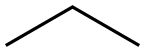
ChEBI: A dithiol that is propane substituted by thiol groups at positions 1 ans 3.
General Description
Clear orange oil with a disagreeable odor.
Air & Water Reactions
Highly flammable. Insoluble in water.
Reactivity Profile
Organosulfides, such as 1,3-Dimercaptopropane, are incompatible with acids, diazo and azo compounds, halocarbons, isocyanates, aldehydes, alkali metals, nitrides, hydrides, and other strong reducing agents. Reactions with these materials generate heat and in many cases hydrogen gas. Many of these compounds may liberate hydrogen sulfide upon decomposition or reaction with an acid. 1,3-Dimercaptopropane may react with oxidizers, bases, reducing agents and alkali metals.
Fire Hazard
1,3-Dimercaptopropane is combustible.
Properties of 1,3-Dimercaptopropane
| Melting point: | -79 °C (lit.) |
| Boiling point: | 169 °C (lit.) |
| Density | 1.078 g/mL at 25 °C (lit.) |
| vapor density | >1 (vs air) |
| vapor pressure | 5 mm Hg ( 37.7 °C) |
| refractive index | n |
| FEMA | 3588 | 1,3-PROPANEDITHIOL |
| Flash point: | 138 °F |
| storage temp. | Store below +30°C. |
| form | Liquid |
| pka | 9.86±0.10(Predicted) |
| Specific Gravity | 1.078 |
| color | Clear light yellow |
| Odor | at 0.10 % in propylene glycol. meaty sulfurous |
| Water Solubility | <0.1 g/100 mL at 21 ºC |
| Merck | 14,7801 |
| JECFA Number | 535 |
| BRN | 1071197 |
| Stability: | Stable. Incompatible with oxidizing agents, bases, reducing agents, alkali metals. Store cool. |
| CAS DataBase Reference | 109-80-8(CAS DataBase Reference) |
| NIST Chemistry Reference | 1,3-Propanedithiol(109-80-8) |
| EPA Substance Registry System | 1,3-Propanedithiol (109-80-8) |
Safety information for 1,3-Dimercaptopropane
| Signal word | Danger |
| Pictogram(s) |
 Flame Flammables GHS02  Skull and Crossbones Acute Toxicity GHS06 |
| GHS Hazard Statements |
H226:Flammable liquids H301:Acute toxicity,oral H315:Skin corrosion/irritation |
| Precautionary Statement Codes |
P210:Keep away from heat/sparks/open flames/hot surfaces. — No smoking. P233:Keep container tightly closed. P240:Ground/bond container and receiving equipment. P241:Use explosion-proof electrical/ventilating/lighting/…/equipment. P301+P310:IF SWALLOWED: Immediately call a POISON CENTER or doctor/physician. P303+P361+P353:IF ON SKIN (or hair): Remove/Take off Immediately all contaminated clothing. Rinse SKIN with water/shower. |
Computed Descriptors for 1,3-Dimercaptopropane
New Products
2-(2-Chlorophenyl)glycine Propiolic Acid 1-(3-Hydroxy-4-methoxyphenyl)-2-nitroethene (±)-amino(2-fluorophenyl)acetic acid trans-3-Benzyloxy-4-methoxy-beta-nitrostyrene 1-Pentadecanol 2,4-Dihydroxybenzaldehyde Dipropyl disulfide Pyrrolo[1,2-a]pyrimidine-6-carboxylic acid, 4,6,7,8-tetrahydro-4-oxo-, sodium salt (1:1), (6S) Obidoxime hydrochloride API 4 pentyn 1 ol N-Vinylformamide Methacrylate-PEG-Methacrylate, Mn:35000 2,4-Dihydroxyacetophenone 2-Chloro 5-Fluoro Pyridine Vasicinone 2-Chloroisonicotinic Acid Tween 80 or Polysorbate 80 2-Butyn-1-oL N-(4-Cyano-3-(trifluoromethyl)phenyl)-2-methyloxirane-2-carboxamide N-(4-fluoro-2-methoxy-5-nitrophenyl)-4-(1-methyl-1H-indol-3-yl)pyrimidin-2-amine Pirtobrutinib intd. 2-Pentyn-1-oL 4-NitrobenzotrifluorideRelated products of tetrahydrofuran


![2-Ethylhexyl 10-ethyl-4-[[2-[(2-ethylhexyl)oxy]-2-oxoethyl]thio]-4-methyl-7-oxo-8-oxa-3,5-dithia-4-stannatetradecanoate](https://img.chemicalbook.in/CAS/GIF/57583-34-3.gif)
You may like
-
 1,3-Propanedithiol CAS 109-80-8View Details
109-80-8 -
471-25-0 Propiolic Acid 98+View Details
471-25-0 -
84145-28-8 98+View Details
84145-28-8 -
trans-3-Benzyloxy-4-methoxy-beta-nitrostyrene 98+View Details
63909-29-5 -
2-(2-Chlorophenyl)glycine 88744-36-9 98+View Details
88744-36-9 -
40216-83-9 trans-4-Hydroxy-L-proline methyl ester hydrochloride 98+View Details
40216-83-9 -
629-76-5 98+View Details
629-76-5 -
1-(3-Hydroxy-4-methoxyphenyl)-2-nitroethene 98+View Details
39816-35-8