
1,3-Bis(bromomethyl)benzene
- CAS NO.:626-15-3
- Empirical Formula: C8H8Br2
- Molecular Weight: 263.96
- MDL number: MFCD00000178
- EINECS: 210-931-6
- SAFETY DATA SHEET (SDS)
- Update Date: 2026-06-04 16:00:12
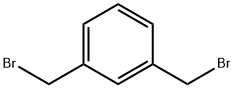
What is 1,3-Bis(bromomethyl)benzene?
Chemical properties
white to light yellow crystal powde
The Uses of 1,3-Bis(bromomethyl)benzene
1,3-Bis(bromomethyl)benzene has been used in preparation of four novel dinuclear half-titanocenes with meta - and ortho xylene bridges as new metallocenes 1 . It was used in the synthesis of dissymmetrical bis -macrocyclic salt 2 .
The Uses of 1,3-Bis(bromomethyl)benzene
It is used in preparation of four novel dinuclear half-titanocenes with?meta- and?orthoxylene bridges as new metallocenes. It was used in the synthesis of dissymmetrical bis-macro cyclic salt.
General Description
α,α′-Dibromo-m-xylene can cross-link and cyclize peptides containing two cysteine residues.
Purification Methods
Crystallise it from acetone or *benzene, and fractionally distil it under vacuum. [Wenner Org Chem 17 527 1952, Beilstein 5 H 374, 5 I 184, 5 II 294, 5 III 839, 5 IV 946.]
Properties of 1,3-Bis(bromomethyl)benzene
| Melting point: | 74-77 °C(lit.) |
| Boiling point: | 135-140 °C20 mm Hg(lit.) |
| Density | 1.9590 |
| refractive index | 1.6113 (estimate) |
| storage temp. | Keep in dark place,Sealed in dry,Room Temperature |
| solubility | dioxane: 0.1 g/mL, clear, colorless |
| form | Crystalline Powder and Chunks |
| color | White to brown |
| Water Solubility | Insoluble in water. |
| BRN | 971085 |
| CAS DataBase Reference | 626-15-3(CAS DataBase Reference) |
| NIST Chemistry Reference | Benzene, 1,3-bis(bromomethyl)-(626-15-3) |
| EPA Substance Registry System | 1,3-Bis(bromomethyl)benzene (626-15-3) |
Safety information for 1,3-Bis(bromomethyl)benzene
| Signal word | Warning |
| Pictogram(s) |
 Exclamation Mark Irritant GHS07 |
| GHS Hazard Statements |
H315:Skin corrosion/irritation H319:Serious eye damage/eye irritation H335:Specific target organ toxicity, single exposure;Respiratory tract irritation |
| Precautionary Statement Codes |
P261:Avoid breathing dust/fume/gas/mist/vapours/spray. P264:Wash hands thoroughly after handling. P264:Wash skin thouroughly after handling. P271:Use only outdoors or in a well-ventilated area. P280:Wear protective gloves/protective clothing/eye protection/face protection. P302+P352:IF ON SKIN: wash with plenty of soap and water. P305+P351+P338:IF IN EYES: Rinse cautiously with water for several minutes. Remove contact lenses, if present and easy to do. Continuerinsing. |
Computed Descriptors for 1,3-Bis(bromomethyl)benzene
New Products
2-Bromo-4-hydroxypyridine 2-Benzyl-1,1,3,3-tetramethylisoindoline AMINO-O-TOLYL-ACETIC ACID AMINO(2-BROMOPHENYL)ACETIC ACID 6-BROMOTETRAZOLO[1,5-A]PYRIDINE 3-Oxocyclobutanecarboxylic acid 1,3-Diazaspiro[4.5]decane-2,4-dione, 8,8-difluoro- AMINO-(3-FLUORO-PHENYL)-ACETIC ACID Pyrrolo[1,2-a]pyrimidine-6-carboxylic acid, 4,6,7,8-tetrahydro-4-oxo-, sodium salt (1:1), (6S) Obidoxime hydrochloride API Piperazine, 1-(3-methoxyphenyl)-, hydrochloride (1:1) Decanoic acid, 2-[4-(phenylmethoxy)phenyl]ethyl ester 2,4-Dihydroxybenzaldehyde 3-Cyano-4-(2-methylpropoxy)benzenecarbothioamide 1-(2, 4-dichlorophenyl)-N-(2, 4-difluorophenyl)-N isopropyl-5-oxo-1H-1, 2, 4-trizole-4(5H)-carboxamide 2,4-Dihydroxyacetophenone 2-Chloro 5-Fluoro Pyridine Vasicinone 2-Chloroisonicotinic Acid Tween 80 or Polysorbate 80 2-Butyn-1-oL N-(4-fluoro-2-methoxy-5-nitrophenyl)-4-(1-methyl-1H-indol-3-yl)pyrimidin-2-amine Pirtobrutinib intd. N-(4-Cyano-3-(trifluoromethyl)phenyl)-2-methyloxirane-2-carboxamideRelated products of tetrahydrofuran
You may like
-
 α,α'-Dibromo-m-xylene CAS 626-15-3View Details
626-15-3 -
α,α′-Dibromo-m-xylene CAS 626-15-3View Details
626-15-3 -
Methyl-2-chloro pyridine-5-carboxylate 98%View Details
58481-11-1 -
695-34-1 2-Amino 4-Methyl Pyridine 98%View Details
695-34-1 -
2398-81-4 Nicotinic acid N-oxide 98%View Details
2398-81-4 -
9005-64-6 Tween 80 or Polysorbate 80 98%View Details
9005-64-6 -
Tetrahydropiperin 23434-88-0 >98%View Details
23434-88-0 -
N,N,N',N'-Tetramethylmethylenediamine Or Bis(dimethylamino)methane 51-80-9 98%View Details
51-80-9
Statement: All products displayed on this website are only used for non medical purposes such as industrial applications or scientific research, and cannot be used for clinical diagnosis or treatment of humans or animals. They are not medicinal or edible.