
Dibenzotetrathiafulvalene
Synonym(s):[2,2’]Bi[benzo[1,3]dithiolylidene];DBTTF
- CAS NO.:24648-13-3
- Empirical Formula: C14H8S4
- Molecular Weight: 304.47
- MDL number: MFCD00443822
- SAFETY DATA SHEET (SDS)
- Update Date: 2026-05-27 23:55:05
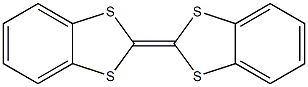
What is Dibenzotetrathiafulvalene?
The Uses of Dibenzotetrathiafulvalene
Dibenzotetrathiafulvalene(DBTTF, also known as 1,3-Benzodithiole,2-(1,3-benzodithiol-2-ylidene)-) is an organic electronic material that can be used to form semiconductor charge transfer salts with electron accepting (n-type) materials (TCNQ and F4TCNQ). It can also be used to form charge transfer complexes (TCNQ and DDQ) with a variety of semiconductor crystals for the manufacture of organic field effect transistors (OFETs) and organic light emitting diodes (OLEDs).
Synthesis
Dibenzotetrathiafulvalene was prepared from 2,2'-Bi-1,3-benzodithiol under reaction conditions with 2,3-dicyano-5,6-dichloro-p-benzoquinone and dichloromethane. The specific method of operation is described below:
General procedure: Dithioacetal (0.1 mmol) and DDQ (68 mg, 0.30 mol) were dissolved in CH2Cl2 (3 mL). The resultant dark blue mixture was stirred at room temperature for 16 h and was then washed with a saturated NaOH aqueous solution (2 mL) and CH2Cl2 (10 mL). The orange organic phase was dried over anhydrous Na2SO4, filtered, and then evaporated under reduced pressure. The crude solid was recrystallized from hexane to give the corresponding dibenzotetrathiafulvalene derivative. Dibenzotetrathiafulvalene. Yield: 30 mg (99%); orange solid; mp 239.8-243.0 °C. 1H NMR (500 MHz, CDCl3): δ = 7.27-7.24 (m, 4 H), 7.13-7.10 (m, 4 H). 13C NMR (125 MHz, CDCl3): δ = 136.6, 125.9, 121.9, 110.6. MS (FAB): m/z = 304 [M+]. HRMS (FAB): m/z calcd for [M]+ (C14H8S4): 303.9509; found: 303.9519.
Properties of Dibenzotetrathiafulvalene
| Melting point: | 239-243 °C |
| Boiling point: | 367.1±42.0 °C(Predicted) |
| Density | 1.538±0.06 g/cm3(Predicted) |
Safety information for Dibenzotetrathiafulvalene
| Signal word | Warning |
| Pictogram(s) |
 Environment GHS09 |
| GHS Hazard Statements |
H410:Hazardous to the aquatic environment, long-term hazard |
| Precautionary Statement Codes |
P273:Avoid release to the environment. P501:Dispose of contents/container to..… |
Computed Descriptors for Dibenzotetrathiafulvalene
New Products
5-bromo-4-fluoro-2-nitrobenzaldehyde (R)-(-)-2-Amino-1-propanol Cyclobutanone Fmoc-OSu 1-(2-Chloroethyl)pyrrolidine Hydrochloride 2-Amino-2-(4-methylphenyl)acetic acid Obidoxime hydrochloride API Decanoic acid, 2-[4-(phenylmethoxy)phenyl]ethyl ester Piperazine, 1-(3-methoxyphenyl)-, hydrochloride (1:1) 4-Bromo-2,6-difluoroaniline 4 pentyn 1 ol N-Vinylformamide Methacrylate-PEG-Methacrylate, Mn:35000 2,4-Dihydroxyacetophenone 2-Chloro 5-Fluoro Pyridine Vasicinone 2-Chloroisonicotinic Acid Tween 80 or Polysorbate 80 2-Pentyn-1-oL 4-Nitrobenzotrifluoride N-(4-Cyano-3-(trifluoromethyl)phenyl)-2-methyloxirane-2-carboxamide N-(4-fluoro-2-methoxy-5-nitrophenyl)-4-(1-methyl-1H-indol-3-yl)pyrimidin-2-amine Pirtobrutinib intd. 2-Butyn-1-oLRelated products of tetrahydrofuran


You may like
-
 Dibenzotetrathiafulvalene CAS 24648-13-3View Details
24648-13-3 -
Fmoc-OSu 98+View Details
82911-69-1 -
7250-67-1 1-(2-Chloroethyl)pyrrolidine Hydrochloride 98+View Details
7250-67-1 -
13227-01-5 98+View Details
13227-01-5 -
7250-67-1 1-(2-Chloroethyl)pyrrolidine Hydrochloride 98+View Details
7250-67-1 -
13227-01-5 98+View Details
13227-01-5 -
7250-67-1 1-(2-Chloroethyl)pyrrolidine Hydrochloride 98+View Details
7250-67-1 -
13227-01-5 98+View Details
13227-01-5