
1,1,1-Trimethoxypentane
Synonym(s):1,1,1-Trimethoxypentane
- CAS NO.:13820-09-2
- Empirical Formula: C8H18O3
- Molecular Weight: 162.23
- MDL number: MFCD00008481
- EINECS: 237-496-5
- SAFETY DATA SHEET (SDS)
- Update Date: 2026-05-27 23:33:31
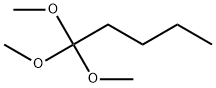
What is 1,1,1-Trimethoxypentane?
Chemical properties
CLEAR COLORLESS LIQUID
The Uses of 1,1,1-Trimethoxypentane
Trimethyl orthovalerate is used in the synthesis of 1,2,4-triazolo[1,5-c]pyrimidine derivatives as human adenosine A3 receptor ligands. It can also be used as a precursor to prepare N-sulfonyl and N-sulfinyl imines and imidates.
The Uses of 1,1,1-Trimethoxypentane
Trimethyl orthovalerate has been used in the preparation of:
- various 9-O-acyl derivatives of N-acetyl- and N-glycoloyl-neuraminic acid
- 2-methyl, 2-ethyl, 2-propyl and 2-butyl-3-benzimidazolyl-4(3H)-quinazolinones
Synthesis Reference(s)
Journal of the American Chemical Society, 68, p. 1922, 1946 DOI: 10.1021/ja01214a015
General Description
Kinetics of unimolecular gas-phase elimination of trimethyl orthovalerate has been investigated.
Properties of 1,1,1-Trimethoxypentane
| Boiling point: | 164-166 °C (lit.) |
| Density | 0.941 g/mL at 25 °C (lit.) |
| refractive index | 1.408-1.41 |
| Flash point: | 41 °C |
| storage temp. | Flammables area |
| solubility | Chloroform (Slightly), DMSO, Methanol (Slightly) |
| form | clear liquid |
| color | Colorless to Almost colorless |
| Sensitive | Moisture Sensitive |
| Merck | 14,9717 |
| BRN | 1739200 |
| Stability: | Unstable in acidic solution, Unstable In Acidic Solution |
| CAS DataBase Reference | 13820-09-2(CAS DataBase Reference) |
| NIST Chemistry Reference | Pentane, 1,1,1-trimethoxy-(13820-09-2) |
| EPA Substance Registry System | Pentane, 1,1,1-trimethoxy- (13820-09-2) |
Safety information for 1,1,1-Trimethoxypentane
| Signal word | Warning |
| Pictogram(s) |
 Flame Flammables GHS02  Exclamation Mark Irritant GHS07 |
| GHS Hazard Statements |
H226:Flammable liquids H315:Skin corrosion/irritation H319:Serious eye damage/eye irritation |
| Precautionary Statement Codes |
P210:Keep away from heat/sparks/open flames/hot surfaces. — No smoking. P302+P352:IF ON SKIN: wash with plenty of soap and water. P305+P351+P338:IF IN EYES: Rinse cautiously with water for several minutes. Remove contact lenses, if present and easy to do. Continuerinsing. |
Computed Descriptors for 1,1,1-Trimethoxypentane
1,1,1-Trimethoxypentane manufacturer
New Products
5-bromo-4-fluoro-2-nitrobenzaldehyde (R)-(-)-2-Amino-1-propanol Cyclobutanone Fmoc-OSu 1-(2-Chloroethyl)pyrrolidine Hydrochloride 2-Amino-2-(4-methylphenyl)acetic acid β-Bromostyrene Ethyl 3-phenylpropanoate Phenethyl cinnamate Dipropyl disulfide 4 pentyn 1 ol N-Vinylformamide Methacrylate-PEG-Methacrylate, Mn:35000 2,4-Dihydroxyacetophenone 2-Chloro 5-Fluoro Pyridine Vasicinone 2-Chloroisonicotinic Acid Tween 80 or Polysorbate 80 2-Butyn-1-oL 2-Pentyn-1-oL 4-Nitrobenzotrifluoride N-(4-fluoro-2-methoxy-5-nitrophenyl)-4-(1-methyl-1H-indol-3-yl)pyrimidin-2-amine Pirtobrutinib intd. N-(4-Cyano-3-(trifluoromethyl)phenyl)-2-methyloxirane-2-carboxamideRelated products of tetrahydrofuran
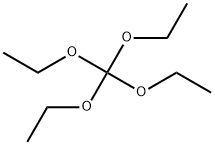
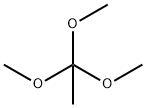
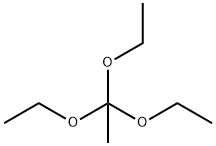
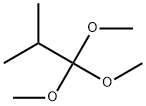
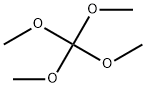

![1,1',1''-[propylidynetris(oxy)]tributane](https://img.chemicalbook.in/CAS/GIF/62042-45-9.gif)
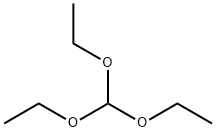
You may like
-
 13820-09-2 98%View Details
13820-09-2 -
 Trimethyl orthovalerate 13820-09-2 99%View Details
13820-09-2 -
 Trimethyl orthovalerate CAS 13820-09-2View Details
13820-09-2 -
Trimethyl orthovalerate 95% CAS 13820-09-2View Details
13820-09-2 -
Trimethyl orthovalerate CAS 13820-09-2View Details
13820-09-2 -
Trimethyl Orthovalerate CAS 13820-09-2View Details
13820-09-2 -
Trimethyl orthovalerate CAS 13820-09-2View Details
13820-09-2 -
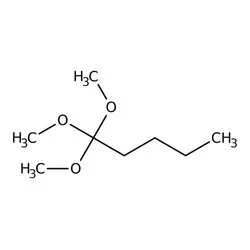 Thermo Fisher Trimethyl OrthovalerateView Details
13820-09-2
Statement: All products displayed on this website are only used for non medical purposes such as industrial applications or scientific research, and cannot be used for clinical diagnosis or treatment of humans or animals. They are not medicinal or edible.