
1,1-Dimethoxyoctane
- CAS NO.:10022-28-3
- Empirical Formula: C10H22O2
- Molecular Weight: 174.28
- MDL number: MFCD00036644
- EINECS: 233-018-4
- SAFETY DATA SHEET (SDS)
- Update Date: 2026-06-24 18:39:39
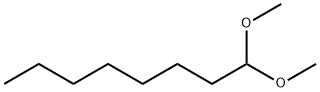
What is 1,1-Dimethoxyoctane?
Description
Octanal dimethyl acetal has a characteristic woody aroma reminiscent of cognac. May be synthesized by condensation of octaldehyde with methanol using dry HCL as a dehydrating agent.
Chemical properties
Octanal dimethyl acetal has a green, woody, citrusy odor reminiscent of cognac.
The Uses of 1,1-Dimethoxyoctane
1,1-Dimethoxyoctane is used in perfume compositions and flavor compositions for imitation Orange, Lemon, Melon, Coconut, in fruit complexes, Liqueur flavors, Cognac imitations, etc.
Preparation
By condensation of octaldehyde with methanol using dry HCl as a dehydrating agent.
Definition
ChEBI: 1,1-Dimethoxyoctane is an acetal.
Synthesis Reference(s)
Journal of the American Chemical Society, 93, p. 2080, 1971 DOI: 10.1021/ja00737a057
Flammability and Explosibility
Non flammable
Properties of 1,1-Dimethoxyoctane
| Boiling point: | 206-207 °C(lit.) |
| Density | 0.851 g/mL at 25 °C(lit.) |
| vapor pressure | 12.52Pa at 24℃ |
| FEMA | 2798 | OCTANAL DIMETHYL ACETAL |
| refractive index | n |
| Flash point: | 194 °F |
| storage temp. | Inert atmosphere,Room Temperature |
| solubility | Practically insoluble in water, soluble in alcohol and oils. |
| form | clear liquid |
| color | Colorless to Almost colorless |
| Specific Gravity | 0.86 |
| Odor | at 100.00 %. citrus floral green leafy rose violet |
| Water Solubility | 210.5mg/L at 24℃ |
| JECFA Number | 942 |
| CAS DataBase Reference | 10022-28-3(CAS DataBase Reference) |
| NIST Chemistry Reference | Octanal dimethyl acetal(10022-28-3) |
| EPA Substance Registry System | Octane, 1,1-dimethoxy- (10022-28-3) |
Safety information for 1,1-Dimethoxyoctane
| Signal word | Warning |
| Pictogram(s) |
 Exclamation Mark Irritant GHS07 |
| GHS Hazard Statements |
H227:Flammable liquids |
| Precautionary Statement Codes |
P210:Keep away from heat/sparks/open flames/hot surfaces. — No smoking. P280:Wear protective gloves/protective clothing/eye protection/face protection. P370+P378:In case of fire: Use … for extinction. P403+P235:Store in a well-ventilated place. Keep cool. |
Computed Descriptors for 1,1-Dimethoxyoctane
New Products
1-(4-methoxyphenyl)-4-(4-Nitrophenyl)Piperazine (IT-1) 1,2,3,9-Tetrahydro-9-Methyl-4H-Carbazole-4-One Dibenzo[b,f][1,4]thiazepin-11(10H)-one Cis-Tosylate Dibenzoyl-L-tartaric acid Anhydrous (Resolution Reagent) 1-Benzhydrylazetane-3-carbonitrile 8-oxa-1,3-diazaspiro[4.5]decane-2,4-dione (±)-amino(2-fluorophenyl)acetic acid 2-(2-Chlorophenyl)glycine AMINO-(3-CHLORO-PHENYL)-ACETIC ACID 2'-Fluoroacetophenone METHANOL-D1(OD) N-ETHYL-D5-AMINE HYDROCHLORIDE BENZOIC ACID-D CHLOROFORM-D BENZENE-D6 TOLUENE-D3 2-Hydroxybutanenitrile 1-Benzylindolin-2-one Ethyl 2-bromo-3-oxobutanoate 4-(3-chloropropyl)morpholine 1-Benzylindoline-2,3-dione 3-Oxocyclobutanecarboxylic acid 1-(3-Chlorophenyl)piperazine hydrochlorideRelated products of tetrahydrofuran



You may like
-
 n-Octanal Dimethyl Acetal CAS 10022-28-3View Details
10022-28-3 -
5-Bromo-2-chloro- benzoic acid 21739-92-4 98%View Details
21739-92-4 -
Guar Hydroxypropyltrimonium Chloride 98%View Details
65497-29-2 -
52092-43-0 2-Bromo-4-nitropyridine-N-oxide 98%View Details
52092-43-0 -
2,4,6-Trichloro-5-nitropyrimidine 98%View Details
4359-87-9 -
ethyl 2-amino-4-methoxy-5-(3-morpholinopropoxy)benzoate 1040264-49-0 98%View Details
1040264-49-0 -
1-Methylpiperidine-4-thiol 1072-99-7 98%View Details
1072-99-7 -
68886-07-7 98%View Details
68886-07-7
Statement: All products displayed on this website are only used for non medical purposes such as industrial applications or scientific research, and cannot be used for clinical diagnosis or treatment of humans or animals. They are not medicinal or edible.