
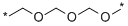
Polyoxymethylene
- CAS NO.:9002-81-7
- Empirical Formula: (CH2O)n
- Molecular Weight: 90.08
- MDL number: MFCD00133991
- EINECS: 200-001-8
- SAFETY DATA SHEET (SDS)
- Update Date: 2026-08-25 20:17:46

What is Polyoxymethylene?
The Uses of Polyoxymethylene
Acetal resins, also known as polyoxymethylene and polyformaldehyde, are polymers of pure formaldehyde with unusually good mechanical properties. They are resistant to elongation and impact and replace light metals in many uses. The finished polymer has not been related to adverse health effects in humans or animals. They can be thermally degraded, for example, in an overheated molding machine, to produce formaldehyde gas, with its well-recognized irritant and sensitizing properties.
Definition
ChEBI: A poly(alkylene oxide) macromolecule, composed of repeating methyleneoxy units.
Industrial uses
Polyoxymethylene, or polyacetal, resins arepolymers of formaldehyde. With high molecularweights and high degrees of crystallinity, theyare strong and tough and are established in thegeneral class of engineering thermoplastics.
Although somewhat similar to polyethylenein general molecular structure, polyacetal moleculespack more closely, and attract each otherto a much greater extent, so that the polymer isharder and higher-melting than polyethylene.Polyacetals are typically strong and tough,resistant to fatigue, creep, organic chemicals(but not strong acids or bases), and have lowcoefficients of friction. Electrical properties arealso good. Improved properties for particularapplication may be attained by reinforcementwith fibers of glass or polytetrafluoroethylene.
The combination of properties has led tomany uses such as plumbing fittings, pump andvalve components, bearings and gears, computerhardware, automobile body parts, andappliance housings. Other aldehydes may bepolymerized in a similar way.
Properties of Polyoxymethylene
| Melting point: | 175 °C |
| Density | 1.42 g/mL at 25 °C |
| vapor density | 1.03 (vs air) |
| vapor pressure | <1.45 mm Hg ( 25 °C) |
| Flash point: | 158 °F |
| solubility | chlorophenol above 70°C: soluble |
| form | prilled |
| Dielectric constant | 3.6(Ambient) |
| EPA Substance Registry System | Poly(oxymethylene) (9002-81-7) |
Safety information for Polyoxymethylene
Computed Descriptors for Polyoxymethylene
New Products
5-bromo-4-fluoro-2-nitrobenzaldehyde (R)-(-)-2-Amino-1-propanol Cyclobutanone Fmoc-OSu 1-(2-Chloroethyl)pyrrolidine Hydrochloride 2-Amino-2-(4-methylphenyl)acetic acid Obidoxime hydrochloride API Decanoic acid, 2-[4-(phenylmethoxy)phenyl]ethyl ester Piperazine, 1-(3-methoxyphenyl)-, hydrochloride (1:1) 4-Bromo-2,6-difluoroaniline 4 pentyn 1 ol N-Vinylformamide Methacrylate-PEG-Methacrylate, Mn:35000 2,4-Dihydroxyacetophenone 2-Chloro 5-Fluoro Pyridine Vasicinone 2-Chloroisonicotinic Acid Tween 80 or Polysorbate 80 2-Pentyn-1-oL 4-Nitrobenzotrifluoride N-(4-Cyano-3-(trifluoromethyl)phenyl)-2-methyloxirane-2-carboxamide N-(4-fluoro-2-methoxy-5-nitrophenyl)-4-(1-methyl-1H-indol-3-yl)pyrimidin-2-amine Pirtobrutinib intd. 2-Butyn-1-oLRelated products of tetrahydrofuran


You may like
-
 Fmoc-OSu 98+View Details
82911-69-1 -
(R)-(-)-2-Amino-1-propanol 35320-23-1 98+View Details
35320-23-1 -
7250-67-1 1-(2-Chloroethyl)pyrrolidine Hydrochloride 98+View Details
7250-67-1 -
13227-01-5 98+View Details
13227-01-5 -
7250-67-1 1-(2-Chloroethyl)pyrrolidine Hydrochloride 98+View Details
7250-67-1 -
13227-01-5 98+View Details
13227-01-5 -
7250-67-1 1-(2-Chloroethyl)pyrrolidine Hydrochloride 98+View Details
7250-67-1 -
13227-01-5 98+View Details
13227-01-5