
1,1-Dimethoxydecane
- CAS NO.:7779-41-1
- Empirical Formula: C12H26O2
- Molecular Weight: 202.33
- MDL number: MFCD00036509
- EINECS: 231-928-6
- SAFETY DATA SHEET (SDS)
- Update Date: 2026-06-24 18:39:39
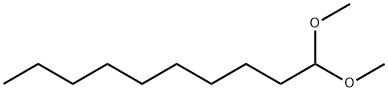
What is 1,1-Dimethoxydecane?
Chemical properties
1,1-Dimethoxydecane is a colorless liquid. Almost insoluble in water, soluble in alcohol and oils. It has a characteristic, herbaceous, green, citrus-floral odor and a brandy, cognac flavor.
The Uses of 1,1-Dimethoxydecane
1,1-Dimethoxydecane is an aroma compound of fresh blackberries and is used in citrus oils.
The Uses of 1,1-Dimethoxydecane
Finds some use in perfume compositions, mainly in heavy floral bases, Gardenia, Cassie, Tuberose, etc. and occasionally in Citrusy topnotes as a modifier for the Aldehydes. Its odor is overall more refreshing than that of the parent aldehyde.
Preparation
From decanal and methyl alcohol.
Definition
ChEBI: 1,1-Dimethoxydecane is an acetal.
Aroma threshold values
Aroma characteristics at 1.0%: heavy fatty, waxy citrus orange with a strong aldehydic character. It also has a slightly green/vegetative bell pepper nuance.
Taste threshold values
Taste characteristics at 2 ppm: fatty, waxy, citrus orange with fatty aldehydic nuances and a hint of mushroom.
Safety Profile
A skin irritant. When heated to decomposition it emits acrid smoke and irritating fumes
Properties of 1,1-Dimethoxydecane
| Boiling point: | 218 °C(lit.) |
| Density | 0.83 g/mL at 25 °C(lit.) |
| FEMA | 2363 | DECANAL DIMETHYL ACETAL |
| refractive index | n |
| Flash point: | 199 °F |
| solubility | Chloroform (Sparingly), Ethyl Acetate (Slightly), Methanol |
| form | Oil |
| color | Colourless |
| Odor | at 10.00 % in dipropylene glycol. waxy herbal citrus green neroli |
| JECFA Number | 945 |
| NIST Chemistry Reference | Decanal dimethyl acetal(7779-41-1) |
| EPA Substance Registry System | Decane, 1,1-dimethoxy- (7779-41-1) |
Safety information for 1,1-Dimethoxydecane
| Signal word | Warning |
| Pictogram(s) |
 Exclamation Mark Irritant GHS07  Environment GHS09 |
| GHS Hazard Statements |
H315:Skin corrosion/irritation H411:Hazardous to the aquatic environment, long-term hazard |
| Precautionary Statement Codes |
P273:Avoid release to the environment. |
Computed Descriptors for 1,1-Dimethoxydecane
New Products
5-bromo-4-fluoro-2-nitrobenzaldehyde (R)-(-)-2-Amino-1-propanol Cyclobutanone Fmoc-OSu 1-(2-Chloroethyl)pyrrolidine Hydrochloride 2-Amino-2-(4-methylphenyl)acetic acid β-Bromostyrene Ethyl 3-phenylpropanoate Phenethyl cinnamate Dipropyl disulfide 4 pentyn 1 ol N-Vinylformamide Methacrylate-PEG-Methacrylate, Mn:35000 2,4-Dihydroxyacetophenone 2-Chloro 5-Fluoro Pyridine Vasicinone 2-Chloroisonicotinic Acid Tween 80 or Polysorbate 80 2-Butyn-1-oL 2-Pentyn-1-oL 4-Nitrobenzotrifluoride N-(4-fluoro-2-methoxy-5-nitrophenyl)-4-(1-methyl-1H-indol-3-yl)pyrimidin-2-amine Pirtobrutinib intd. N-(4-Cyano-3-(trifluoromethyl)phenyl)-2-methyloxirane-2-carboxamideRelated products of tetrahydrofuran


You may like
-
 Fmoc-OSu 98+View Details
82911-69-1 -
(R)-(-)-2-Amino-1-propanol 35320-23-1 98+View Details
35320-23-1 -
7250-67-1 1-(2-Chloroethyl)pyrrolidine Hydrochloride 98+View Details
7250-67-1 -
13227-01-5 98+View Details
13227-01-5 -
7250-67-1 1-(2-Chloroethyl)pyrrolidine Hydrochloride 98+View Details
7250-67-1 -
13227-01-5 98+View Details
13227-01-5 -
7250-67-1 1-(2-Chloroethyl)pyrrolidine Hydrochloride 98+View Details
7250-67-1 -
13227-01-5 98+View Details
13227-01-5