
1-N-Boc-4-(Phenylamino)piperidine
- CAS NO.:125541-22-2
- Empirical Formula: C16H24N2O2
- Molecular Weight: 276.37
- MDL number: MFCD02102489
- EINECS: 203-105-0
- SAFETY DATA SHEET (SDS)
- Update Date: 2026-05-28 00:31:21
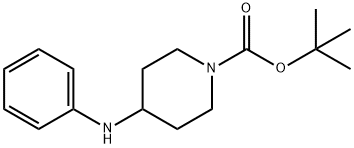
What is 1-N-Boc-4-(Phenylamino)piperidine?
Description
4-Anilino-1-Boc-piperidine (Item No. 29119) is an analytical reference standard that is structurally similar to known opioids. 4-Anilino-1-Boc-piperidine is a precursor in the synthesis of 4-anilinopiperidine . This product is intended for research and forensic applications.
Chemical properties
Pale Brown Solid
The Uses of 1-N-Boc-4-(Phenylamino)piperidine
Intermediate in the preparation of Fentanyl derivatives.
What are the applications of Application
1-N-Boc-4-(Phenylamino)piperidine is an amino acid derivative widely employed as a reagent in organic synthesis. This compound exhibits remarkable versatility, finding applications in various fields such as peptide and protein synthesis, organic synthesis, and drug development. It possesses strong basic properties, allowing for diverse reactions with acids that lead to the formation of a wide array of products. The extensive use of this compound in organic synthesis is well-documented, particularly in the synthesis of peptides and proteins. By facilitating the coupling of amino acids, it enables the creation of peptides that can be utilized in diverse applications, including the development of pharmaceutical drugs.
Properties of 1-N-Boc-4-(Phenylamino)piperidine
| Melting point: | 136-137 |
| Boiling point: | 400.6±38.0 °C(Predicted) |
| Density | 1.107±0.06 g/cm3(Predicted) |
| storage temp. | Keep in dark place,Inert atmosphere,Room temperature |
| solubility | DMF: 15mg/mL; DMSO: 25mg/mL; Ethanol: 25mg/mL; Ethanol:PBS (pH 7.2) (1:1): 0.5mg/mL |
| form | A crystalline solid |
| pka | 5.00±0.20(Predicted) |
| InChI | InChI=1S/C16H24N2O2/c1-16(2,3)20-15(19)18-11-9-14(10-12-18)17-13-7-5-4-6-8-13/h4-8,14,17H,9-12H2,1-3H3 |
Safety information for 1-N-Boc-4-(Phenylamino)piperidine
| Signal word | Warning |
| Pictogram(s) |
 Exclamation Mark Irritant GHS07 |
| GHS Hazard Statements |
H315:Skin corrosion/irritation H319:Serious eye damage/eye irritation H335:Specific target organ toxicity, single exposure;Respiratory tract irritation |
| Precautionary Statement Codes |
P261:Avoid breathing dust/fume/gas/mist/vapours/spray. P305+P351+P338:IF IN EYES: Rinse cautiously with water for several minutes. Remove contact lenses, if present and easy to do. Continuerinsing. |
Computed Descriptors for 1-N-Boc-4-(Phenylamino)piperidine
| InChIKey | HTIWISWAPVQGMI-UHFFFAOYSA-N |
| SMILES | N1(C(OC(C)(C)C)=O)CCC(NC2=CC=CC=C2)CC1 |
New Products
1-(4-methoxyphenyl)-4-(4-Nitrophenyl)Piperazine (IT-1) 1,2,3,9-Tetrahydro-9-Methyl-4H-Carbazole-4-One Dibenzo[b,f][1,4]thiazepin-11(10H)-one Cis-Tosylate Dibenzoyl-L-tartaric acid Anhydrous (Resolution Reagent) 1-Benzhydrylazetane-3-carbonitrile 8-oxa-1,3-diazaspiro[4.5]decane-2,4-dione (±)-amino(2-fluorophenyl)acetic acid 2-(2-Chlorophenyl)glycine AMINO-(3-CHLORO-PHENYL)-ACETIC ACID 2'-Fluoroacetophenone METHANOL-D1(OD) N-ETHYL-D5-AMINE HYDROCHLORIDE BENZOIC ACID-D CHLOROFORM-D BENZENE-D6 TOLUENE-D3 2-Hydroxybutanenitrile 1-Benzylindolin-2-one Ethyl 2-bromo-3-oxobutanoate 4-(3-chloropropyl)morpholine 1-Benzylindoline-2,3-dione 3-Oxocyclobutanecarboxylic acid 1-(3-Chlorophenyl)piperazine hydrochlorideRelated products of tetrahydrofuran

You may like
-
 5-Bromo-2-chloro- benzoic acid 21739-92-4 98%View Details
21739-92-4 -
Guar Hydroxypropyltrimonium Chloride 98%View Details
65497-29-2 -
(2,4-dimethoxyphenyl)methanol 7314-44-5 98%View Details
7314-44-5 -
52092-43-0 2-Bromo-4-nitropyridine-N-oxide 98%View Details
52092-43-0 -
2,4,6-Trichloro-5-nitropyrimidine 98%View Details
4359-87-9 -
ethyl 2-amino-4-methoxy-5-(3-morpholinopropoxy)benzoate 1040264-49-0 98%View Details
1040264-49-0 -
1-Methylpiperidine-4-thiol 1072-99-7 98%View Details
1072-99-7 -
68886-07-7 98%View Details
68886-07-7