
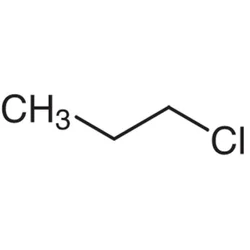
1-Chloropropane
Synonym(s):n-Propyl chloride;1-Chlorpropane;Propyl chloride
- CAS NO.:540-54-5
- Empirical Formula: C3H7Cl
- Molecular Weight: 78.54
- MDL number: MFCD00000995
- EINECS: 208-749-7
- SAFETY DATA SHEET (SDS)
- Update Date: 2026-05-28 06:31:36
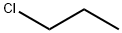
What is 1-Chloropropane?
Chemical properties
1-Chloropropane is the simplest asymmetric chloropropane. Because of the presence of the heavy electronegative chlorine atom, 1-chloropropane has a higher melting point and boiling point than propane (BP 46.6 °C vs ?42 °C). It is highly flammable.
The Uses of 1-Chloropropane
1-Chloropropane is used in organic synthesis, pesticides, pharmaceutical intermediates.
Preparation
1-chloropropane is prepared by reacting n-propyl alcohol with phosphorus trichloride in the presence of a zinc chloride catalyst.
General Description
A clear colorless liquid. Boiling point 46.6°C. Flash point below 0°F. Less dense than water and slightly soluble in water. Vapors are heavier than air. Irritant and narcotic.
Air & Water Reactions
Highly flammable. Slightly soluble in water.
Reactivity Profile
1-Chloropropane presents a dangerous fire risk. May be incompatible with strong oxidizing and reducing agents. Incompatible with many amines, nitrides, azo/diazo compounds, alkali metals, and epoxides.
Hazard
1-Chloropropane is highly flammable, dangerous fire risk, explosive limits in air 2.5–11%. Irritant and narcotic.
Health Hazard
Exposure can cause irritation of eyes, nose and throat. May cause nausea, headache, and vomiting. High concentrations may have a narcotic effect.
Safety Profile
A moderately poisonous irritant to skin, eyes, and mucous membranes. Narcotic in high concentrations. Flammable liquid and dangerous fire hazard when exposed to heat, flame, or oxiduers. Moderately explosive when exposed to flame. Keep away from heat and open flame; can react vigorously with oxilzing materials. To fight fire, use CO2, dry chemical. When heated to decomposition it emits toxic fumes of Cl-.
Purification Methods
Dry the chloride with MgSO4 and fractionally distil. It can be more extensively purified using extraction with H2SO4 as for n-propyl bromide. Alternatively, Chien and Willard [J Am Chem Soc 75 6160 1953] passed a stream of oxygen containing about 5% ozone through the n-propyl chloride for three times as long as was needed to cause the first coloration of starch iodide paper by the exit gas. After washing with aqueous NaHCO3 to hydrolyse ozonides and remove organic acids, the chloride was dried with MgSO4 and fractionally distilled. [Beilstein 1 IV 189.]
Properties of 1-Chloropropane
| Melting point: | -123 °C |
| Boiling point: | 46-47 °C(lit.) |
| Density | 0.892 g/mL at 25 °C(lit.) |
| vapor density | 2.71 (vs air) |
| vapor pressure | 5.51 psi ( 20 °C) |
| refractive index | n |
| Flash point: | −25 °F |
| storage temp. | 2-8°C |
| solubility | 2.7g/l |
| form | Liquid |
| color | Clear colorless |
| explosive limit | 2.6-11.1%(V) |
| Water Solubility | 2.7 g/L (20 ºC) |
| Merck | 14,7847 |
| BRN | 1730771 |
| Dielectric constant | 8.5299999999999994 |
| CAS DataBase Reference | 540-54-5(CAS DataBase Reference) |
| NIST Chemistry Reference | Propane, 1-chloro-(540-54-5) |
| EPA Substance Registry System | 1-Chloropropane (540-54-5) |
Safety information for 1-Chloropropane
| Signal word | Danger |
| Pictogram(s) |
 Flame Flammables GHS02  Exclamation Mark Irritant GHS07 |
| GHS Hazard Statements |
H225:Flammable liquids |
| Precautionary Statement Codes |
P210:Keep away from heat/sparks/open flames/hot surfaces. — No smoking. P233:Keep container tightly closed. P280:Wear protective gloves/protective clothing/eye protection/face protection. P301+P312:IF SWALLOWED: call a POISON CENTER or doctor/physician IF you feel unwell. P303+P361+P353:IF ON SKIN (or hair): Remove/Take off Immediately all contaminated clothing. Rinse SKIN with water/shower. |
Computed Descriptors for 1-Chloropropane
New Products
2-(2-Chlorophenyl)glycine Propiolic Acid 1-(3-Hydroxy-4-methoxyphenyl)-2-nitroethene (±)-amino(2-fluorophenyl)acetic acid trans-3-Benzyloxy-4-methoxy-beta-nitrostyrene 1-Pentadecanol 2,4-Dihydroxybenzaldehyde Dipropyl disulfide Pyrrolo[1,2-a]pyrimidine-6-carboxylic acid, 4,6,7,8-tetrahydro-4-oxo-, sodium salt (1:1), (6S) Obidoxime hydrochloride API 4 pentyn 1 ol N-Vinylformamide Methacrylate-PEG-Methacrylate, Mn:35000 2,4-Dihydroxyacetophenone 2-Chloro 5-Fluoro Pyridine Vasicinone 2-Chloroisonicotinic Acid Tween 80 or Polysorbate 80 2-Butyn-1-oL N-(4-Cyano-3-(trifluoromethyl)phenyl)-2-methyloxirane-2-carboxamide N-(4-fluoro-2-methoxy-5-nitrophenyl)-4-(1-methyl-1H-indol-3-yl)pyrimidin-2-amine Pirtobrutinib intd. 2-Pentyn-1-oL 4-NitrobenzotrifluorideRelated products of tetrahydrofuran

You may like
-
 1-Chloropropane CAS 540-54-5View Details
540-54-5 -
1-Chlorpropane CAS 540-54-5View Details
540-54-5 -
1-Chloropropane CAS 540-54-5View Details
540-54-5 -
 99% 1-Chloropropane (working standard), Analytical GradeView Details
540-54-5 -
471-25-0 Propiolic Acid 98+View Details
471-25-0 -
2-(2-Chlorophenyl)glycine 88744-36-9 98+View Details
88744-36-9 -
40216-83-9 trans-4-Hydroxy-L-proline methyl ester hydrochloride 98+View Details
40216-83-9 -
1-(3-Hydroxy-4-methoxyphenyl)-2-nitroethene 98+View Details
39816-35-8