
1-bromo-4-nitronaphthalene
- CAS NO.:4236-05-9
- Empirical Formula: C10H6BrNO2
- Molecular Weight: 252.06
- MDL number: MFCD00971828
- SAFETY DATA SHEET (SDS)
- Update Date: 2026-01-13 11:25:34
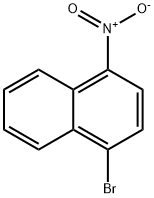
What is 1-bromo-4-nitronaphthalene?
The Uses of 1-bromo-4-nitronaphthalene
1-Bromo-4-nitronaphthalene is a useful reagent for organic synthesis.
Properties of 1-bromo-4-nitronaphthalene
| Melting point: | 87-88 °C |
| Boiling point: | 355.9±17.0 °C(Predicted) |
| Density | 1.662±0.06 g/cm3(Predicted) |
| storage temp. | Sealed in dry,Room Temperature |
Safety information for 1-bromo-4-nitronaphthalene
Computed Descriptors for 1-bromo-4-nitronaphthalene
New Products
2-(2-Chlorophenyl)glycine Propiolic Acid 1-(3-Hydroxy-4-methoxyphenyl)-2-nitroethene (±)-amino(2-fluorophenyl)acetic acid trans-3-Benzyloxy-4-methoxy-beta-nitrostyrene 1-Pentadecanol 2,4-Dihydroxybenzaldehyde Obidoxime hydrochloride API Pyrrolo[1,2-a]pyrimidine-6-carboxylic acid, 4,6,7,8-tetrahydro-4-oxo-, sodium salt (1:1), (6S) Dipropyl disulfide 4 pentyn 1 ol N-Vinylformamide Methacrylate-PEG-Methacrylate, Mn:35000 2,4-Dihydroxyacetophenone 2-Chloro 5-Fluoro Pyridine Vasicinone 2-Chloroisonicotinic Acid Tween 80 or Polysorbate 80 2-Butyn-1-oL N-(4-Cyano-3-(trifluoromethyl)phenyl)-2-methyloxirane-2-carboxamide N-(4-fluoro-2-methoxy-5-nitrophenyl)-4-(1-methyl-1H-indol-3-yl)pyrimidin-2-amine Pirtobrutinib intd. 2-Pentyn-1-oL 4-NitrobenzotrifluorideYou may like
-
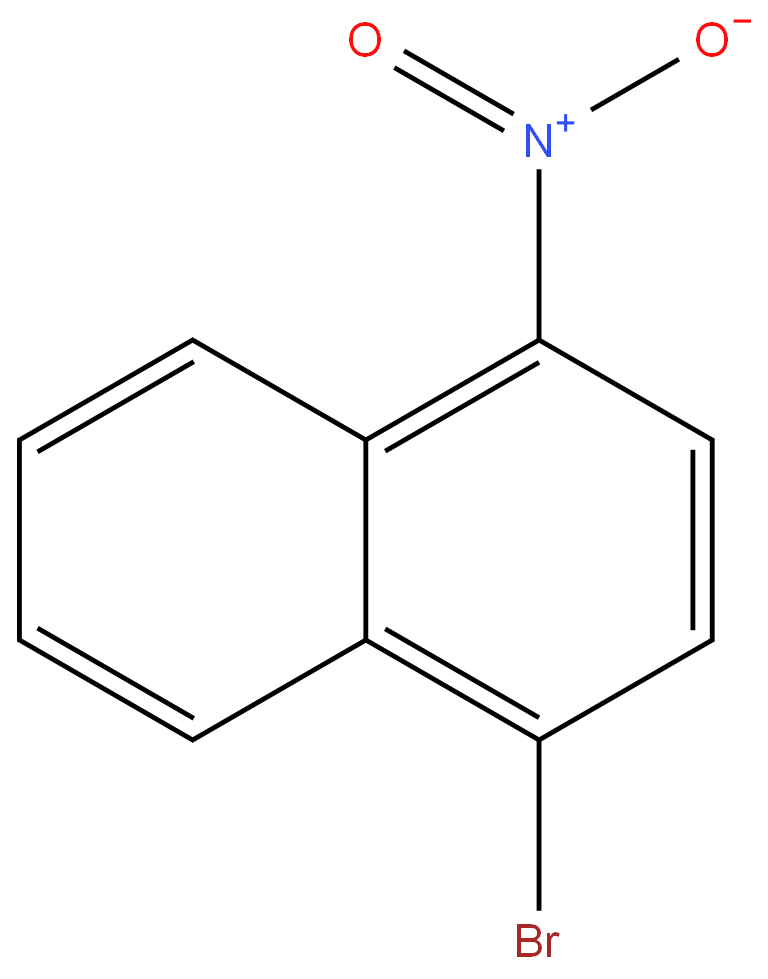 4236-05-9 1-BROMO-4-NITRO-NAPHTHALENE 98%View Details
4236-05-9 -
 1-BROMO-4-NITRO-NAPHTHALENE CAS 4236-05-9View Details
4236-05-9 -
471-25-0 Propiolic Acid 98+View Details
471-25-0 -
84145-28-8 98+View Details
84145-28-8 -
trans-3-Benzyloxy-4-methoxy-beta-nitrostyrene 98+View Details
63909-29-5 -
2-(2-Chlorophenyl)glycine 88744-36-9 98+View Details
88744-36-9 -
40216-83-9 trans-4-Hydroxy-L-proline methyl ester hydrochloride 98+View Details
40216-83-9 -
1-(3-Hydroxy-4-methoxyphenyl)-2-nitroethene 98+View Details
39816-35-8
Statement: All products displayed on this website are only used for non medical purposes such as industrial applications or scientific research, and cannot be used for clinical diagnosis or treatment of humans or animals. They are not medicinal or edible.