
1-ACETOXY-1,3-BUTADIENE
Synonym(s):1,3-Butadienyl acetate
- CAS NO.:1515-76-0
- Empirical Formula: C6H8O2
- Molecular Weight: 112.13
- MDL number: MFCD00008714
- EINECS: 216-159-6
- SAFETY DATA SHEET (SDS)
- Update Date: 2026-05-28 03:53:53
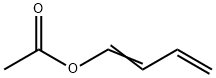
What is 1-ACETOXY-1,3-BUTADIENE?
Chemical properties
clear colorless to slightly yellow viscous liquid
The Uses of 1-ACETOXY-1,3-BUTADIENE
1-Acetoxy-1,3-butadiene was used as diene in the following reactions:
- Diels-Alder reaction with ortho-carbazolequinones to yield benzocarbazolequinone.
- Diels-Alder reaction with diethyl ketovinylphosphonate, with and without Lewis acid assistance.
- Diels-Alder reaction with methyl acrylate to yield racemic forms of 2-hydroxy-3-cyclohexenecarboxylic acid.
It was used for the reaction with dienophiles such as maleimides, a juglone, a butyne-1,4-dione and methyl 2-(4-methylphenyl)-2H-azirine-3-carboxylate and during visible light photocatalysis. It was also used as reactant during intermolecular oxa-Pictet-Spengler cyclization.
What are the applications of Application
1-Acetoxy-1,3-butadiene, mixture of cis and trans is a Diels-Alder diene
General Description
1-Acetoxy-1,3-butadiene (1-ABD) can be generated by potassium or sodium acetate catalyzed reaction between crotonaldehyde and acetic anhydride. The product is a mixture of cis and trans forms, that has been confirmed by its physical properties and IR spectra. It is reported to be formed as a major product during the acetoxylation of 1,3-butadiene (BD) in gas-phase in the presence of Pd-KOAc (palladium-potassium acetate) catalyst. 1-ABD participates as 2Π or 4Π diene in cycloaddition reactions. Enantioselective Diels Alder reaction of 2-methoxy-5-methyl-1,4-benzoquinone with 1-ABD in the presence of molecular sieves (mesh size:4?) has been reported.
Safety Profile
Poison by inhalation. Moderatelytoxic by other routes. A skin irritant. Mutation datareported. When heated to decomposition it emits acridsmoke.
Purification Methods
The commercial sample is stabilised with 0.1% of p-tert-butylcatechol. If the material contains crotonaldehyde (by IR, used in its synthesis), it should be dissolved in Et2O, shaken with 40% aqueous sodium bisulfite, then 5% aqueous Na2CO3, water, dried (Na2SO4) and distilled several times in a vacuum through a Widmer [Helv Chim Acta 7 59 1924] (p 11) or Vigreux column (p 11) [Wicterle & Hudlicky Collect Czech Chem Commun 12 564 1947, Hagemeyer & Hull Ind Eng Chem 41 2920 1949]. [Beilstein 2 III 295.]
Properties of 1-ACETOXY-1,3-BUTADIENE
| Boiling point: | 60-61 °C40 mm Hg(lit.) |
| Density | 0.96 g/mL at 20 °C(lit.) |
| vapor pressure | 40 mm Hg ( 60 °C) |
| refractive index | n |
| Flash point: | 92 °F |
| storage temp. | 2-8°C |
| form | Liquid |
| BRN | 1743394 |
| CAS DataBase Reference | 1515-76-0(CAS DataBase Reference) |
Safety information for 1-ACETOXY-1,3-BUTADIENE
| Signal word | Danger |
| Pictogram(s) |
 Flame Flammables GHS02  Skull and Crossbones Acute Toxicity GHS06 |
| GHS Hazard Statements |
H226:Flammable liquids H302:Acute toxicity,oral H311:Acute toxicity,dermal H315:Skin corrosion/irritation H319:Serious eye damage/eye irritation H335:Specific target organ toxicity, single exposure;Respiratory tract irritation |
| Precautionary Statement Codes |
P210:Keep away from heat/sparks/open flames/hot surfaces. — No smoking. P233:Keep container tightly closed. P280:Wear protective gloves/protective clothing/eye protection/face protection. P301+P312:IF SWALLOWED: call a POISON CENTER or doctor/physician IF you feel unwell. P303+P361+P353:IF ON SKIN (or hair): Remove/Take off Immediately all contaminated clothing. Rinse SKIN with water/shower. P305+P351+P338:IF IN EYES: Rinse cautiously with water for several minutes. Remove contact lenses, if present and easy to do. Continuerinsing. |
Computed Descriptors for 1-ACETOXY-1,3-BUTADIENE
New Products
9-Mesityl-10-methylacridinium perchlorate Sulfapyridine Fmoc-OSu (R)-(-)-2-Amino-1-propanol Cyclobutanone 5-bromo-4-fluoro-2-nitrobenzaldehyde 4 pentyn 1 ol N-Vinylformamide Phenethyl cinnamate Pyrrolo[1,2-a]pyrimidine-6-carboxylic acid, 4,6,7,8-tetrahydro-4-oxo-, sodium salt (1:1), (6S) Ethyl 3-phenylpropanoate β-Bromostyrene Methacrylate-PEG-Methacrylate, Mn:35000 2,4-Dihydroxyacetophenone 2-Chloro 5-Fluoro Pyridine Vasicinone 2-Chloroisonicotinic Acid Tween 80 or Polysorbate 80 5-Bromo-1-Pentyne 1-(2-Methyl-5-nitrophenyl)guanidine Nitrate Methyl trans-4-Aminocyclohexanecarboxylate Hydrochloride N-(4-Cyano-3-(trifluoromethyl)phenyl)-2-methyloxirane-2-carboxamide 4-Nitrobenzotrifluoride 2-Pentyn-1-oLRelated products of tetrahydrofuran


![5-ISOPROPYL-3-(METHOXYCARBONYL)-2H-CYCLOHEPTA[B]FURAN-2-ONE](https://img.chemicalbook.in/CAS/GIF/99909-62-3.gif)
![3-(METHOXYCARBONYL)-2H-CYCLOHEPTA[B]FURAN-2-ONE](https://img.chemicalbook.in/CAS/GIF/50603-71-9.gif)
You may like
-
 1515-76-0 1-Acetoxy-1,3-butadiene 98%View Details
1515-76-0 -
 1-Acetoxy-1,3-butadiene, 90% CAS 1515-76-0View Details
1515-76-0 -
1-Acetoxy-1,3-butadiene CAS 1515-76-0View Details
1515-76-0 -
Fmoc-OSu 98+View Details
82911-69-1 -
1191-95-3 Cyclobutanone 98+View Details
1191-95-3 -
213382-45-7 98+View Details
213382-45-7 -
Fmoc-OSu 98+View Details
82911-69-1 -
(R)-(-)-2-Amino-1-propanol 35320-23-1 98+View Details
35320-23-1