
(+)-Usniacin
Synonym(s):(+)-Usnic acid from Usnea dasypoga;2,6-Diacetyl-7,9-dihydroxy-8,9b-dimethyldibenzofuran-1,3(2H,9bH)-dione
- CAS NO.:7562-61-0
- Empirical Formula: C18H16O7
- Molecular Weight: 344.32
- MDL number: MFCD00016878
- EINECS: 231-456-0
- SAFETY DATA SHEET (SDS)
- Update Date: 2026-09-12 10:01:08
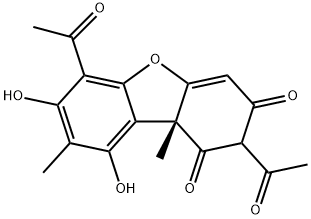
What is (+)-Usniacin?
The Uses of (+)-Usniacin
Usnic acid is used as fragrance; preservative in deodorants; in anti ac ne formulations; antibiotic for topical application.
The Uses of (+)-Usniacin
Usnic Acid acts as an antibacterial and antifungal agent, and are often seen used in cosmetics and facial application chemicals.
The Uses of (+)-Usniacin
(+)-Usnic acid has been used to study the following:
- The mechanism of its antimicrobial activity in bacterial cells.
- Its ability as an antibiofilm agent against Group A Streptococci (GAS).
- Its ability as a potent anti-virulent compound against Candida albicans.
- The mechanism of its toxic effect on hepatocytes.
- Its ability to inhibit the motility of human lung cancer cells.
Definition
ChEBI: (-)-usnic acid is the (-)-enantiomer of usnic acid. It has a role as an EC 1.13.11.27 (4-hydroxyphenylpyruvate dioxygenase) inhibitor. It is a conjugate acid of a (-)-usnic acid(2-). It is an enantiomer of a (+)-usnic acid.
General Description
(+)-Usniacin is a primary reference substance with assigned absolute purity (considering chromatographic purity, water, residual solvents, inorganic impurities). The exact value can be found on the certificate. Produced by PhytoLab GmbH & Co. KG.
Biological Activity
mic: 0.05 μg/62.5 μl to 3.1 μg/62.5 μlmicroorganisms can colonize a wide variety of medical devices, putting patients at risk for systemic and local infectious complications, including local-site infections, endocarditis, and catheter-related bloodstream infections. (+)-usniacin is a secondary lichen metabolite that possesses antimicrobial activity against various planktonic gram-positive bacteria.
Contact allergens
Usnic acid is a component of lichens, also used as a topical antibiotic. Allergic contact dermatitis from lichens occurs mainly occupationally in forestry and horticultural workers, and in lichen pickers.
in vitro
(+)-usniacin showed antimicrobial activity against the same microorganisms as that of acetone extract. among the three analogues it was the most active one having quite low mic values. furthermore, (+)-usniacin did not show any activity against a. hydrophila and b. cereus whereas (d)-usnic acid did. on the other hand, (+)-usniacin was active against y. enterocolitica whereas (d)-usnic acid was not active [1].
Purification Methods
This very weak acid is the natural form which is recrystallised from Me2CO, MeOH or *C6H6. At 25o it is soluble in H2O (<0.01%), Me2CO (0.77%), EtOAc (0.88%), MeOCH2CH2OH (0.22%) and furfural (7.32%). [Curd & Robertson J Chem Soc 894 1937, Barton & Brunn J Chem Soc 603 1953, resolution: Dean et al. J Chem Soc 1250 1953, synthesis: Barton et al. J Chem Soc 538 1956, Beilstein 18/5 V 586.]
References
[1] tay t, türk ao, yilmaz m, türk h, kivanç m. evaluation of the antimicrobial activity of the acetone extract of the lichen ramalina farinacea and its (+)-usnic acid, norstictic acid, and protocetraric acid constituents. z naturforsch c. 2004 may-jun;59(5-6):384-8.
[2] ghione m, parrello d, grasso l. usnic acid revisited, its activity on oral flora. chemioterapia. 1988 oct;7(5):302-5.
Properties of (+)-Usniacin
| Melting point: | 201-203 °C(lit.) |
| Boiling point: | 399.43°C (rough estimate) |
| alpha | 488 º (c=0.4, CHCl3) |
| Density | 1.2869 (rough estimate) |
| refractive index | 1.4790 (estimate) |
| storage temp. | Sealed in dry,Room Temperature |
| solubility | almost transparency in Chloroform |
| form | powder to crystal |
| pka | 4.00±0.40(Predicted) |
| color | Light orange to Yellow to Green |
| optical activity | [α]25/D +488°, c = 0.7% in chloroform |
| Water Solubility | Partly soluble in water. Soluble in acetone, ethanol, chloroform and furfural. |
| Merck | 14,9893 |
| BRN | 96698 |
| CAS DataBase Reference | 7562-61-0(CAS DataBase Reference) |
Safety information for (+)-Usniacin
| Signal word | Warning |
| Pictogram(s) |
 Exclamation Mark Irritant GHS07 |
| GHS Hazard Statements |
H302:Acute toxicity,oral |
Computed Descriptors for (+)-Usniacin
New Products
9-Mesityl-10-methylacridinium perchlorate Sulfapyridine Fmoc-OSu (R)-(-)-2-Amino-1-propanol Cyclobutanone 5-bromo-4-fluoro-2-nitrobenzaldehyde 4 pentyn 1 ol N-Vinylformamide Phenethyl cinnamate Pyrrolo[1,2-a]pyrimidine-6-carboxylic acid, 4,6,7,8-tetrahydro-4-oxo-, sodium salt (1:1), (6S) Ethyl 3-phenylpropanoate β-Bromostyrene Methacrylate-PEG-Methacrylate, Mn:35000 2,4-Dihydroxyacetophenone 2-Chloro 5-Fluoro Pyridine Vasicinone 2-Chloroisonicotinic Acid Tween 80 or Polysorbate 80 5-Bromo-1-Pentyne 1-(2-Methyl-5-nitrophenyl)guanidine Nitrate Methyl trans-4-Aminocyclohexanecarboxylate Hydrochloride 2-Pentyn-1-oL 4-Nitrobenzotrifluoride N-(4-Cyano-3-(trifluoromethyl)phenyl)-2-methyloxirane-2-carboxamideRelated products of tetrahydrofuran


You may like
-
 (+)-Usnic Acid CAS 7562-61-0View Details
7562-61-0 -
Usnic acid CAS 7562-61-0View Details
7562-61-0 -
(+)-Usnic acid CAS 7562-61-0View Details
7562-61-0 -
(+)-Usnic acid CAS 7562-61-0View Details
7562-61-0 -
1191-95-3 Cyclobutanone 98+View Details
1191-95-3 -
213382-45-7 98+View Details
213382-45-7 -
Fmoc-OSu 98+View Details
82911-69-1 -
(R)-(-)-2-Amino-1-propanol 35320-23-1 98+View Details
35320-23-1