
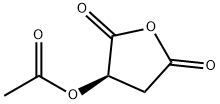
(-)-O-ACETYL-L-MALIC ANHYDRIDE
Synonym(s):(S)-3-Acetoxy-dihydro-2,5-furandione;O-Acetyl-L -malic anhydride
- CAS NO.:59025-03-5
- Empirical Formula: C6H6O5
- Molecular Weight: 158.11
- MDL number: MFCD00082708
- SAFETY DATA SHEET (SDS)
- Update Date: 2026-05-28 02:32:46
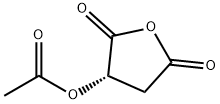
What is (-)-O-ACETYL-L-MALIC ANHYDRIDE?
Chemical properties
White Crystalline Solid
The Uses of (-)-O-ACETYL-L-MALIC ANHYDRIDE
(-)-O-Acetyl-L-Malic Anhydride can be used as intermediates for detergents via O-acetylmalic acid amides. Regioselective ring opening of malic acid anhydrides by carbon nucleophiles
The Uses of (-)-O-ACETYL-L-MALIC ANHYDRIDE
(S)-(-)-2-Acetoxysuccinic anhydride is used as intermediates for detergents via O-acetylmalic acid amides. Regioselective ring opening of malic acid anhydrides by carbon nucleophiles.
Purification Methods
Recrystallise it from Ac2O and dry it in a vacuum over KOH, or by washing it with dry Et2O due to its deliquescent nature. [Jones J Chem Soc 788 1933, Henrot et al. Synth Commun 16 183 1986, Shiuey et al. J Org Chem 52 1040 1988, RS: Cohen et al. J Am Chem Soc 88 5306 1966.]
Properties of (-)-O-ACETYL-L-MALIC ANHYDRIDE
| Melting point: | 54-56 °C(lit.) |
| Boiling point: | 296.6±33.0 °C(Predicted) |
| Density | 1.38±0.1 g/cm3(Predicted) |
| refractive index | -25.5 ° (C=5, CHCl3) |
| storage temp. | Inert atmosphere,Room Temperature |
| solubility | Dichloromethane, DMF, Ethyl Acetate |
| form | Powder |
| color | White Crystalline |
| optical activity | [α]20/D 27°, c = 1 in chloroform |
| Water Solubility | Reacts in water. |
| Sensitive | Moisture Sensitive |
| BRN | 82504 |
| Stability: | Stable. Incompatible with strong oxidizing agents. Sensitive to moisture. |
| CAS DataBase Reference | 59025-03-5(CAS DataBase Reference) |
Safety information for (-)-O-ACETYL-L-MALIC ANHYDRIDE
| Signal word | Warning |
| Pictogram(s) |
 Exclamation Mark Irritant GHS07 |
| GHS Hazard Statements |
H315:Skin corrosion/irritation H319:Serious eye damage/eye irritation H335:Specific target organ toxicity, single exposure;Respiratory tract irritation |
| Precautionary Statement Codes |
P261:Avoid breathing dust/fume/gas/mist/vapours/spray. P264:Wash hands thoroughly after handling. P264:Wash skin thouroughly after handling. P280:Wear protective gloves/protective clothing/eye protection/face protection. P304+P340:IF INHALED: Remove victim to fresh air and Keep at rest in a position comfortable for breathing. P305+P351+P338:IF IN EYES: Rinse cautiously with water for several minutes. Remove contact lenses, if present and easy to do. Continuerinsing. P405:Store locked up. |
Computed Descriptors for (-)-O-ACETYL-L-MALIC ANHYDRIDE
New Products
Cis-Tosylate Dibenzo[b,f][1,4]thiazepin-11(10H)-one Dibenzoyl-L-tartaric acid Anhydrous (Resolution Reagent) 1,2,3,9-Tetrahydro-9-Methyl-4H-Carbazole-4-One N-BOC-piperidine-4-carboxylic acid 1-Benzhydrylazetane-3-carbonitrile AMINO-(3-CHLORO-PHENYL)-ACETIC ACID 2-(2-Chlorophenyl)glycine (±)-amino(2-fluorophenyl)acetic acid 8-oxa-1,3-diazaspiro[4.5]decane-2,4-dione TRIFLOURO ACETICACID-D METHANE SULFONIC ACID-D4 PHOSPORIC ACID-D3 85 W% IN D2O DEUTERIUM OXIDE FOR NMR TOLUENE-D3 BENZENE-D6 1-Acetyl-4-(4-hydroxyphenyl)piperazine 1-(3-Chlorophenyl)piperazine hydrochlorideRelated products of tetrahydrofuran

You may like
-
 (-)-O-Acetyl-L-malic Anhydride CAS 59025-03-5View Details
59025-03-5 -
7292-71-9 AMINO-(3-CHLORO-PHENYL)-ACETIC ACID 98+View Details
7292-71-9 -
84145-28-8 98+View Details
84145-28-8 -
2-(2-Chlorophenyl)glycine 98+View Details
88744-36-9 -
7292-71-9 AMINO-(3-CHLORO-PHENYL)-ACETIC ACID 98+View Details
7292-71-9 -
84145-28-8 98+View Details
84145-28-8 -
2-(2-Chlorophenyl)glycine 98+View Details
88744-36-9 -
8-oxa-1,3-diazaspiro[4.5]decane-2,4-dione 39124-19-1 98+View Details
39124-19-1
Statement: All products displayed on this website are only used for non medical purposes such as industrial applications or scientific research, and cannot be used for clinical diagnosis or treatment of humans or animals. They are not medicinal or edible.