
(±)-Equol
Synonym(s):3,4-Dihydro-3-(4-hydroxyphenyl)-2H-1-benzopyran-7-ol;4′,7-Dihydroxyisoflavane
- CAS NO.:94105-90-5
- Empirical Formula: C15H14O3
- Molecular Weight: 242.27
- MDL number: MFCD00016662
- EINECS: 618-999-2
- SAFETY DATA SHEET (SDS)
- Update Date: 2026-09-19 14:29:14
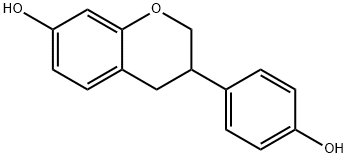
What is (±)-Equol?
Description
Equol is a nonsteroidal estrogen produced from the metabolism of the isoflavonoid phytoestrogen daidzein by human intestinal microflora. The estrogen receptor (ER) binding activity of the naturally occurring (S)-enantiomer demonstrates greater affinity toward ERβ while the (R)-enantiomer demonstrates greater affinity towards ERα. Synthesized as a racemic mixture, (±)-equol exhibits EC50 values of 200 and 74 nM for human ERα and ERβ, respectively and induces breast cancer cell proliferation in vitro at concentrations as low as 100 nM.
Chemical properties
White to Off-White Solid
The Uses of (±)-Equol
(+/-)-Equol exhibits EC50 values of 200 and 74 nM for human ERα and ERβ, respectively and induces breast cancer cell proliferation in vitro at concentrations as low as 100 nM. It is a weak estrogenic agonist, and competitive inhibitor of 17β-estradiol at the estradiol receptor. It inhibits 12-O-tetradecanoylphorbol 13-acetate (TPA)-induced neoplastic cell transformation by targeting the MEK/ERK/p90RSK/activator protein-1 signalling pathway. It functions as a DHT blocker.
The Uses of (±)-Equol
A human urinary metabolite of Daidzein. It is also a natural estrogenic metabolite from soy isoflavones.
The Uses of (±)-Equol
(R,S)-Equol is a human urinary metabolite of the soy isoflavones Daidzein (D103500).
What are the applications of Application
(R,S)-Equol is an inhibitor that targets the MEK/ERK/p90RSK/activator protein-1 signalling pathway
What are the applications of Application
(±)-Equol is a metabolite produced in vivo from the soy phytoestrogen daidzein by the action of certain gut microflora, and is a nonsteroidal estrogen of the isoflavonoid class. (±)-Equo has been reported to have estrogenic activity and affinity for estrogen receptors. (±)-Equo can exist in two enantiomeric forms, (S)-equol and (R)-equol. In binding assays, (S)-equol has a higher binding affinity for estrogen β receptors.
Definition
ChEBI: 3-(4-Hydroxyphenyl)chroman-7-ol is a member of hydroxyisoflavans.
Biological Activity
Metabolite of daidzein. Weak estrogenic agonist, and competitive inhibitor of 17β-estradiol at the estradiol receptor.
(R,S)-Equol is a flavonoid. Racemic mixture. This is a metabolite that is produced in vivo from soy phytoestrogen daidzein from gut microflora. (R,S)-Equol inhibits 12-O-tetradecanoylphorbol 13-acetate (TPA)-induced neoplastic cell transformation by targeting the MEK/ERK/p90RSK/activator protein-1 signalling pathway. (R,S)-Equol shows positive effects on the incidence of prostate cancer. Functions as a DHT blocker. Preferentially activates estrogen receptor β (ERβ).
Biochem/physiol Actions
Metabolite of daidzein. Weak estrogenic agonist, and competitive inhibitor of 17β-estradiol at the estradiol receptor.
References
Equol, a natural estrogenic metabolite from soy isoflavones convenient preparation and resolution of R- and S-equols and their differing binding and biological activity through estrogen receptors alpha and beta
R. S. Muthyala, Y. H. Ju, S. Sheng, L. D. Williams, D. R. Doerge, B. S. Katzenellenbogen, W. G. Helferich, J. A. Katzenellenbogen, Bioorg. Med. Chem. 2004, 12, 1559.
Isolation and identification of new bacterial stains producing equol from Pueraria lobate extract fermentation
J. E. Kwon, J. Lim, I. Kim, D. Kim, S. C. Kang, PLoS ONE 2018, 13, e0192490.
Setchell, K.D.R., Clerici, C., Lephart, E.D., et al. S-equol, a potent ligand for estrogen receptor β, is the exclusive enantiomeric form of the soy isoflavone metabolite produced by human intestinal bacterial flora. Am. J. Clin. Nutr. 81(5), 1072-1079 (2005).
Liu, H., Du, J., Hu, C., et al. Delayed activation of extracellular-signal-regulated kinase ? is involved in genistein- and equol-induced cell proliferation and estrogen-receptor-α-mediated transcription in MCF-7 breast cancer cells. Journal of Nutritional Biochemistry (2009).
Properties of (±)-Equol
| Melting point: | 158-160?C |
| Boiling point: | 441.7±45.0 °C(Predicted) |
| Density | 1.286±0.06 g/cm3(Predicted) |
| storage temp. | Inert atmosphere,Store in freezer, under -20°C |
| solubility | soluble in Ethanol |
| form | Crystalline powder |
| pka | 9.94±0.40(Predicted) |
| color | White to Light yellow to Light red |
| Water Solubility | Soluble in DMSO and methanol or 100% ethanol. Insoluble in water. |
| Sensitive | Hygroscopic |
| BRN | 87752 |
Safety information for (±)-Equol
| Signal word | Warning |
| Pictogram(s) |
 Exclamation Mark Irritant GHS07 |
| GHS Hazard Statements |
H302:Acute toxicity,oral H315:Skin corrosion/irritation H319:Serious eye damage/eye irritation H332:Acute toxicity,inhalation H335:Specific target organ toxicity, single exposure;Respiratory tract irritation |
| Precautionary Statement Codes |
P261:Avoid breathing dust/fume/gas/mist/vapours/spray. P280:Wear protective gloves/protective clothing/eye protection/face protection. P305+P351+P338:IF IN EYES: Rinse cautiously with water for several minutes. Remove contact lenses, if present and easy to do. Continuerinsing. |
Computed Descriptors for (±)-Equol
| InChIKey | ADFCQWZHKCXPAJ-UHFFFAOYSA-N |
New Products
5-bromo-4-fluoro-2-nitrobenzaldehyde (R)-(-)-2-Amino-1-propanol Cyclobutanone Fmoc-OSu 1-(2-Chloroethyl)pyrrolidine Hydrochloride 2-Amino-2-(4-methylphenyl)acetic acid β-Bromostyrene Ethyl 3-phenylpropanoate Phenethyl cinnamate Dipropyl disulfide 4 pentyn 1 ol N-Vinylformamide Methacrylate-PEG-Methacrylate, Mn:35000 2,4-Dihydroxyacetophenone 2-Chloro 5-Fluoro Pyridine Vasicinone 2-Chloroisonicotinic Acid Tween 80 or Polysorbate 80 2-Butyn-1-oL 2-Pentyn-1-oL 4-Nitrobenzotrifluoride N-(4-fluoro-2-methoxy-5-nitrophenyl)-4-(1-methyl-1H-indol-3-yl)pyrimidin-2-amine Pirtobrutinib intd. N-(4-Cyano-3-(trifluoromethyl)phenyl)-2-methyloxirane-2-carboxamideRelated products of tetrahydrofuran
You may like
-
 Equol 98% (GC) CAS 94105-90-5View Details
94105-90-5 -
(±)-Equol CAS 94105-90-5View Details
94105-90-5 -
Equol 95% CAS 94105-90-5View Details
94105-90-5 -
(±)-Equol CAS 94105-90-5View Details
94105-90-5 -
7250-67-1 1-(2-Chloroethyl)pyrrolidine Hydrochloride 98+View Details
7250-67-1 -
13227-01-5 98+View Details
13227-01-5 -
7250-67-1 1-(2-Chloroethyl)pyrrolidine Hydrochloride 98+View Details
7250-67-1 -
13227-01-5 98+View Details
13227-01-5