
(+)-DIHYDROCARVONE
Synonym(s):(2R,5R)-5-Isopropenyl-2-methylcyclohexanone
- CAS NO.:5948-04-9
- Empirical Formula: C10H16O
- Molecular Weight: 152.23
- MDL number: MFCD00001636
- EINECS: 611-836-6
- SAFETY DATA SHEET (SDS)
- Update Date: 2025-12-31 16:09:46
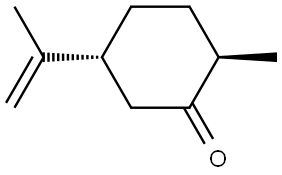
What is (+)-DIHYDROCARVONE?
Definition
ChEBI: (+)-dihydrocarvone is a dihydrocarvone in (R,R) configuration. It is an enantiomer of a (-)-dihydrocarvone.
Properties of (+)-DIHYDROCARVONE
| Melting point: | 125 °C |
| Boiling point: | 87-88 °C6 mm Hg(lit.) |
| Density | 0.929 g/mL at 25 °C(lit.) |
| vapor density | 5.2 (vs air) |
| vapor pressure | 0.06 mm Hg ( 20 °C) |
| FEMA | 3565 | P-MENTH-8-EN-2-ONE |
| refractive index | n |
| Flash point: | 178 °F |
| Odor | at 100.00?%. warm herbal |
| JECFA Number | 377 |
| Dielectric constant | 8.5(19℃) |
Safety information for (+)-DIHYDROCARVONE
Computed Descriptors for (+)-DIHYDROCARVONE
New Products
Dibenzoyl-L-tartaric acid Anhydrous (Resolution Reagent) Cis-Tosylate Dibenzo[b,f][1,4]thiazepin-11(10H)-one 1,2,3,9-Tetrahydro-9-Methyl-4H-Carbazole-4-One 1-(4-methoxyphenyl)-4-(4-Nitrophenyl)Piperazine (IT-1) BOC Piperazine 1-Benzhydrylazetane-3-carbonitrile 8-oxa-1,3-diazaspiro[4.5]decane-2,4-dione (±)-amino(2-fluorophenyl)acetic acid 2-(2-Chlorophenyl)glycine AMINO-(3-CHLORO-PHENYL)-ACETIC ACID 2'-Fluoroacetophenone METHANOL-D1(OD) TERTIARY BUTANOL-D9 N-ETHYL-D5-AMINE HYDROCHLORIDE BENZOIC ACID-D CHLOROFORM-D TOLUENE-D3 Trans,trans muconic acid HC Blue-16 4-Amino-2-chloro-6,7-dimethoxyquinazoline Ethyl 4,5-bis(2-methoxyethoxy)-2-nitrobenzoate 2,3-Dimethoxypyridine 1-(3-Chlorophenyl)piperazine hydrochlorideRelated products of tetrahydrofuran




You may like
-
 Product IntroductionView Details
 -
 Product InrtroductionView Details
 -
 DGO24View Details
 -
 DGO25View Details
 -
 DGO29View Details
 -
 DGO32View Details
 -
 DGO36View Details
 -
 DGO37View Details
Statement: All products displayed on this website are only used for non medical purposes such as industrial applications or scientific research, and cannot be used for clinical diagnosis or treatment of humans or animals. They are not medicinal or edible.