
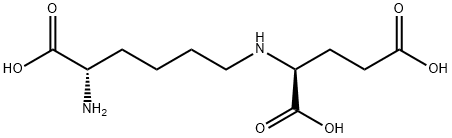
CHEMICAL AND PHYSICAL PROPERTIES
| Physical Description | Solid |
|---|---|
| Melting Point | 247 - 250 °C |
| Collision Cross Section | 159.8 Ų [M+H]+ [CCS Type: DT, Method: single field calibrated with Agilent tune mix (Agilent)] |
COMPUTED DESCRIPTORS
| Molecular Weight | 276.29 g/mol |
|---|---|
| XLogP3 | -5.5 |
| Hydrogen Bond Donor Count | 5 |
| Hydrogen Bond Acceptor Count | 8 |
| Rotatable Bond Count | 11 |
| Exact Mass | 276.13213636 g/mol |
| Monoisotopic Mass | 276.13213636 g/mol |
| Topological Polar Surface Area | 150 Ų |
| Heavy Atom Count | 19 |
| Formal Charge | 0 |
| Complexity | 320 |
| Isotope Atom Count | 0 |
| Defined Atom Stereocenter Count | 2 |
| Undefined Atom Stereocenter Count | 0 |
| Defined Bond Stereocenter Count | 0 |
| Undefined Bond Stereocenter Count | 0 |
| Covalently-Bonded Unit Count | 1 |
| Compound Is Canonicalized | Yes |
PRODUCT INTRODUCTION
description
L-saccharopine is the N(6)-(1,3-dicarboxypropan-1-yl) derivative of L-lysine. It has a role as a human metabolite, a Saccharomyces cerevisiae metabolite and a mouse metabolite. It is an amino acid opine and a L-lysine derivative. It is a conjugate acid of a L-saccharopinate(1-).