
91-01-0
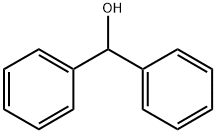
Product Name:
Benzhydrol
Formula:
C13H12O
Synonyms:
Benzhydrol;Diphenylmethanol;Diphenyl carbinol;Benzhydryl alcohol;Diphenhydramine Impurity D
Inquiry
CHEMICAL AND PHYSICAL PROPERTIES
| Physical Description | Solid; [Merck Index] White crystalline powder; Odorless; [Alfa Aesar MSDS] |
|---|---|
| Vapor Pressure | 0.0000273 [mmHg] |
| Kovats Retention Index | 1654.7 1652 |
| Chemical Classes | Other Classes -> Other Aromatic Compounds |
SAFETY INFORMATION
| Signal word | Warning |
|---|---|
| Pictogram(s) |
 Exclamation Mark Irritant GHS07 |
| GHS Hazard Statements |
H303:Acute toxicity,oral H315:Skin corrosion/irritation H319:Serious eye damage/eye irritation H320:Serious eye damage/eye irritation H335:Specific target organ toxicity, single exposure;Respiratory tract irritation |
| Precautionary Statement Codes |
P261:Avoid breathing dust/fume/gas/mist/vapours/spray. P264:Wash hands thoroughly after handling. P264:Wash skin thouroughly after handling. P304+P340:IF INHALED: Remove victim to fresh air and Keep at rest in a position comfortable for breathing. P305+P351+P338:IF IN EYES: Rinse cautiously with water for several minutes. Remove contact lenses, if present and easy to do. Continuerinsing. P405:Store locked up. |
COMPUTED DESCRIPTORS
| Molecular Weight | 184.23 g/mol |
|---|---|
| XLogP3 | 2.7 |
| Hydrogen Bond Donor Count | 1 |
| Hydrogen Bond Acceptor Count | 1 |
| Rotatable Bond Count | 2 |
| Exact Mass | 184.088815002 g/mol |
| Monoisotopic Mass | 184.088815002 g/mol |
| Topological Polar Surface Area | 20.2 Ų |
| Heavy Atom Count | 14 |
| Formal Charge | 0 |
| Complexity | 137 |
| Isotope Atom Count | 0 |
| Defined Atom Stereocenter Count | 0 |
| Undefined Atom Stereocenter Count | 0 |
| Defined Bond Stereocenter Count | 0 |
| Undefined Bond Stereocenter Count | 0 |
| Covalently-Bonded Unit Count | 1 |
| Compound Is Canonicalized | Yes |
PRODUCT INTRODUCTION
description
Benzhydrol is a versatile chemical reagent. It can be used in organic synthesis, carbon-catalytic dynamic kinetic resolution of α,α-disubstituted carboxylic acid esters. It can also be used for chiral resolution of free bases and Ni(II) porphyrin complexes.