
87-62-7
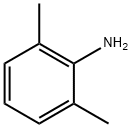
Product Name:
2,6-Dimethylaniline
Formula:
C8H11N
Synonyms:
2,6-Dimethylaniline;2,6-Xylidine;2-Amino-m-xylene;2-Amino-1,3-dimethylbenzene;vic.-m-Xylidine
Inquiry
CHEMICAL AND PHYSICAL PROPERTIES
| Physical Description | 2,6-xylidine appears as a liquid. Toxic by ingestion, inhalation and skin absorption. Slightly soluble in water. Used in pharmaceuticals, as dye intermediates and organic syntheses. |
|---|---|
| Color/Form | Yellow liquid |
| Odor | Characteristic odor |
| Boiling Point | 417 °F at 739 mmHg (NTP, 1992) |
| Melting Point | 47.1 °F (NTP, 1992) |
| Flash Point | 196 °F (NTP, 1992) |
| Solubility | less than 1 mg/mL at 75 °F (NTP, 1992) |
| Density | 0.984 (USCG, 1999) - Less dense than water; will float |
| Vapor Density | 4.17 (NTP, 1992) - Heavier than air; will sink (Relative to Air) |
| Vapor Pressure | 1 mmHg at 111.2 °F ; 5 mmHg at 162.7 °F; 100 mmHg at 295 °F (NTP, 1992) |
| LogP | log Kow = 1.84 |
| Stability/Shelf Life | Stable under recommended storage conditions. |
| Autoignition Temperature | 761 °F (NTP, 1992) |
| Decomposition | When heated to decomposition it emits toxic fumes of /nitrogen oxides/. |
| Viscosity | 1.7 mPa.s (dynamic) at 50 °C |
| Heat of Vaporization | Enthalpy of vaporization: 59.2 kJ/mol at 286-326 K |
| Odor Threshold | Odor threshold in air= 1.00X10+12 molecules/cc /Xylidines/ |
| Refractive Index | Index of refraction: 1.5610 at 20 °C/D |
| Dissociation Constants | pKa = 3.95 at 25 °C |
| Kovats Retention Index | 1136.2 1135.52 1136.26 1136.34 1137.15 1137.93 1143.41 1179 1140.7 1149 1131 1134 1143 1143 1146 1157 1173 1130 |
| Other Experimental Properties | Forms more or less sol salts with the strong mineral acids /Xylidine/ |
SAFETY INFORMATION
| Signal word | Warning |
|---|---|
| Pictogram(s) |
 Exclamation Mark Irritant GHS07  Health Hazard GHS08  Environment GHS09 |
| GHS Hazard Statements |
H315:Skin corrosion/irritation H335:Specific target organ toxicity, single exposure;Respiratory tract irritation H351:Carcinogenicity H411:Hazardous to the aquatic environment, long-term hazard |
| Precautionary Statement Codes |
P273:Avoid release to the environment. P280:Wear protective gloves/protective clothing/eye protection/face protection. P301+P312:IF SWALLOWED: call a POISON CENTER or doctor/physician IF you feel unwell. P308+P313:IF exposed or concerned: Get medical advice/attention. |
COMPUTED DESCRIPTORS
| Molecular Weight | 121.18 g/mol |
|---|---|
| XLogP3 | 1.8 |
| Hydrogen Bond Donor Count | 1 |
| Hydrogen Bond Acceptor Count | 1 |
| Rotatable Bond Count | 0 |
| Exact Mass | 121.089149355 g/mol |
| Monoisotopic Mass | 121.089149355 g/mol |
| Topological Polar Surface Area | 26 Ų |
| Heavy Atom Count | 9 |
| Formal Charge | 0 |
| Complexity | 80.6 |
| Isotope Atom Count | 0 |
| Defined Atom Stereocenter Count | 0 |
| Undefined Atom Stereocenter Count | 0 |
| Defined Bond Stereocenter Count | 0 |
| Undefined Bond Stereocenter Count | 0 |
| Covalently-Bonded Unit Count | 1 |
| Compound Is Canonicalized | Yes |
PRODUCT INTRODUCTION
description
2,6-xylidine appears as a liquid. Toxic by ingestion, inhalation and skin absorption. Slightly soluble in water. Used in pharmaceuticals, as dye intermediates and organic syntheses.