
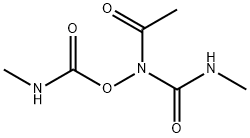
CHEMICAL AND PHYSICAL PROPERTIES
| Solubility | H2O > 76 (mg/mL) |
|---|---|
| Stability/Shelf Life | Bulk: The half life at 45 °C is estimated at 8 weeks and the time for 10% decomposition is 2 weeks. The compound is stable at room temperature for 4 weeks (HPLC). Solution: A 50 mg/mL solution in water at room temperature showed 5% decomposition after 4 hours and 17% decomposition after 24 hours (HPLC). |
COMPUTED DESCRIPTORS
| Molecular Weight | 189.17 g/mol |
|---|---|
| XLogP3 | -0.2 |
| Hydrogen Bond Donor Count | 2 |
| Hydrogen Bond Acceptor Count | 4 |
| Rotatable Bond Count | 2 |
| Exact Mass | 189.07495584 g/mol |
| Monoisotopic Mass | 189.07495584 g/mol |
| Topological Polar Surface Area | 87.7 Ų |
| Heavy Atom Count | 13 |
| Formal Charge | 0 |
| Complexity | 228 |
| Isotope Atom Count | 0 |
| Defined Atom Stereocenter Count | 0 |
| Undefined Atom Stereocenter Count | 0 |
| Defined Bond Stereocenter Count | 0 |
| Undefined Bond Stereocenter Count | 0 |
| Covalently-Bonded Unit Count | 1 |
| Compound Is Canonicalized | Yes |
PRODUCT INTRODUCTION
description
Caracemide is an agent derived from acetohydroxamic acid with potential antineoplastic activity. Caracemide inhibits ribonuclease reductase, resulting in decreased DNA synthesis and tumor growth; it also inhibits acetylcholinesterase. In vivo, caracemide contributes to the formation of the neurotoxin methyl isocyanate; this effect, along with the agent's acetylcholinesterase activity, may be responsible for the severe central nervous system toxicity observed in clinical trials. (NCI04)