
CHEMICAL AND PHYSICAL PROPERTIES
| Physical Description | Solid |
|---|---|
| Melting Point | 180 |
| Solubility | 5.86e+00 g/L |
| LogP | 1.4 |
| Dissociation Constants | 8.65 |
| Collision Cross Section | 149.4 Ų [M+H]+ [CCS Type: TW, Method: calibrated with polyalanine and drug standards] |
| Kovats Retention Index | 1730 |
COMPUTED DESCRIPTORS
| Molecular Weight | 211.26 g/mol |
|---|---|
| XLogP3 | -0.6 |
| Hydrogen Bond Donor Count | 4 |
| Hydrogen Bond Acceptor Count | 4 |
| Rotatable Bond Count | 4 |
| Exact Mass | 211.12084340 g/mol |
| Monoisotopic Mass | 211.12084340 g/mol |
| Topological Polar Surface Area | 72.7 Ų |
| Heavy Atom Count | 15 |
| Formal Charge | 0 |
| Complexity | 187 |
| Isotope Atom Count | 0 |
| Defined Atom Stereocenter Count | 0 |
| Undefined Atom Stereocenter Count | 1 |
| Defined Bond Stereocenter Count | 0 |
| Undefined Bond Stereocenter Count | 0 |
| Covalently-Bonded Unit Count | 1 |
| Compound Is Canonicalized | Yes |
PRODUCT INTRODUCTION
description
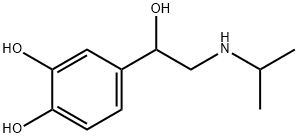
Isoprenaline is a secondary amino compound that is noradrenaline in which one of the hydrogens attached to the nitrogen is replaced by an isopropyl group. A sympathomimetic acting almost exclusively on beta-adrenergic receptors, it is used (mainly as the hydrochloride salt) as a bronghodilator and heart stimulant for the management of a variety of cardiac disorders. It has a role as a sympathomimetic agent, a beta-adrenergic agonist, a bronchodilator agent and a cardiotonic drug. It is a member of catechols, a secondary amino compound and a secondary alcohol.