
71-68-1
SAFETY INFORMATION
| Signal word | Warning |
|---|---|
| Pictogram(s) |
 Exclamation Mark Irritant GHS07 |
| GHS Hazard Statements |
H302:Acute toxicity,oral H336:Specific target organ toxicity,single exposure; Narcotic effects |
COMPUTED DESCRIPTORS
| Molecular Weight | 321.8 g/mol |
|---|---|
| Hydrogen Bond Donor Count | 2 |
| Hydrogen Bond Acceptor Count | 4 |
| Rotatable Bond Count | 0 |
| Exact Mass | 321.1131712 g/mol |
| Monoisotopic Mass | 321.1131712 g/mol |
| Topological Polar Surface Area | 49.8 Ų |
| Heavy Atom Count | 22 |
| Formal Charge | 0 |
| Complexity | 494 |
| Isotope Atom Count | 0 |
| Defined Atom Stereocenter Count | 4 |
| Undefined Atom Stereocenter Count | 0 |
| Defined Bond Stereocenter Count | 0 |
| Undefined Bond Stereocenter Count | 0 |
| Covalently-Bonded Unit Count | 2 |
| Compound Is Canonicalized | Yes |
PRODUCT INTRODUCTION
description
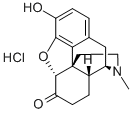
Hydromorphone Hydrochloride is the hydrochloride salt form of hydromorphone, the hydrogenated ketone of morphine, a semi-synthetic opioid with analgesic effects. Hydromorphone selectively binds the mu-opioid receptor which is linked through G-proteins. Binding stimulates the exchange of guanosine triphosphate (GTP) for guanosine diphosphate (GDP) on the G-protein complex and interacts with and inhibits adenylate cyclase located at the inner surface of the plasma membrane. This leads to a reduction in intracellular cyclic 3',5'-adenosine monophosphate (cAMP). Further, voltage-gated potassium channels are activated, thereby causing hyperpolarization and reducing neuronal excitability. In addition, the opening of voltage-gated calcium channels is inhibited, thereby leading to an inhibition of calcium entry and a reduction in the release of various neurotransmitters, including GABA, vasopressin, somatostatin, insulin and glucagons.